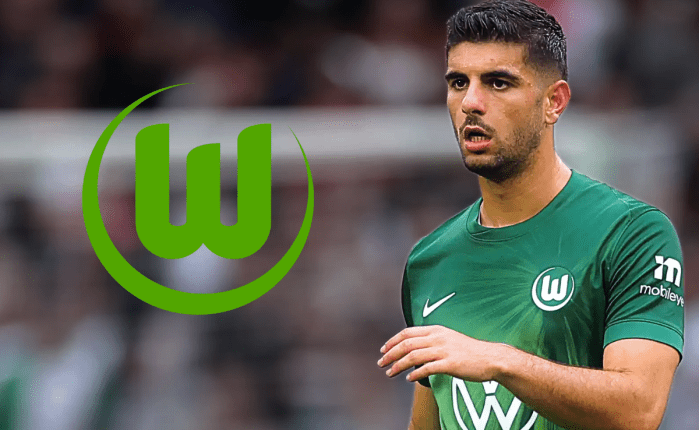
Meet Konstantinos Koulierakis: The Highly Coveted VfL Wolfsburg Defender Already Turning Heads Around Europe

Meet Konstantinos Koulierakis: The Highly Coveted VfL Wolfsburg Defender Already Turning Heads Around Europe

In the last few years, VfL Wolfsburg has masterfully cultivated a reputation for their savvy manoeuvres in the transfer market, where they have consistently showcased their skill in identifying and developing talent. Their most remarkable achievements lie in the profitable sales of centre-backs, where they have adeptly turned promising players into lucrative transactions.

With a keen eye for potential, the club has not only strengthened their own squad but has also capitalised on the high demand for skilled defenders, earning impressive sums and reinforcing their status as a shrewd player in the transfer market.
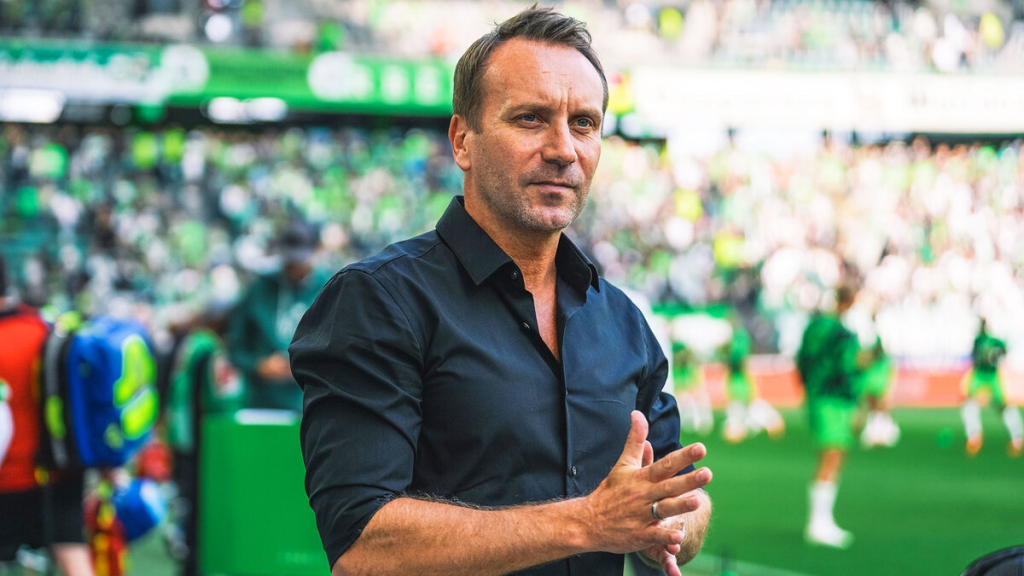
VfL Wolsburg’s sporting director Sebastian Schindzielorz

The German Bundesliga outfit have overseen the rise and profitable sales of both Micky van de Ven and Maxence Lacroix, both of whom developed from unknown quantities to burgeoning defensive talents over the course of a few years, and were rewarded with big moves abroad to the Barclays Premier League.

At the start of the 2023/24 campaign, Die Wolfe sold van de Ven to Tottenham Hotspur for 40m (£34.6m), their second-highest sale after Kevin De Bruyne, when he joined Manchester City in 2015.

Spurs defender Micky van de Ven (when fit) has garnered a reputation as one of the best centre-backs in England

At the start of last season, they sold Maxence Lacroix to Crystal Palace for 18m (£15.6m). At the time of writing, both players have not only firmly established themselves as pivotal cogs at their respective clubs but have also developed into two of the best of their position in the Premier League and in Europe.

This positive trend for Wolfsburg could well have continued into the summer transfer window for a third consecutive year, after yet another of their promising young defenders in Greece international Konstantinos Koulierakis, who only joined the club in August 2024 from PAOK FC, attracted significant interest from Liverpool and Real Madrid throughout the off-season.
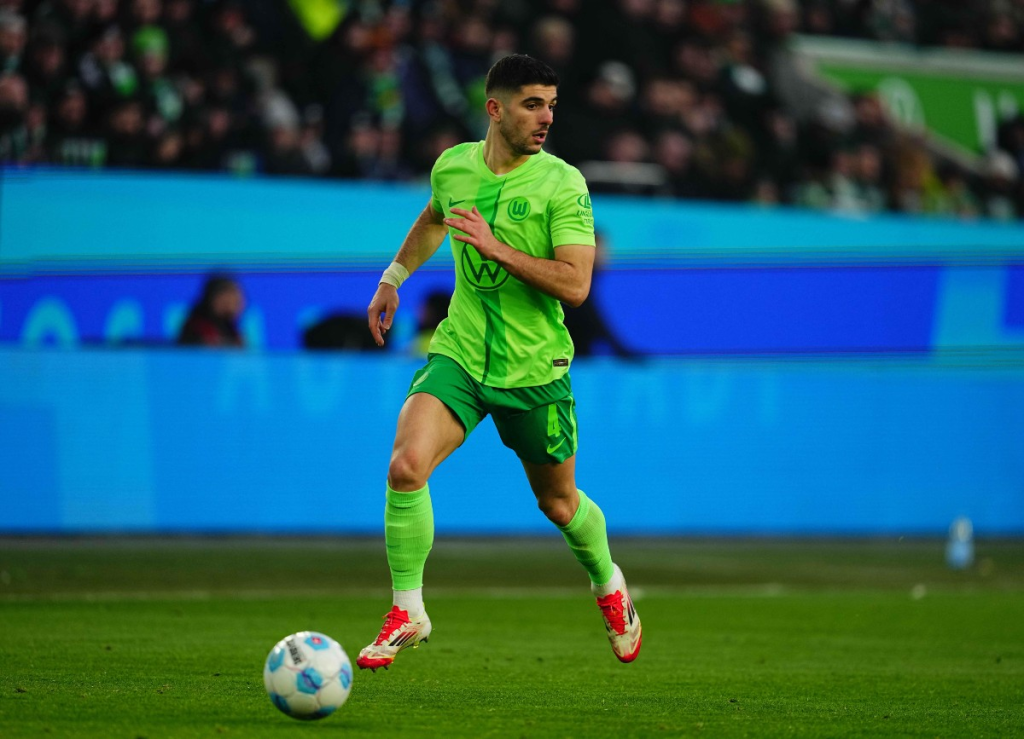
Wolfsburg should be applauded for their brilliant scouting and recruitment.

In 2021, they gambled on a 20-year-old Van de Ven from the second tier of Dutch football, sanctioning the €8m (£7m) signing from FC Volendam. It seems like the risk will also pay off with Koulierakis. It is simply a question of how quickly the £10m fee they paid to PAOK turns into yet another £36m+, not a matter of when.

To ask the usual #AnthonyScouts analysis questions: How good is Koulierakis, how has he gotten to this pre-lofty position in his career, and what does the future hold for him, even if it is not only bright but potentially immediate?

Who is Konstantinos Koulierakis?

Born in Chania, Crete, Greece. Koulierakis joined the PAOK academy as a 13-year-old in 2017. It wouldn’t be long before top European clubs sent scouts to watch and inquire about this impressive young centre-back, who was dominating in PAOK’s academy. The club quoted a price tag of around €15m.

After spending a successful year with the B team, Koulierakis was allowed to join the first team, and he never looked back, making 31 appearances in the 2022/23 season, including being named to the league’s official team of the season at the end of the campaign.
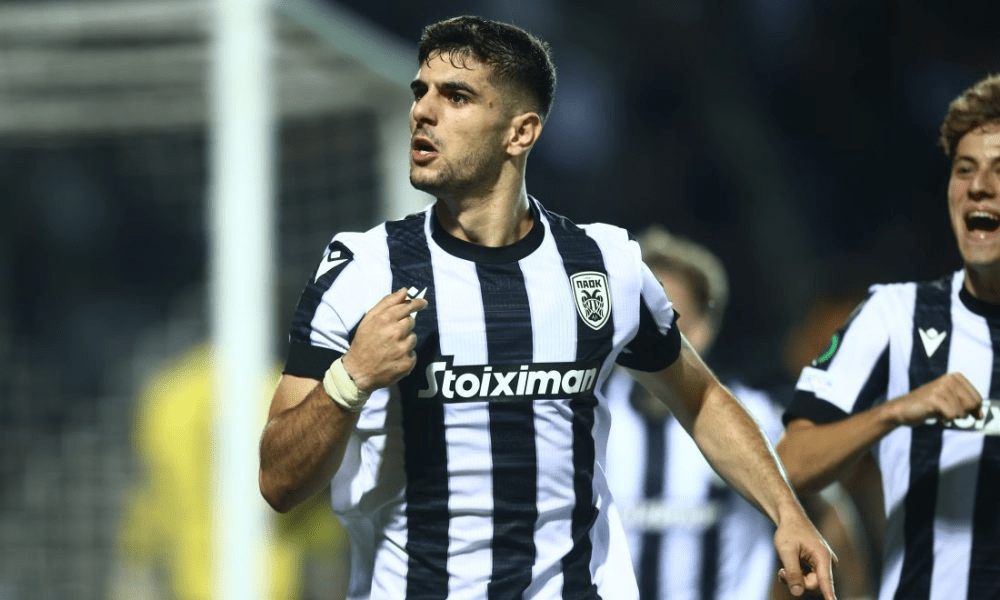
The Greek talent was the subject of interest from Italian Serie A side Fiorentina during the summer window, which was knocked back by PAOK.

While it may have unsettled many other talents his age, not being given the opportunity to chance his arm at a club in a top European league, Koulierakis used that as fuel to better himself and develop further.

He would follow that up with yet another impressive campaign in 2023/24, helping PAOK to the league title and scoring key goals in their run to the UEFA Conference League quarter-finals as well.

After a successful season, both individually and collectively, he would be handed the opportunity to make the move across Europe in the summer of 2024. Wolfsburg officially came calling, and the Greek defender would put pen to paper on 20 August, but PAOK delayed the transfer for Koulierakis to help them qualify for the Europa League via the play-offs.

Nine days later, the deal was completed.

Across 73 appearances for PAOK, Koulierakis scored nine times and assisted four times, underlining his importance not just as a defender but also as an impact-maker in the opposition box.
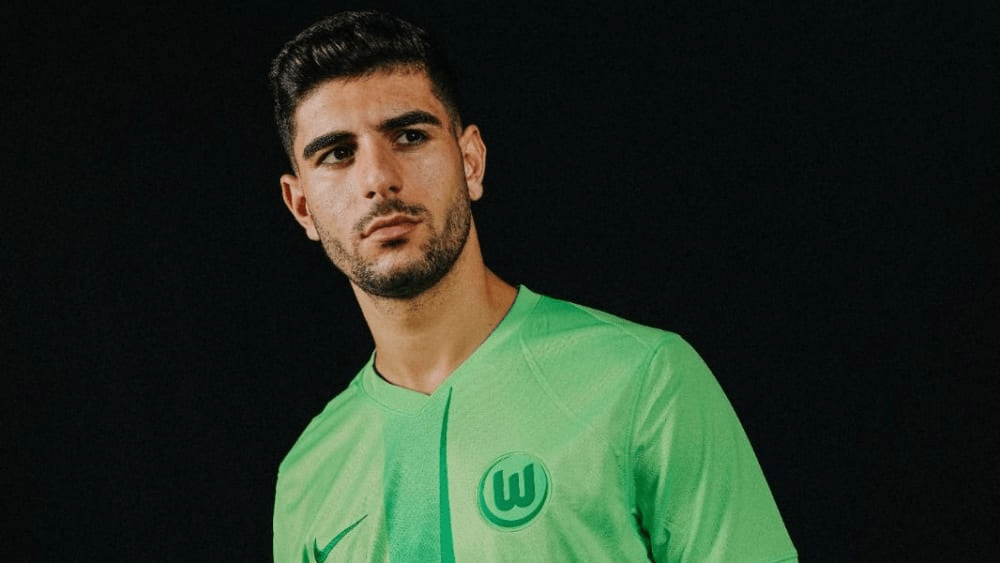
Since his arrival in Germany, the 21-year-old has continued his stunning upward trajectory, quickly establishing himself as one of the best young defenders in the Bundesliga and in Europe.

The 2024/25 campaign would prove a hugely successful one for him individually, even if it was a mixed bag for the club as a whole.

Under manager Ralph Hasenhuttl, he quickly cemented himself as an undisputed starter in a Wolfsburg team aiming to push for the European places, which proved fruitless, finishing in 11th place and ultimately costing the former Southampton coach his job towards the end of the campaign.

Koulierakis’s crucial importance to Die Wolf has carried straight through into the new Bundesliga campaign, featuring in all six of their games so far at the time of writing.

On the international stage, the Chania-born talent has also become a vital figure in a hugely refreshing and rejuvenated Greek national team, possessing such highly coveted young stars such as Koulierakis himself, Konstantinos Karetsas, Christos Zafeiris, Christos Tzolis, Giannis Konstantelias and Christos Mouzakitis.

After just 16 caps for his country, Koulierakis has already become a real focal point and leader at the heart of the defence alongside West Ham United defender Konstantinos Mavropanos.

A fine example of the understanding and strength of that partnership would certainly be evident in arguably the highlight of his international career so far, the memorable 2-1 win over England at Wembley in October 2024.

Koulierakis looked at home on the biggest stage, a composed, measured and immovable presence up against the likes of Harry Kane and Jude Bellingham.
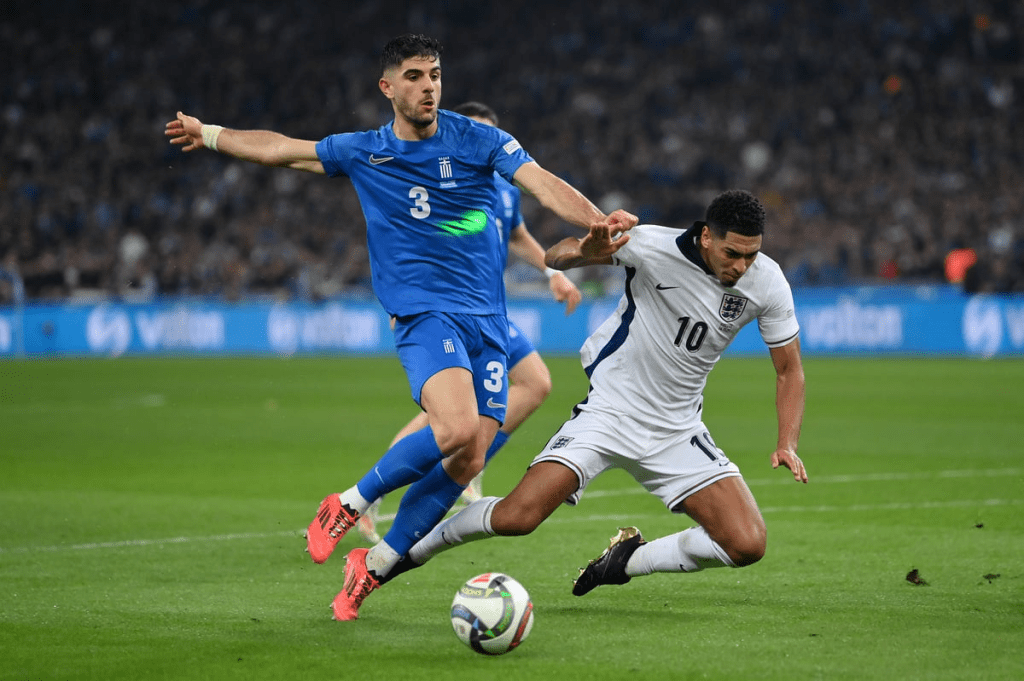
Such performances and characteristics are what made him an attractive prospect for the elite European clubs over the summer, with Juventus, AC Milan and Borussia Dortmund also joining Liverpool and Real Madrid in admiring his profile.

The PAOK academy graduate is certainly an intriguing and exciting defensive profile, one who could blossom into a generational superstar, especially within the context of his nation. But why?

How good is Konstantinos Koulierakis?

Standing at 6’1″, Koulierakis evokes memories of a former graceful young Bundesliga defender who has since established himself at the highest level: Manchester City’s Josko Gvardiol.

Much like Gvardiol, Koulierakis possesses an imposing presence, characterised by his impressive athleticism and striking physical attributes that suggest he was crafted for the sport. His powerful build allows him to dominate both his aerial and ground duels, showcasing remarkable leaping ability and strength.

As a Greek international, he approaches his defensive responsibilities with a fierce intensity, often disrupting opposing attackers with his relentless pursuit and aggressive tackling. This combination of skill, size, and tenacity makes him a formidable force at the heart of defence.

But, he can make telling contributions the other way.

Attacking outlier
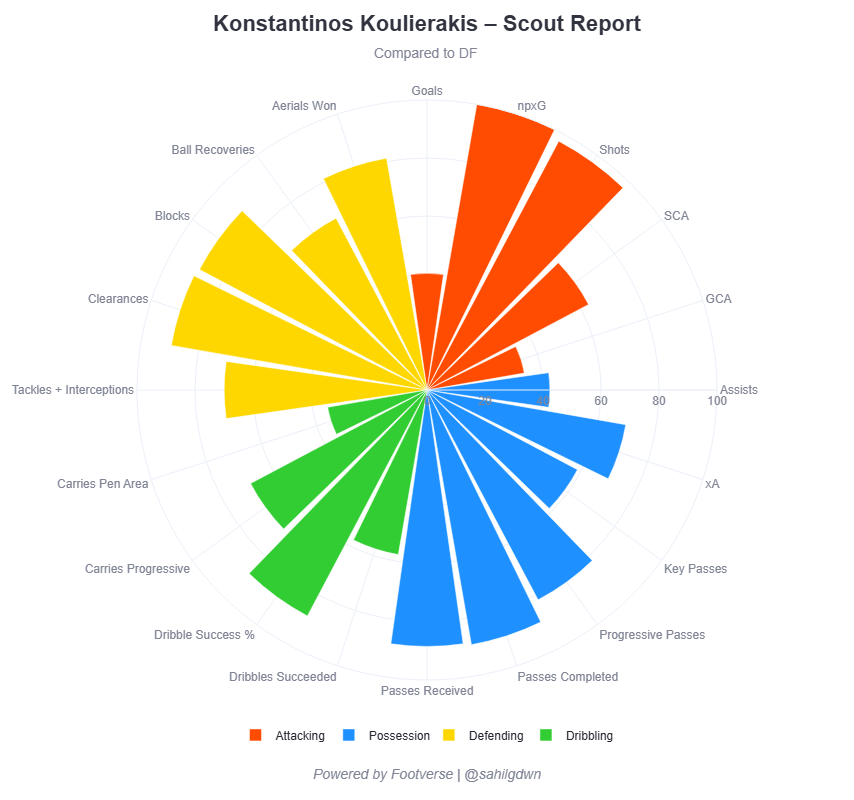
The above graphic, which compares his performance across different data metrics in attack, defence and in possession among other players in his position in the Bundesliga over the past year, certainly paints a picture of Koulierakis’s unique and impressive profile.

First and foremost, despite him being a defender, his attacking metrics certainly stand out at first glance, particularly in shots per 90 and touches in the opposition penalty area per 90, ranking in the 90th and 76th percentiles, respectively.

This highlights that he is one of the most threatening centre-backs in the German Bundesliga, even though he is yet to score a single goal in Wolfsburg colours so far.

However, he did bag an impressive seven goals during his last campaign in Greece, six of which came in European competitions, which suggests that he does and will have the propensity to crop up with the crucial goals when the time comes.

Ultimately, though, where he’s judged is in how he keeps the ball out of the net at the other end, and as is the case for centre-backs in the modern game, his ability and comfort in possession. So let’s address the latter first.

Progressive Line-Breaking Passing

In the modern game, the role of the centre-back has evolved dramatically. These defenders are now not just stalwarts of the backline; they are pivotal playmakers who initiate attacks from deep within their own half. The expectation is to exhibit exceptional passing abilities, allowing them to seamlessly transition from defence to offence.

In addition to technical prowess, modern centre-backs must possess keen tactical awareness, demonstrating the ability to read the game and make split-second decisions, even under immense pressure when their team is building from the back. They must exhibit keen confidence in possession, composure and good pass selection to seamlessly get their team into the attacking phase of play.

Wolfsburg are not known for being one of the possession-focused teams in the German Bundesliga. Last season, they ranked 12th in the league for possession percentage (FBRef) as a collective unit, and so far this season, they still remain around that ballpark after six games. Therefore, evaluating Koulierakis’s passing ability may not provide a complete picture.
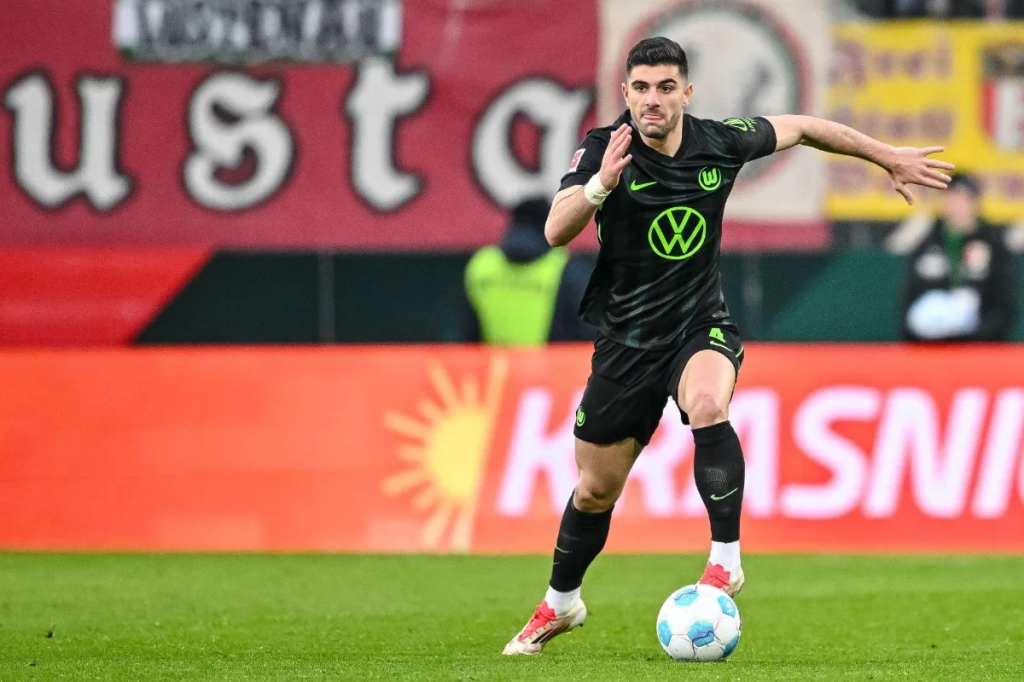
However, statistically, he is amongst the best in the Bundesliga amongst his positional peers when it comes to passing and bringing the ball out of defence.

As per Footverse, Koulierakis ranks in the 86th percentile for passes attempted, 85th for passes completed, 86th for passes into the final third and in the 82nd percentile for progressive passes. All of these metrics certainly show the 21-year-old’s progressive intent in possession, and he isn’t afraid to hit the long, risky pass too. The Crete-born centre-back ranks in the 97th percentile for long passes attempted and 96th for long passes completed.

Some might argue that these impressive metrics are due to Koulierakis being used as the main progressive hub when building from the back. Both Wolfsburg and Greece prefer to initiate their build-up play through him rather than his defensive partners. This is further supported by his ranking in the 88th percentile for passes received and the 95th percentile for touches in the defensive third.
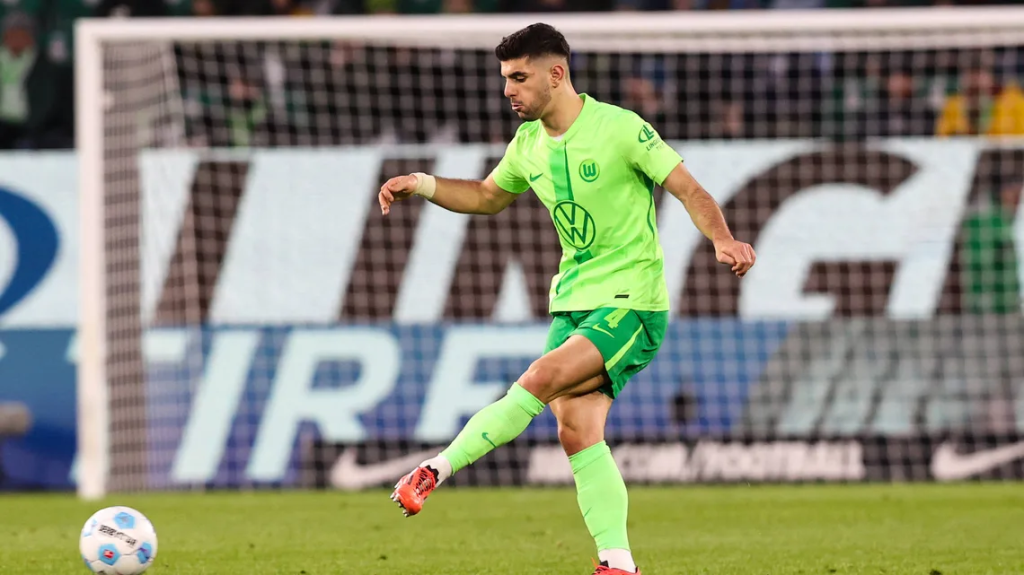
Regardless of this argument, which the numbers seem to validate, the 21-year-old demonstrates an ability to take on this responsibility effectively. He consistently shows reliable ground technique with precise, crisp, and sharp passing, executed with a keen understanding of his teammates’ positions.

He can penetrate and break opposition lines, often finding his more advanced teammates in creative and dangerous areas, whether in the left half-space, central zones, or setting up his deep-lying midfielders for simple wall passes.

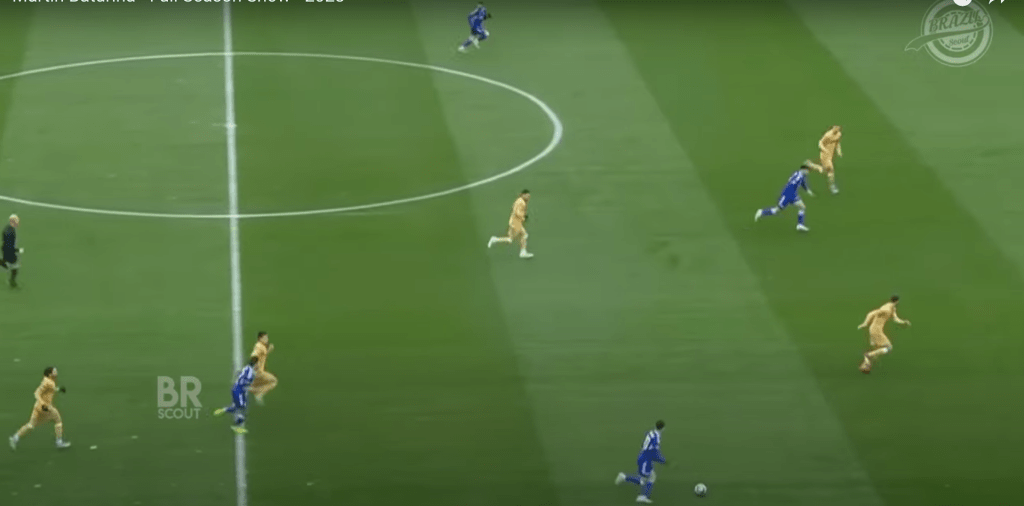
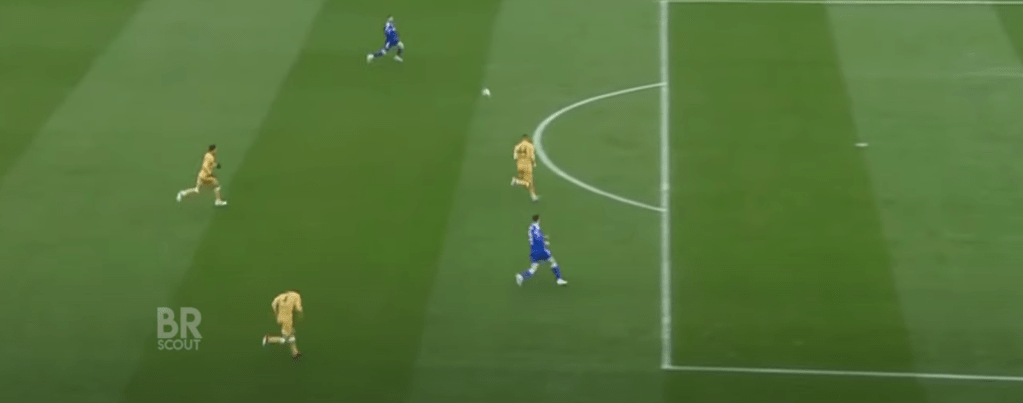
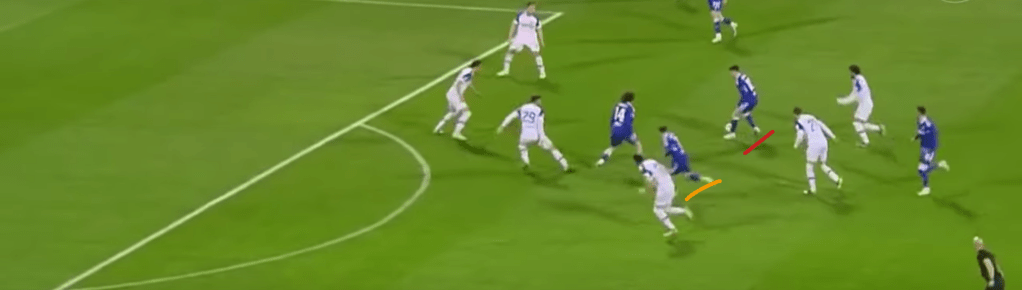
For example, in the image below, Koulierakis receives the ball from his defensive partner, Denis Vavro. He looks up to scan and find a teammate in an advanced zone…
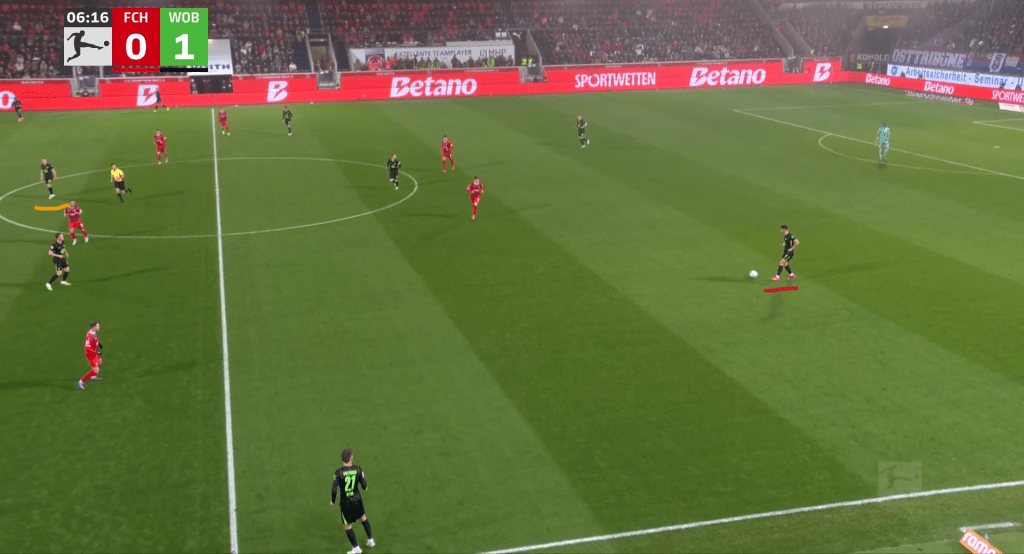
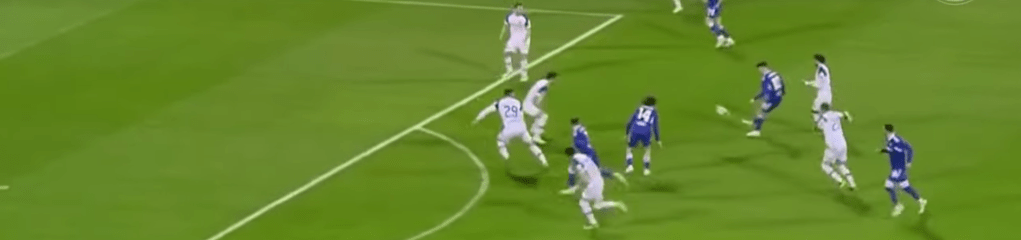
…before executing a sublime line-breaking pass for him in a bit of space…
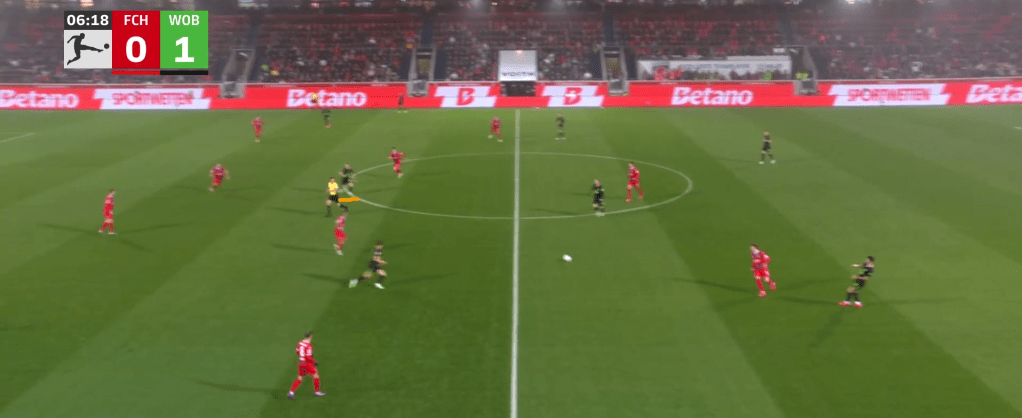
…but it comes to nothing due to his teammate failing to control the pass. However, it’s a fine example of Koulierakis taking responsibility and his intent in progressing the ball for his team.

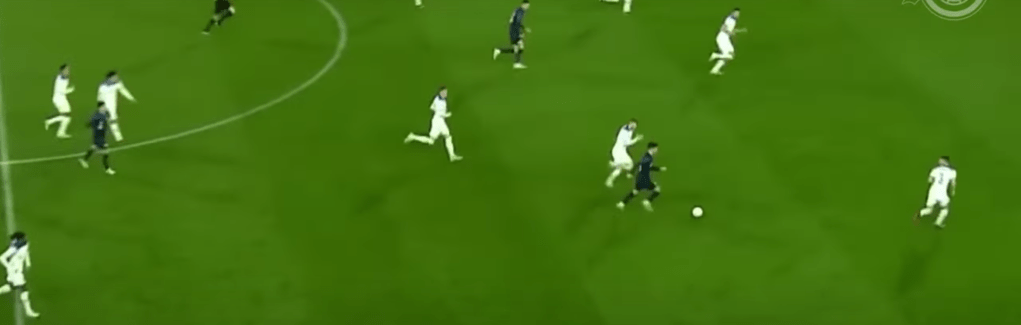
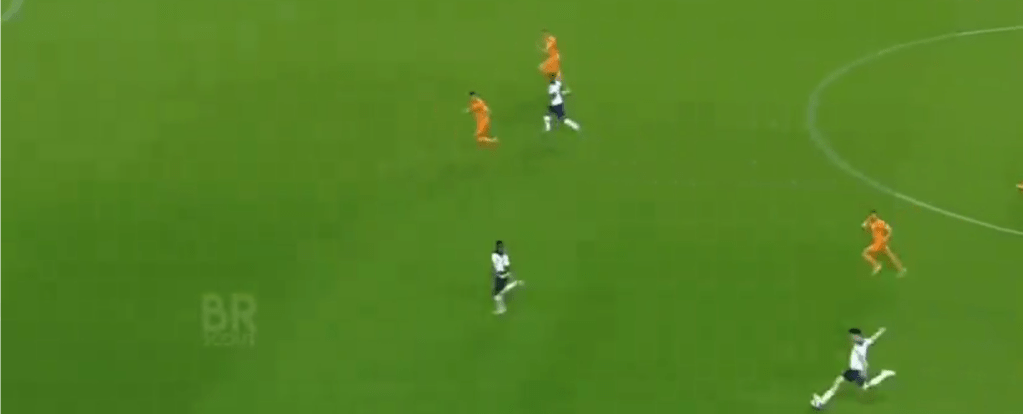
In another instance, we see the talented centre-back taking on the responsibility, this time for Greece, against England at Wembley back in October. However, this time, he’s in the left centre-back position in a back three tasked with finding a teammate from a totally different angle…
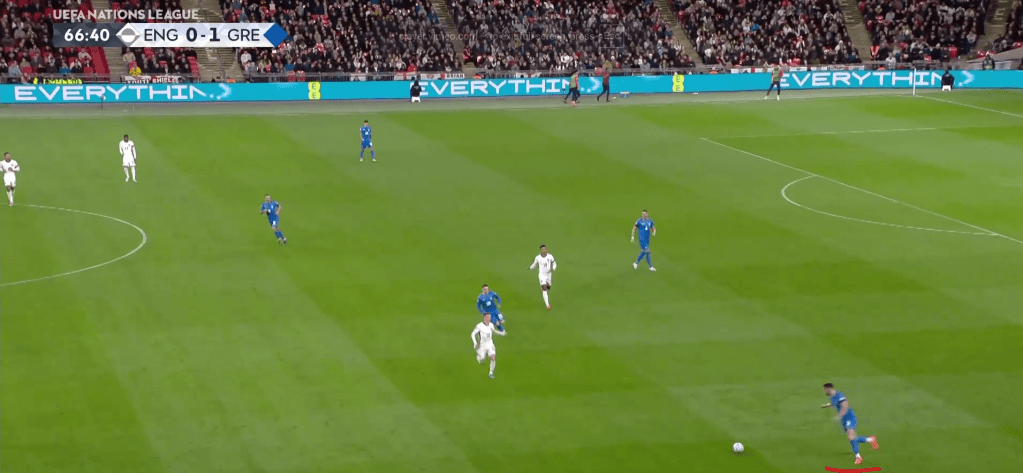
With Phil Foden bearing down on him and Ollie Watkins following, he has to make a snap decision to bypass that line of pressure and get the ball to a teammate in space.

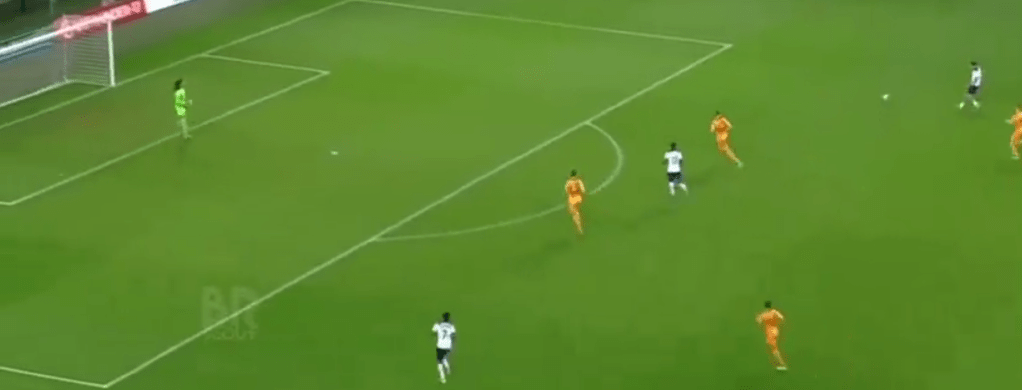
In the image below, it may look like the Greek defender is just hoofing the ball up the pitch to avoid the danger of losing possession under pressure…
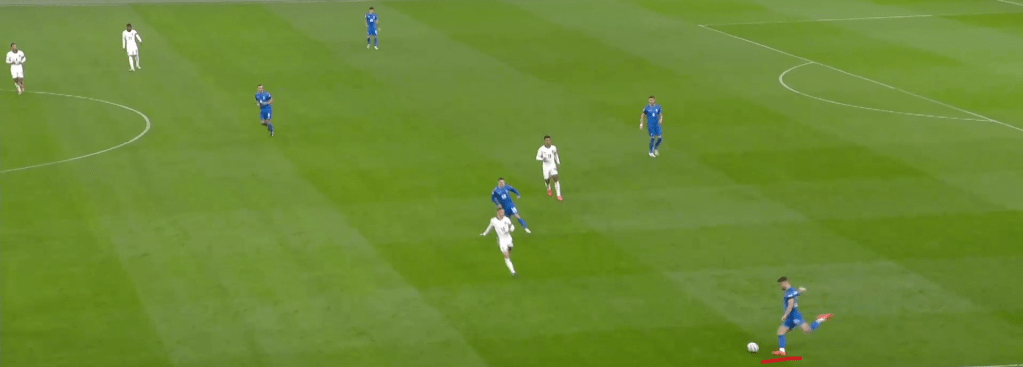
…but that’s not Koulierakis’ style.
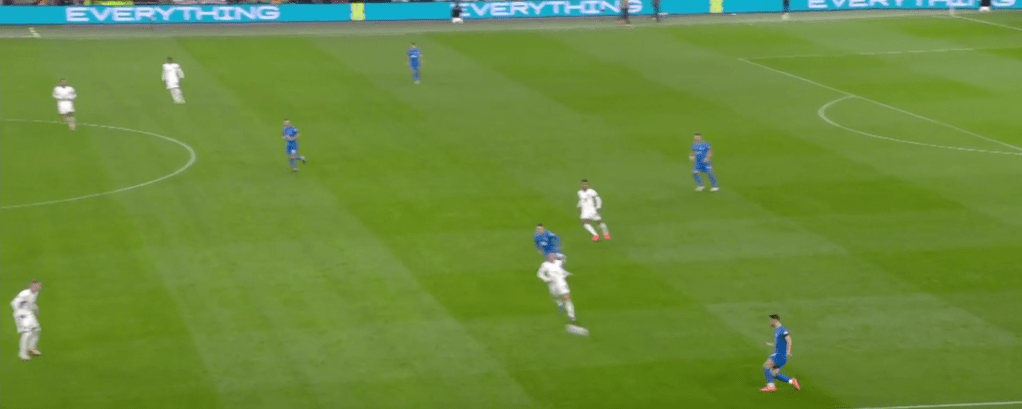
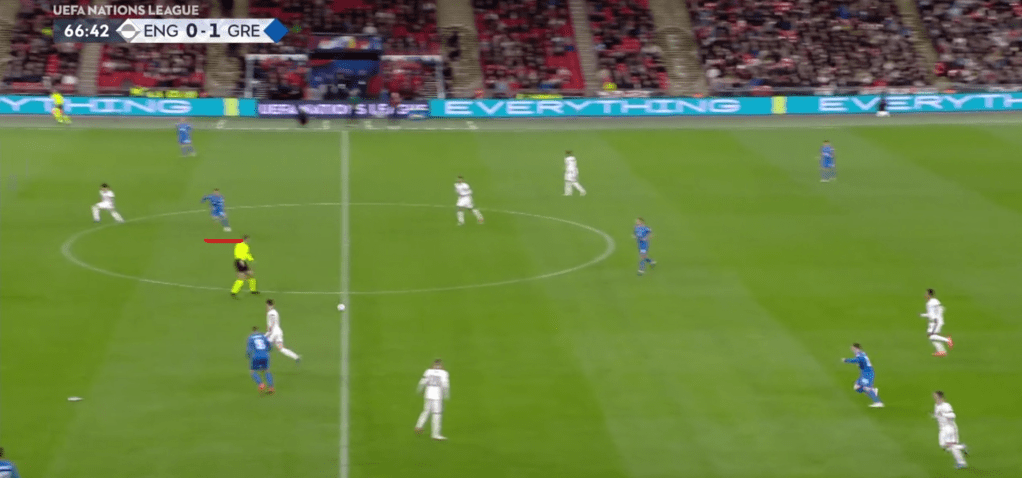
He excellently picks out his teammate in space to run at the opposition defence, completely dissecting England’s gaping midfield.

While England’s press and shape leave a lot to be desired in this scenario, giving Koulierakis ample opportunity and ease to exploit it, there is no discounting, once again, his intent and purposeful passing in order to progress play for his team. He completely turns a near-awkward situation for his team into one filled with goalscoring opportunities.
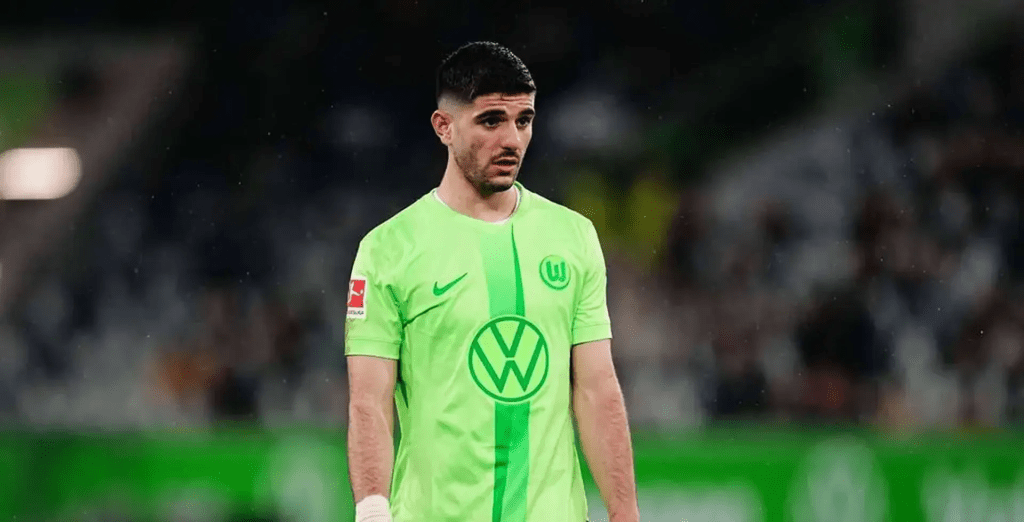
Front-footed proactive defender

While the Greek international’s passing ability has quickly become one of his greatest assets, it is his defensive nous that will face the most scrutiny. Much of Koulierakis’ evolution this past year, and the reason he is certainly turning heads in Europe, is a result of his stark improvement in defending.

First and foremost, just because he’s a smooth operator in possession does not detract from his bullish, aggressive, and immovable nature when defending.
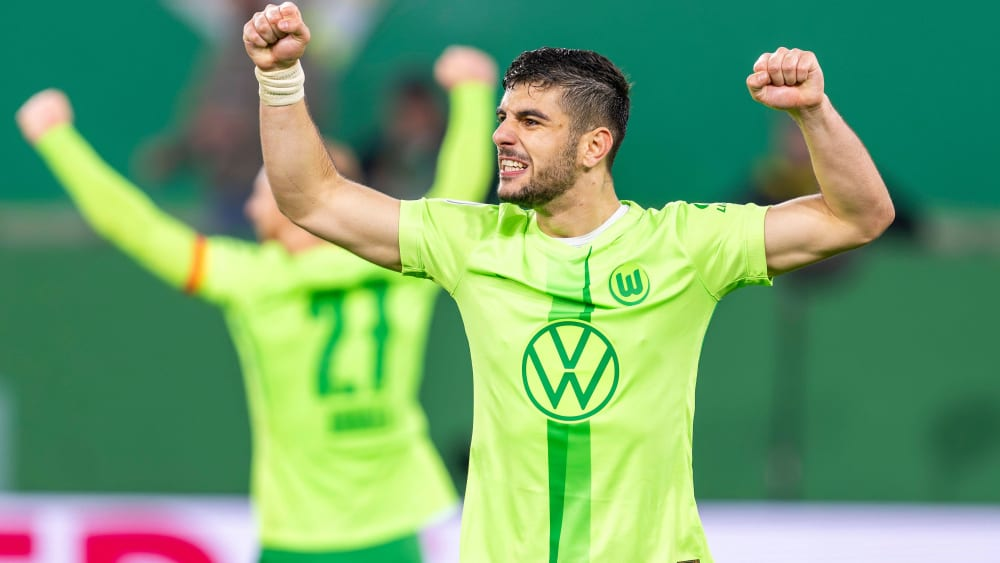
Standing at nearly 6’2″, Koulierakis commands attention with his impressive physique and striking presence. He is exceptional physically, possessing excellent athleticism and flexibility when covering ground within his defensive zones or engaging in duels.

You can almost categorise him as a stopper-type. A no-nonsense centre-back who takes no prisoners when duelling, isn’t afraid to do the dirty work when sweeping, in clearing the ball out of danger and engaging attackers on the ball even before approaching his zone.

Koulierakis shines as a proactive, front-footed centre-back. His timing in challenges and reading of situations is consistently precise, and as highlighted previously, he approaches duels with aggression and unwavering conviction.

He frequently positions himself strategically to win possession in advanced areas of the field, either through skilful interceptions or by stepping into action when his midfield is breached. This readiness to act as a defensive ‘firefighter’ creates opportunities for his team to initiate swift and efficient counter-attacks, turning defensive situations into moments of offensive advantage.

For instance, in the image below, the opponent attempts to progress the ball to his teammate in the attacking third…
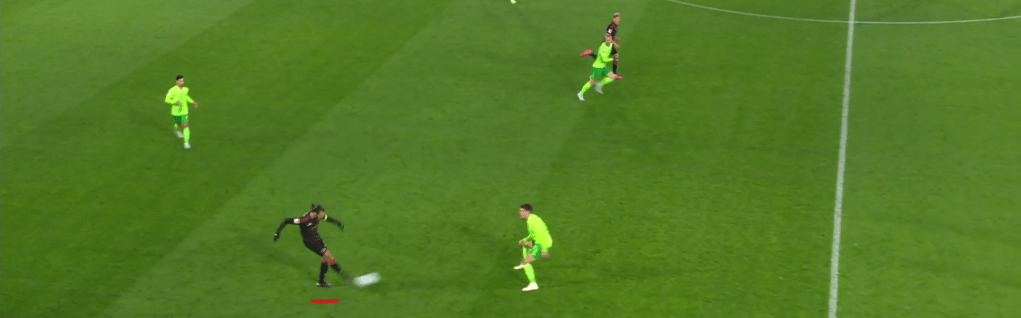
The pass turns out to be a bad one, but Koulierakis still takes responsibility in stepping out of his defensive line,…

…intercepts the pass before launching a swift counter, going past his man and progressing the ball to an advanced teammate in space…
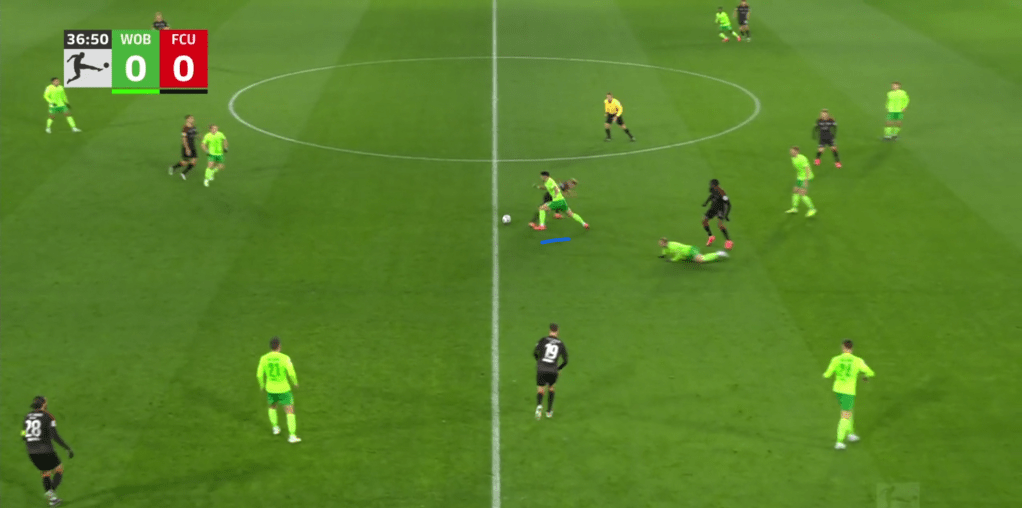
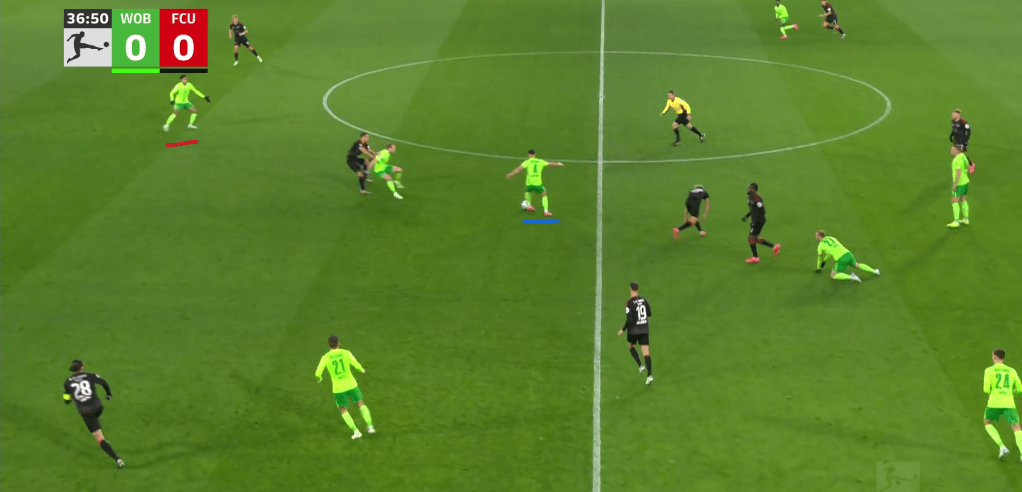
This instance certainly exemplifies the centre-back’s proactive and progressive nature all in one scenario.

He even joins the attack, following his pass.
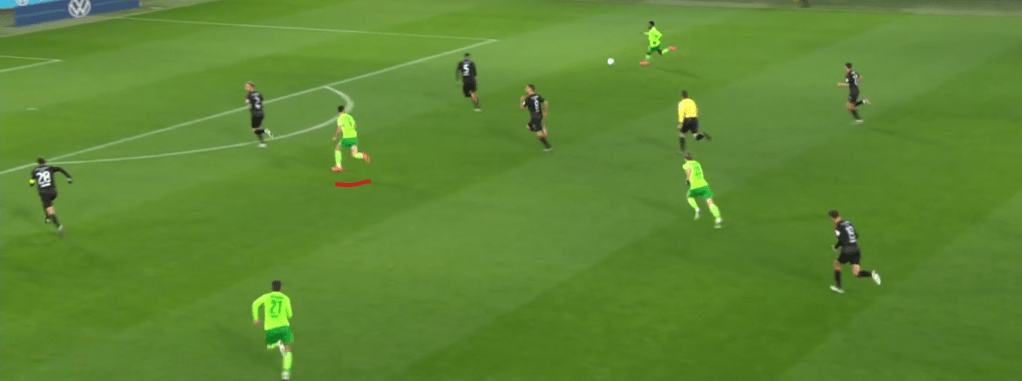
Had his teammate Maximillian Arnold intercepted the initial pass while on the ground, Wolfsburg would not have had the chance to launch a counter, as once the German midfielder got back up with the ball, Union Berlin would have retreated quickly into their defensive shape or, more crucially, pressed Arnold and exploited the gap in Wolfsburg’s defence.

It was imperative Koulierakis take responsibility in that particular moment.

In another fine example of the Greek international’s excellent proactive approach, the opponent receives the ball with his back to goal, with Koulierakis tracking him into midfield as soon as he controls the ball.
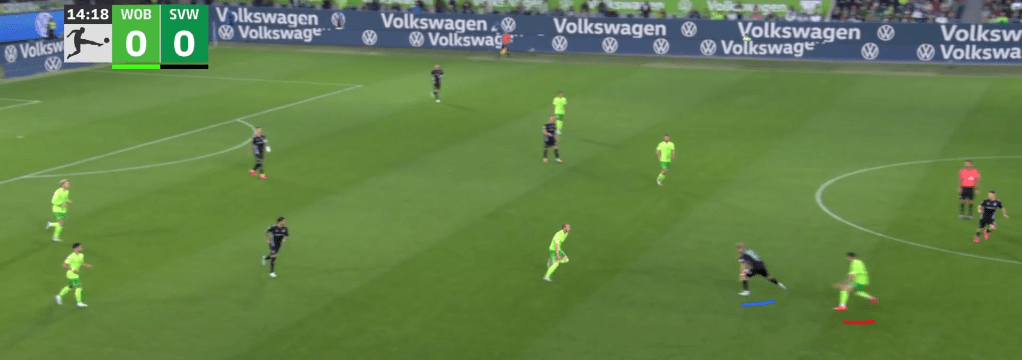
The Werder Bremen player attempts to bypass the surrounding pressure, but has nowhere to turn given Koulierakis’ excellent positioning, anticipation and his nearby teammates covering each direction…
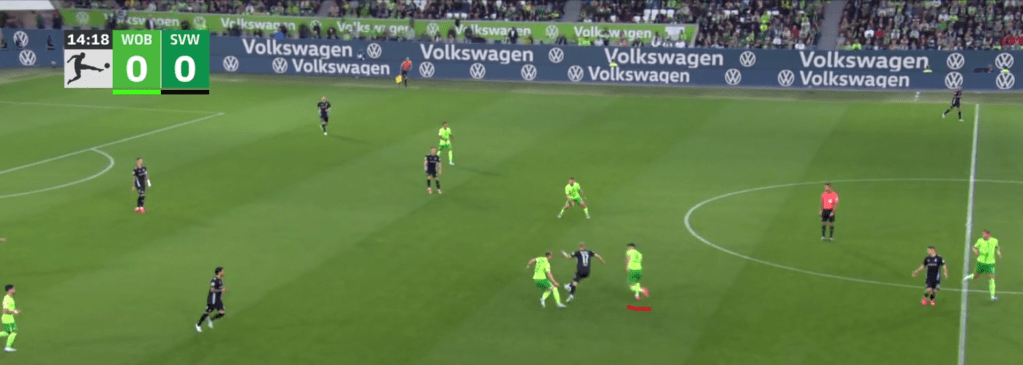
As a result of the pressure, the Greek colossus reads the situation…
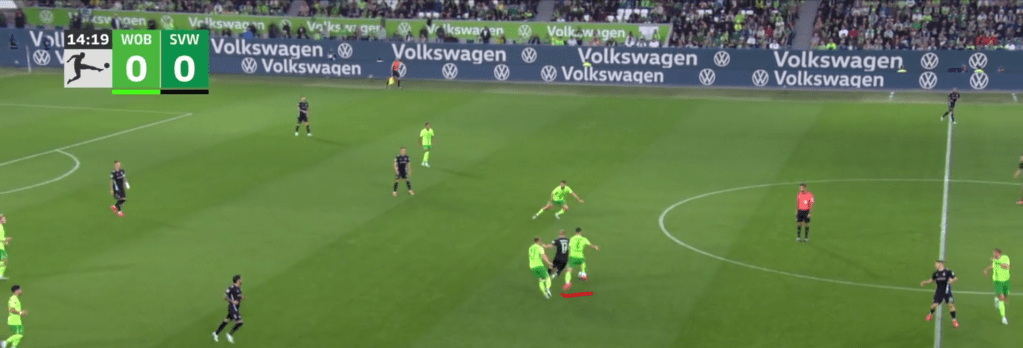
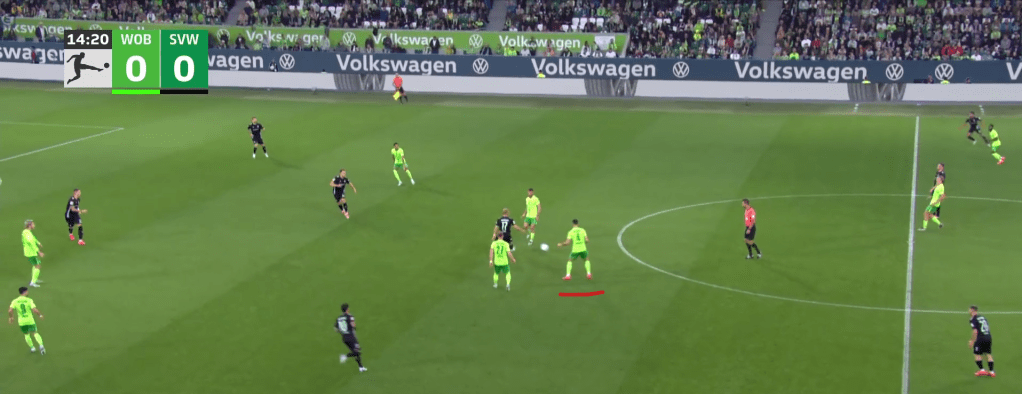
and wins the ball back for his team.

While many centre-backs have the ability to track their markers into midfield, they frequently fall short in terms of aggression and anticipation. They often miss the chance to use their imposing stature and commanding presence to encircle the opponent and reclaim possession. Consequently, the gaps left behind can be gracefully capitalised on by the opposing team, creating dangerous opportunities.

That isn’t the case for Koulierakis. The defender’s imposing stature and freakish athleticism mean he almost always holds the advantage in those risky situations, not allowing his forward marker the opportunity to turn and progress towards his goal.

Koulierakis exhibits very good defensive intelligence, not only in his proactive duelling but also across all phases of defence. He consistently anticipates play, positioning his body optimally to neutralise incoming threats and shut down dangerous situations with great awareness.

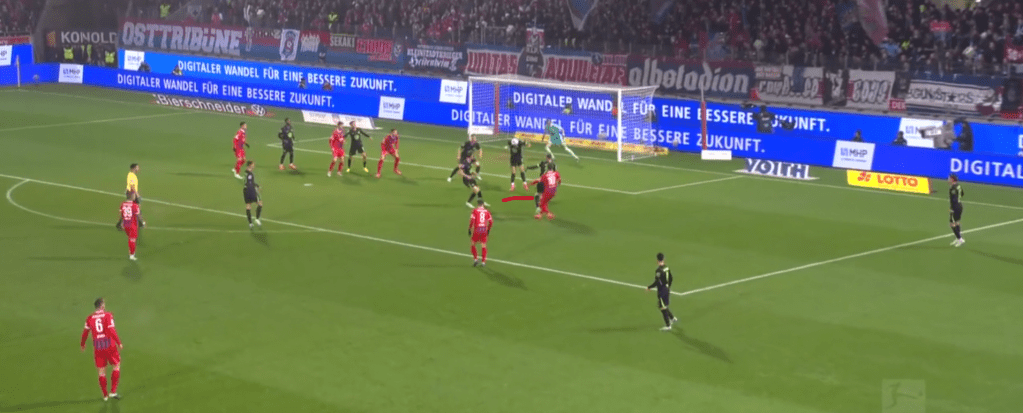
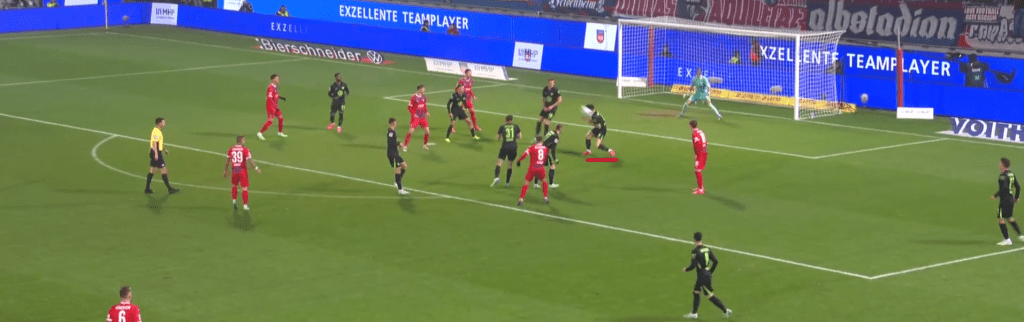
For example, in the image below, the FC Heidenheim player in possession attempts to punch a pass into the feet of his teammate at the edge of the penalty area. It certainly seems Koulierakis (RED) won’t be able to intervene…

…but once again, the 21-year-old’s presence of mind, athleticism and flexibility mean he is very well capable of snuffing out the danger, getting across before the ball arrives…
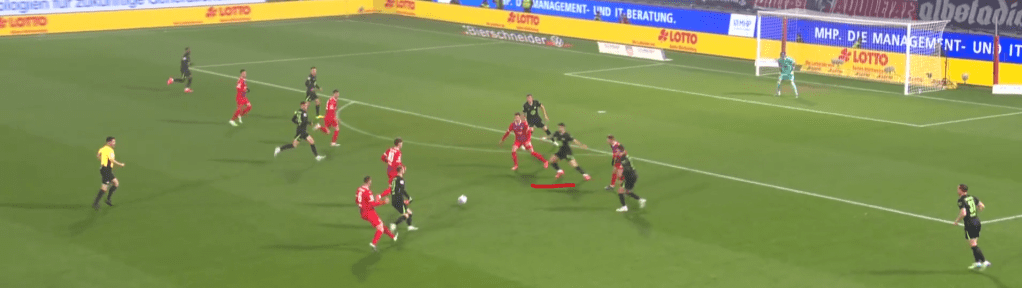
…before reaching a leg out to intercept. Not only did he intercept it, given the volume of danger around him,…
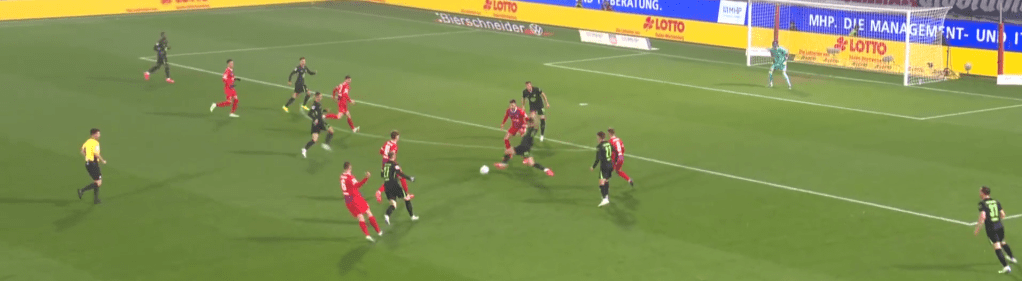
…but he manages to clear it out of the immediate danger too, in the same motion.
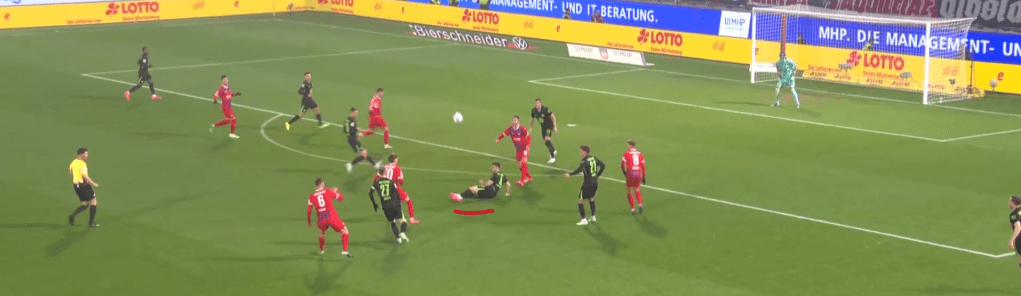
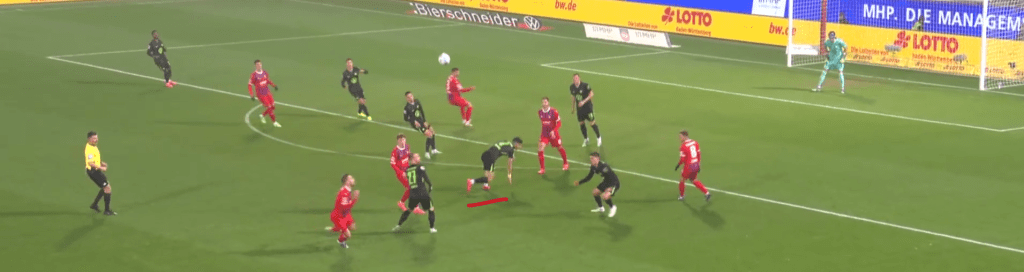
Defenders who possess the presence of mind and consistency to read situations before they become dangerous are a rarity in the modern game.

Koulierakis certainly possesses this in abundance, and it’s easy to see why he’s becoming an attractive proposition for the elite clubs in Europe, including Liverpool.

Another stunning example of this comes up against one of the best strikers in Europe over the past year, Borussia Dortmund’s Serhou Guirassy (BLUE).
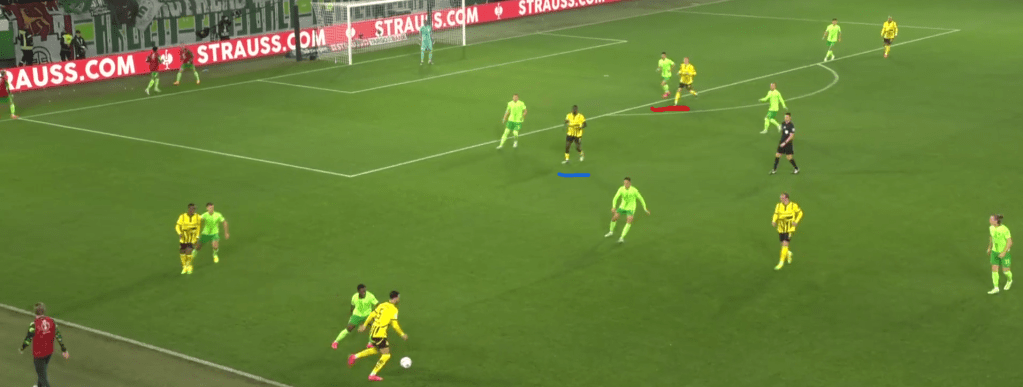
To start with, Koulierakis’ positioning (RED) in this situation is excellent.

He’s goal-side of his marker, in perfect view of the action in front of him, allowing him ample time and opportunity to engage any situations that come in his zone.

However, as the play progresses, one piece of skill from the intelligent and cunning predatory instincts of Guirassy attempts to disrupt it all.

The ball is played to the Guinea international…
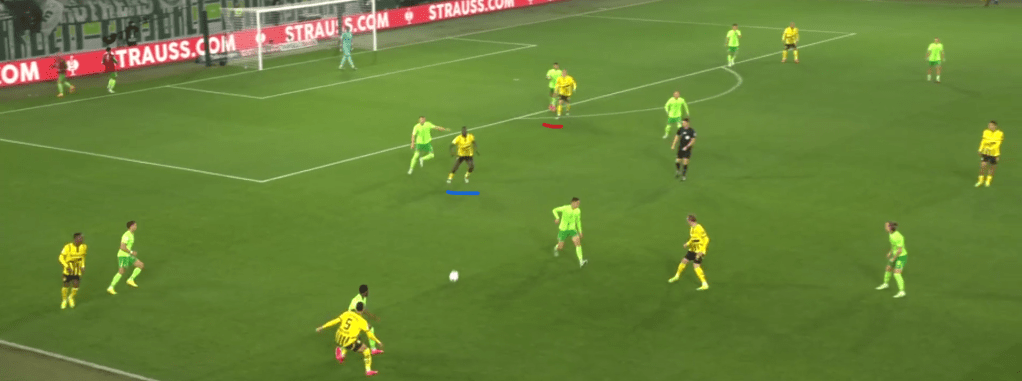
… but Guirassy is aware of what’s immediately behind him, Koulierakis’ marker. Which means the Greek international will need to instantly engage and read whatever occurs…

Guirassy brilliantly dummies the pass, fooling Koulierakis’ defensive partner, taking him out of the game and expecting the return…
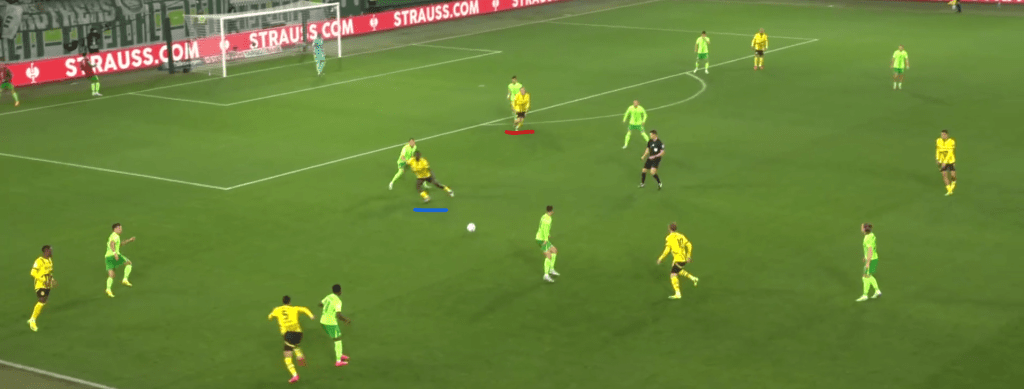
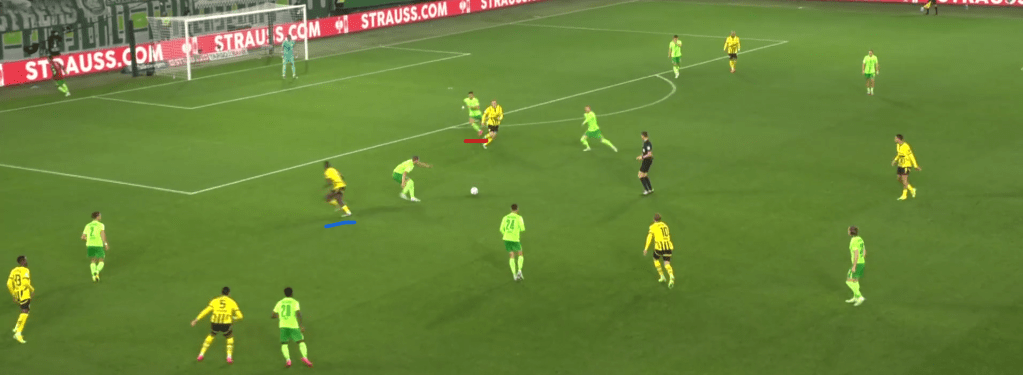
As a result of Guirassy’s smartness, Wolfsburg’s defensive line has been instantly dissected, with Koulierakis their only hope of avoiding being breached.

In this instance, it would be easy for Koulierakis to follow his initial marker towards the ball. However, he excellently reads what Maximilian Beier is intending to do, return the pass to Guirassy, who is through on goal once executed.

Rather than follow Beier, Koulierakis once again is tremendously aware of what’s coming and instantly attempts to engage Guirassy’s run, knowing that the run is more dangerous than Beier’s positioning.
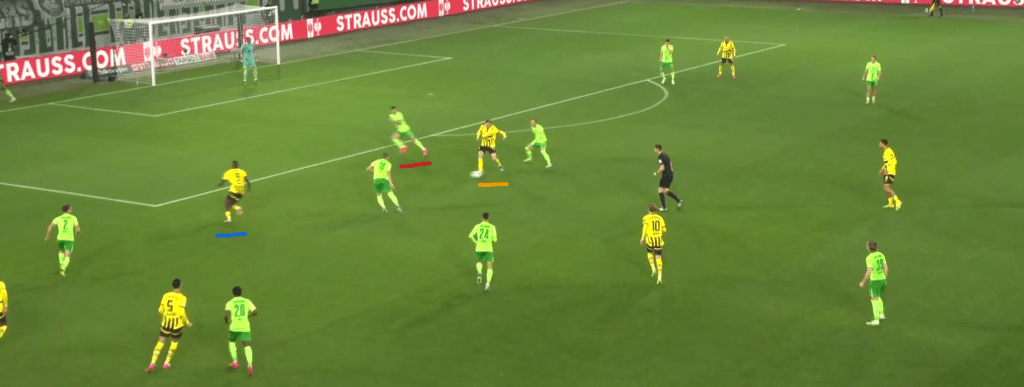
As a result of his excellent awareness and reading of the situation, he’s able to meet and stand up to the tricky Guirassy once he receives the return pass and snuff out the danger…
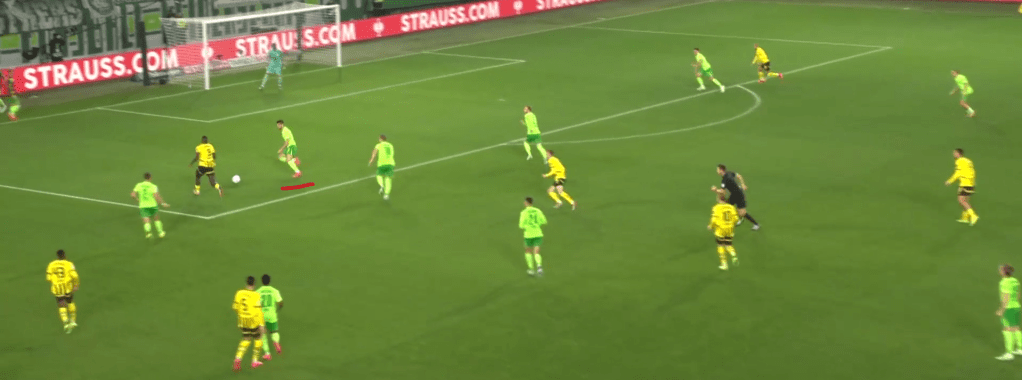
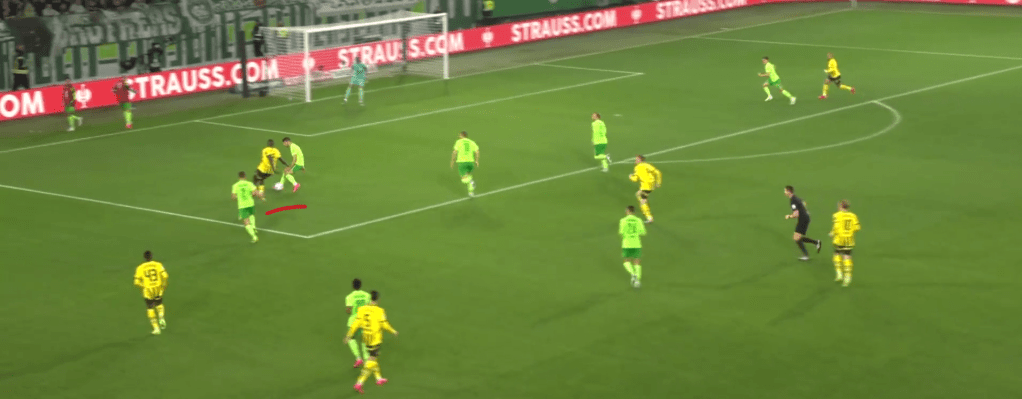
The above scenario also paints a picture of Koulierakis’ wide defending and coverage. When faced with an attacker who’s exploiting wide spaces left by his full-backs, he’s more than capable of matching that opponent for pace and engaging at the right time to dispossess and stop the attack from progressing further.

Koulierakis demonstrates exceptional agility and explosive power over short distances, enabling him to cover ground quickly and recover from dangerous situations not only for himself but also for his teammates, as illustrated in the above example.

A backline leader & shield

Another defining facet of the Greek international’s game is his fearlessness, leadership and bravery in defensive situations, embodying qualities of a dominant defender but more importantly, a backline leader.

He’s a defender who constantly takes responsibility and initiative, and that is shown in his willingness to make first contact for every cross into his own penalty area, his fighter’s mentality to winning crucial duels in the 18-yard box, and his no-nonsense approach to getting rid of danger.

If a loose ball demands a swift, unglamorous and unrefined clearance to safety – a rare commodious trait in centre-backs in the modern game – he’ll execute that task with swift decisiveness, ensuring that no threat lingers in his zone.

The former PAOK defender is also incredible at putting his body on the line to stop opponents’ shots at goal. In fact, the underlying stats certainly paint a picture of his no-nonsense approach when defending.

Amongst centre-backs in Europe, the Greek international ranks in the 98th percentile for blocked shots, 94th percentile for blocks, 89th for clearances and 84th for passes blocked and dribblers tackled per 90 [Footverse].

Koulierakis commands the penalty area with authority, decisiveness and immense bravery. For instance, in the scenario below.
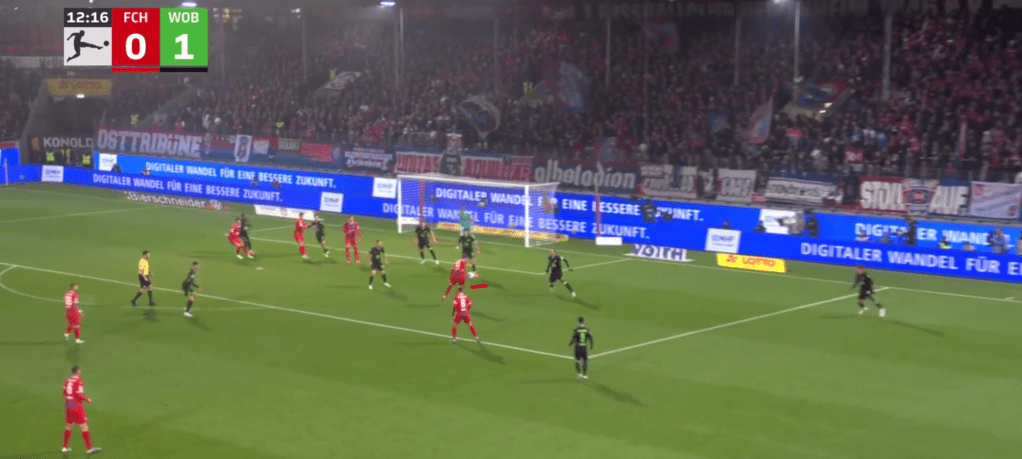
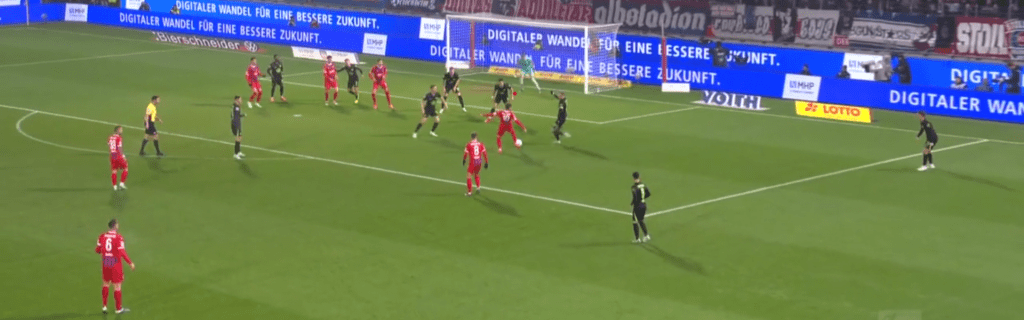
With his side camped in their own box, desperately defending an early lead, it’s Koulierakis who puts himself on the line to keep his opponents at bay.

He excellently and bravely anticipates an incoming shot, positions himself in front of it to block, albeit with his head. Immediately afterwards, another shot is lined up, but Koulierakis gets in the way once again, this time with his shoulder.

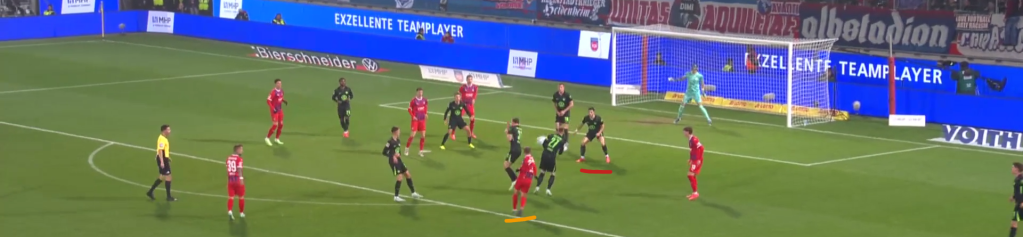
Certainly, it’s unconventional, but we’re talking about a “by any means necessary“-type centre-back, always willing to put his body on the line to ensure his side has the best chance of winning. More crucially, it’s his reading of dangers before they occur that allows him to stand out.

Areas of Improvement

Aerial duelling

He’s always alert and ready through his body positioning and defensive awareness to engage at any moment, but that will also have to aid him in his aerial duelling, which, as stats show, needs some work.

Standing at 1.88m, Koulierakis may not be the tallest centre-back, and the way he oozes confidence going in for ground duels and putting himself on the line for blocks and clearances, as we’ve highlighted, the numbers show he’s not as authoritative in the air.
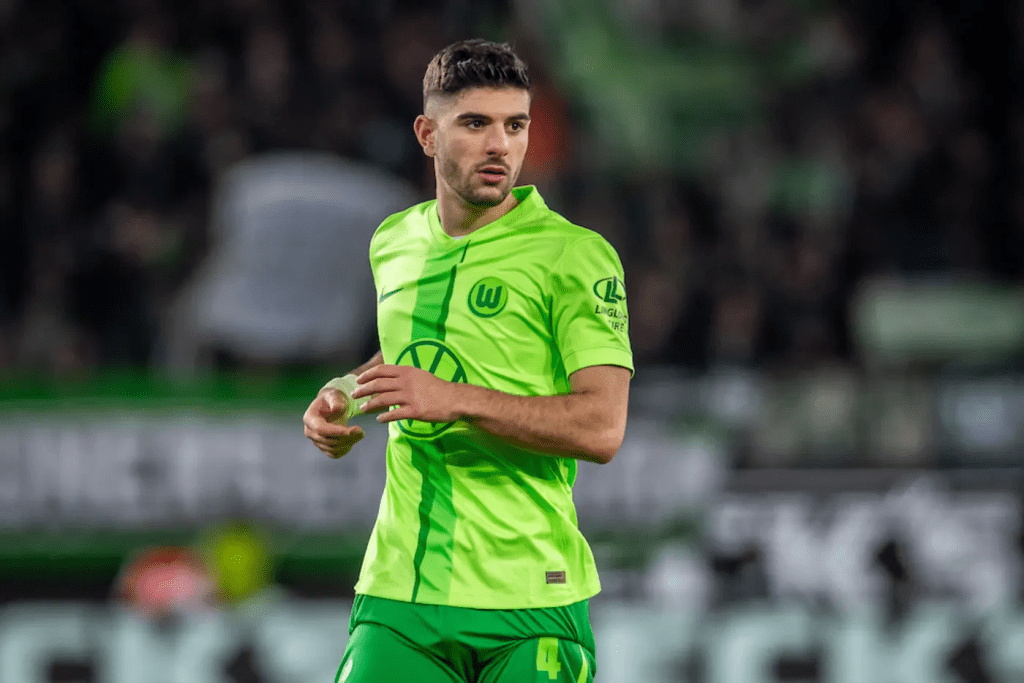
As per Footverse, he ranks in the 69th percentile of centre-backs in Europe’s top five leagues for aerials won. By no means does that make for terrible reading; in fact, it’s decent. However, his leaps and the timing of them are very good, which raises an expectation that he should win most of his aerial duels.

According to SofaScore, he has a win rate of 44% so far this season, which again, isn’t bad but could be better given the authority he exerts in his duels and the sheer presence he possesses amongst his teammates.

Turning radius & mobility in tight situations

We pointed out Koulierakis’ weakness in playing out from the back when faced with an opponent’s press, and another facet of that is his inability to play with his back to goal in certain situations, due to his lack of turning radius and mobility.

While those kind of scenarios are rare for a club like Wolfsburg who aren’t well-versed in a possession-based and fluid back-to-front style, should he make the big move to a Liverpool, Madrid or another elite side, for that matter, those skills will certainly come in handy.

The Greek talent boasts impressive agility and vertical explosiveness, but he faces some limitations when weaving his way out of tight areas. His imposing, athletic and powerful frame can occasionally hinder the fluidity and flexibility required for such tight and pressurised scenarios.

Decision-making in possession, and the quality of pass amidst pressure

While Koulierakis’ line-breaking and progressing passing have become a notable calling card in his game, there are some elements in his decision-making with the ball at his feet which could use more refining. One of those is his pass selection and accuracy, or even the timing of his long passing. He can often try to force the play too prematurely and look to choose the more difficult option in going long rather than playing it short and keeping things simple for his team.

Also, the on-ball scenarios highlighted in this piece show the Greek defender with time to pick a pass, but at times, he can lack the composure needed in certain situations when pressed by an opponent, which leads to those hurried and inaccurate long balls mentioned, ceding possession back to the opposition.

Possessing the ability to retain the ball under pressure is an essential attribute for any player performing in key sensitive areas of the field, especially the zones which centre-backs take up in the build-up phase, where losing the ball can lead to dangerous consequences.
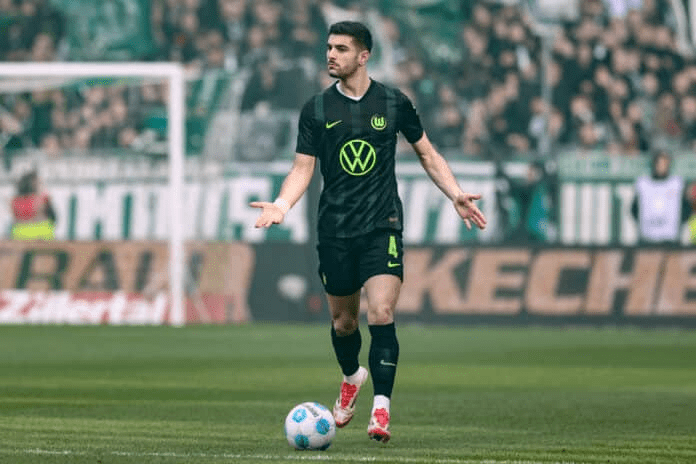
Given that the big teams that are hunting down major silverware are also high-possession-based sides and place a lot of demands on their centre-backs on the ball, this is certainly something the Greek defender will need to develop and improve on if he is to make that expected big jump in the near future.

The issue is not so much with his technical acumen as we’ve pointed out, but more with his decision-making and quality control when pressed, which requires more learning and improvement, but these aspects are crucially addressable with the right coaching and environment.

What does the future hold for Koulierakis?

Konstantinos Koulierakis is an exceptionally versatile defender, embodying all the qualities that modern elite clubs covet in a centre-back.

His game is a masterful blend of technical finesse and precision passing, seamlessly combined with an impressive athleticism characterised by speed, strength, and agility.
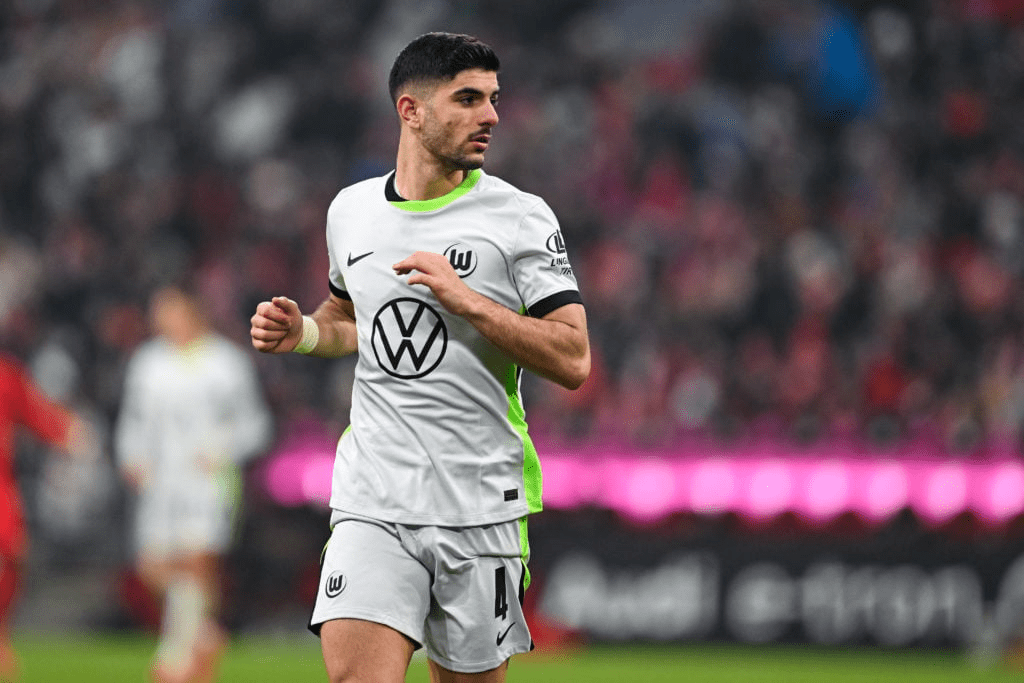
Koulierakis exhibits sharp defensive instincts through his astute tackling, impeccable positioning, and eagle-eyed anticipation of opponents’ moves. Moreover, he adds an exciting dimension to the attack during set pieces, making him a constant double threat on the pitch. This comprehensive skill set leaves no room for concern; there are no glaring weaknesses in his performance.

Given these attributes, he stands out as a prime candidate for a significant transfer to a club vying for glory at the highest levels of competition.

However, the pivotal question now hovers around timing. Despite the absence of a blockbuster move during the summer transfer window, speculation lingers about whether powerhouse clubs like Liverpool, Real Madrid, AC Milan, or Borussia Dortmund will circle back to him next summer or even as soon as January. Yet, such uncertainties are beyond Koulierakis’ influence.
What he can control is his commitment to excellence, focusing on delivering outstanding performances and relentless development. He must continue to shine for Wolfsburg and his national team, just as he has consistently done over the past year.

If he sustains this upward trajectory, there’s every reason to believe that the aforementioned elite clubs will soon line up to present formal offers for his exceptional talents in the near future. Nonetheless, he is ultimately in charge of his destiny.
Meet Dinamo Zagreb’s Martin Baturina: The Next Luka Modric?

Meet Dinamo Zagreb’s Martin Baturina: The Next Luka Modric?

After a runner-up finish in the 2018 World Cup and a third-placed achievement at the 2022 edition, the Croatian national football team have arguably reached the end of their impressive cycle.

Manager Zlatko Dalić has done tremendously in leading his talented group of players to consistently punch above their weight against some of the elite nations in the world but sadly, such achievements have a shelf life in football.

Dalić remains the Croatian manager after nearly seven years in the job and will be entrusted to lead them again for this summer’s upcoming 2024 European Championships and ahead of the 2026 World Cup.

However, whatever happens in Germany, the Croatian Federation and Dalić know they are in for a significant rebuild to ensure the teams stay competitive in future competitions.

Players who have been go-to players for the Croatian coach are certainly on their last stretch at international level; Marcelo Brozovic, Domagoj Vida, Ivan Perisic, Mislav Orsic and Andrej Kramarić have all been crucial components throughout Dalic’s reign.

Though one name considered one of the most decorated performers of all time not just in his beloved country, reaching the latter stages of his fledgling and Ballon d’Or-filled career is one Luka Modric.

Euro 2024 is sure to be – albeit sadly – the Real Madrid superstar’s last international tournament before hanging up his boots.

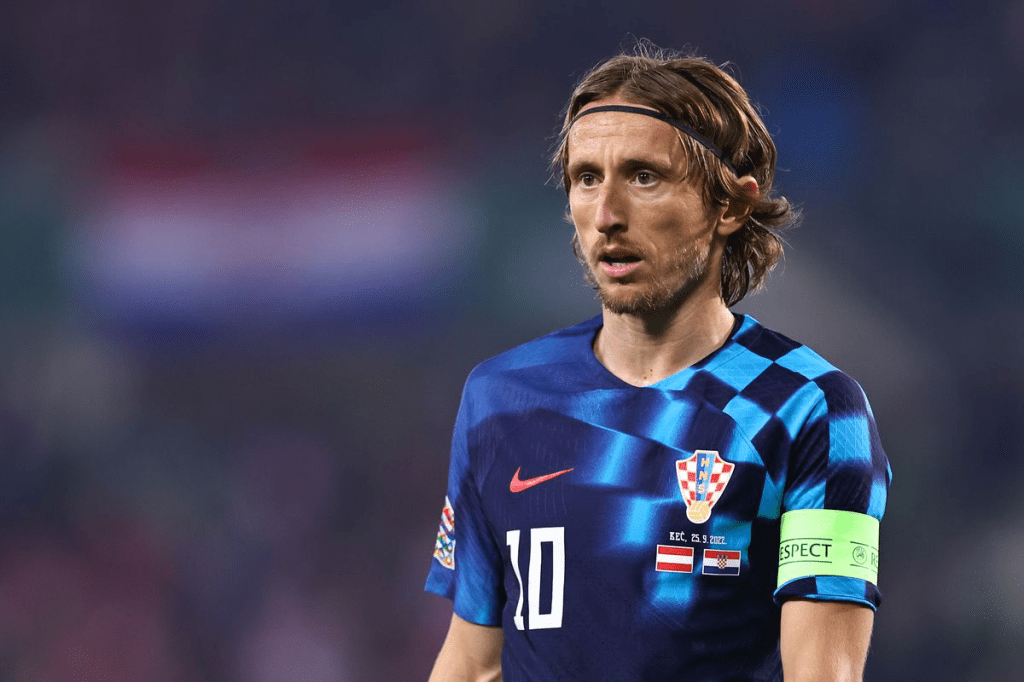
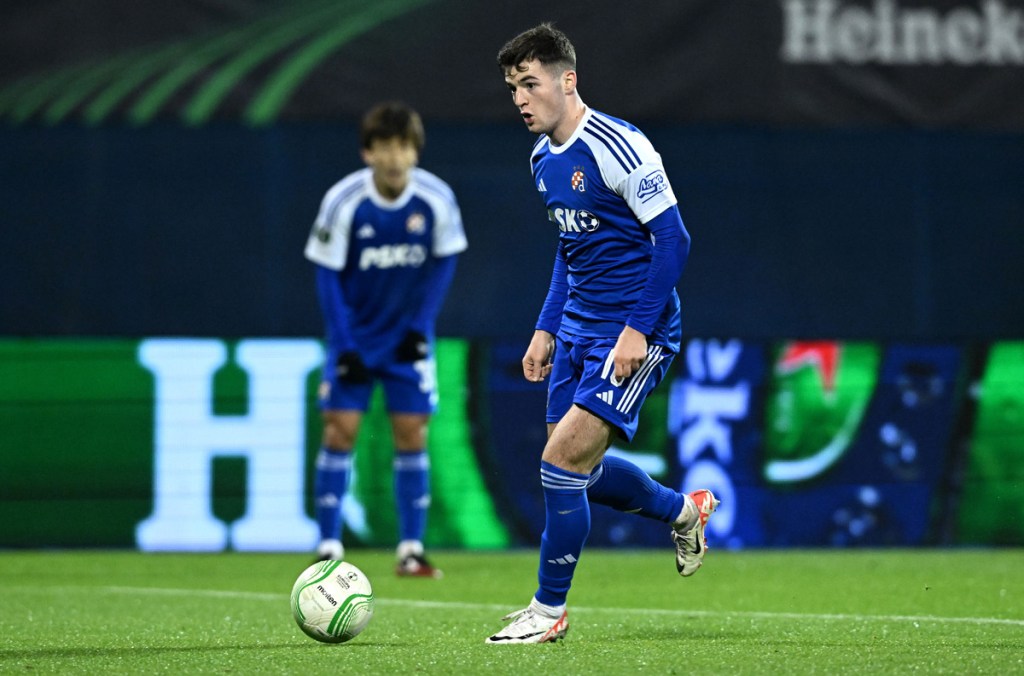
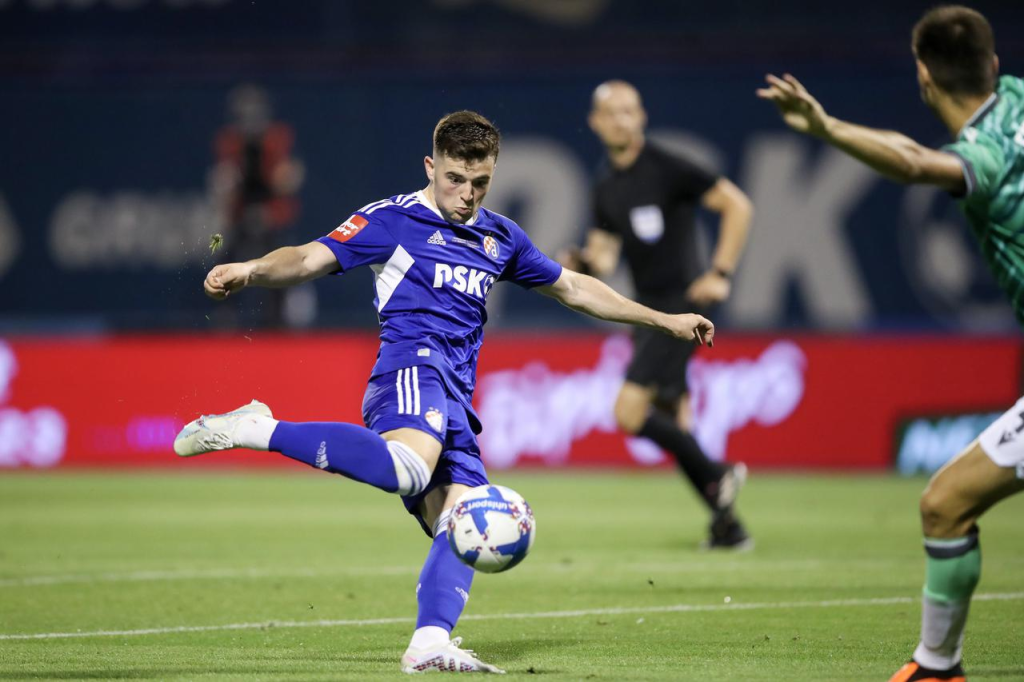
Croatia need a viable and quality successor to step into Modric’s shoes and one young prodigious talent making shockwaves across Southeastern Europe is Dinamo Zagreb’s midfield maestro Martin Baturina.

The 21-year-old has already in his short career drawn favourable comparisons to Modric and could yet be the next big-money departure from Zagreb, following in the footsteps of the likes of the Real Madrid icon, Mateo Kovacic and most recent departures in Josip Šutalo (Ajax – £17.6m) to Joško Gvardiol (RB Leipzig – £31.6m & Manchester City – £78m).

The son of former Croatia international Mate Baturina has proven indispensable for a Dinamo Zagreb side that has just claimed its record 25th and seventh straight Croatian top-division title.

The wonderkid has enjoyed another successful campaign in the first team, registering five goals and five assists after a sensational breakthrough season during the 2022/23 campaign where he notched six goals and a whopping 12 assists.

The Zagreb academy graduate has been linked with European giants Arsenal and Juventus over the past year, once again highlighting how highly thought of he is within Europe.

Baturina is now being considered the future of Croatian football and the ideal heir to Modric’s prestigious and decorated thrown.

As pressurising as that may be for the 21-year-old talent, the huge acclaim placed on his shoulders isn’t inflated at all, this is an exceptional talent but how has he got to this position and what makes him so special?

Who is Martin Baturina?

Born in Split, Croatia on 16 February 2003, Baturina is a product of the much-famed Dinamo de Zagreb academy.

Being in the academy since the 2017/18 season, he has been a fast burner, staying only for a season in all the academy squads (junior, U17, U19, second team) before making his debut and establishing himself as a key element and vital player for arguably one of the biggest Croatian clubs in history.

Baturina made his debut for Dinamo Zagreb II in February 2021, in a 1-0 defeat to Bijelo Brdo and it only took a few months before he made his first team bow for Zagreb in May 2021, featuring in a 3-0 league win over Gorica.

The Croat bagged his first goal for the club in March 2022, a 3–0 victory over Šibenik, before playing a significant role in their 2021/22 final matchday 3-1 win over his hometown club Hajduk Split.

He would go on to feature regularly both in the domestic cups and in Europe that year and the 2022/23 campaign was certainly the year, Martin Baturina made his exceptional breakthrough for Zagreb.

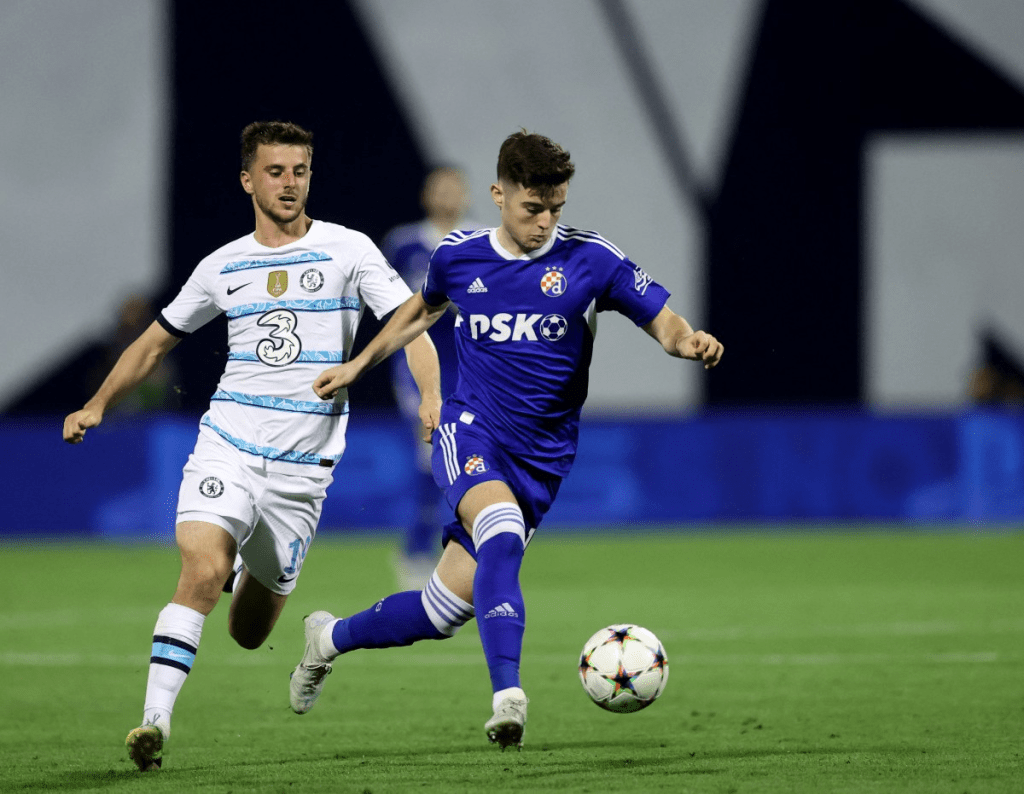
In September 2022, Baturina made his UEFA Champions League bow for the Croatian giants, featuring in a 1-0 win against Thomas Tuchel’s Chelsea, a result which compounded the German to his unfortunate sacking by the new Stamford Bridge co-owners, Todd Boehly and Clearlake Capital’s Behdad Eghbali.

The youngster only made a five-minute cameo for Zagreb but that campaign would go on to be his best for the club, registering seven goals and 13 assists from 49 games in all competitions [Transfermarkt].

The 2022/23 campaign certainly established Baturina as one of Croatia’s most gifted footballing products and he’s carried that on to this season, registering six goals and nine assists, eight of those coming in the league as Zagreb recorded their seventh straight SuperSport HNL league title.

His stunning trajectory and consistent form for Zagreb have deservedly handed the midfielder national acclaim.

Having featured in all of Croatia’s youth groups, including making 14 appearances for the under-21s, Baturina was rewarded with his first call-up to Zlatko Dalic’s senior set-up for the UEFA Euro 2024 qualifiers, making his debut as a substitute in a 2-0 away win against Latvia back in November.

With Dalić set to name his 26-man squad for this summer’s UEFA European Championships in the coming weeks, Baturina is sure to be rewarded with his continued success at club level with a spot on the plane to Germany – a summer which will signal the end of an era for Croatia but the ushering in of a new one, one which Baturina will arguably be the face of.

Martin Baturina’s Style of Play

There’s an intentional reason why Baturina is drawing stark comparisons to Modric and it’s not just because they play the same position on a football pitch.

Standing at 72cm (5’8”) and weighing 68kg (149lbs), the Zagreb wonder is a diminutive and silky technician possessing a skilful right foot and low centre of gravity, which enables him to twist and turn out of pressure and tight spaces.

Remind you of anyone? Modric in his days at Dinamo Zagreb come Tottenham Hotspur held the exact same technical profile and like Baturina, was considered the topic of the whole nation bursting onto the scene on one of Europe’s biggest platforms.

However, when watching the Split-born sensation, he draws even more comparisons to another unique outlet in Croatian football (read on to see or even guess who).

Zagreb’s Linchpin

The 21-year-old has become a dynamic and crucial presence in the Zagreb midfield, usually performing the role of an attacking midfielder, just behind the main striker or in a left-sided advanced #8 role in a 4-3-3 setup with a licence to roam the half-space or find decisive pockets in between the opposition’s defensive line and midfield.

Before delving into Baturina’s style and influence, it’s important to identify the tactical conditions allowing the Croat wonderkid to express himself and fulfil his undoubted potential.

Zagreb are one of the teams in 1. HNL who dominate the ball and control games, and Baturina is often a big part of that possession-heavy approach.

The Croatian giants line up regularly in a flexible and fluid 4-2-3-1 formation, with Baturina at the forefront of the system, becoming the link between midfield and attack. As stated previously, he is handed the license to roam into space/pockets to disrupt and dissect low blocks.

Their system can alternate from a 4-2-3-1 to a 4-3-1-2 but one constant aspect is that Baturina will always remain their creative linchpin.

This is clearly evident through the numbers. Within Europe’s next 14 competitions after the top five leagues, Baturina ranks in the top 13% of attacking midfielders for passes received per 90, pass completion % per 90, and ranks in the top 11% for passes attempted.

While he isn’t necessarily a tempo setter or a deep-lying presence, Baturina certainly likes to be highly involved and needs to touch the ball often to maximise his influence.

It is why he possesses the tendency to drop deep from his #10 position and get involved with the build-up to progress the ball through passing – ranking in the top 9 per cent of attacking midfielders for progressive passes per 90 – or through ball-carrying, also ranking in the top 15% for progressive carries per 90 and top 16% for successful take-ons per 90 highlighting his tremendous bravery and technical acumen.

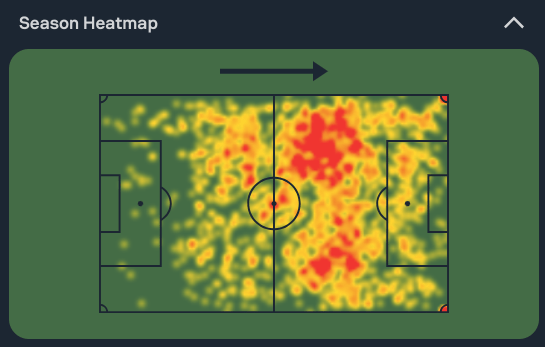
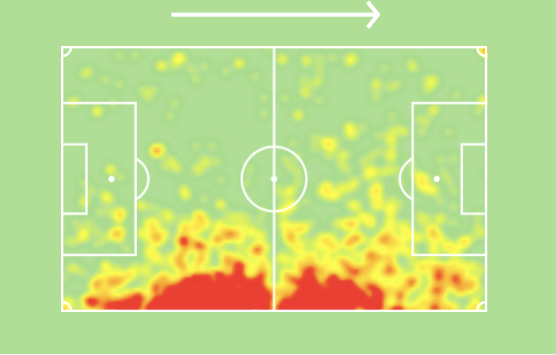
Looking at Baturina’s season heatmap, it’s clear his influence has come from the left half-spaces, allowing him to find the perfect angles to thread through balls or unleash long-range shots.

As stated previously, Baturina loves to drop deep and advance high up the pitch, as well as operating centrally or out wide, depending on the team’s needs or where he feels he could make the most impact.

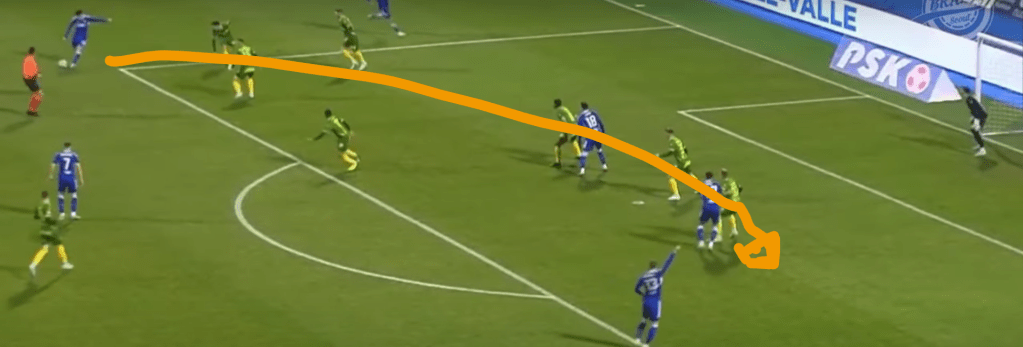
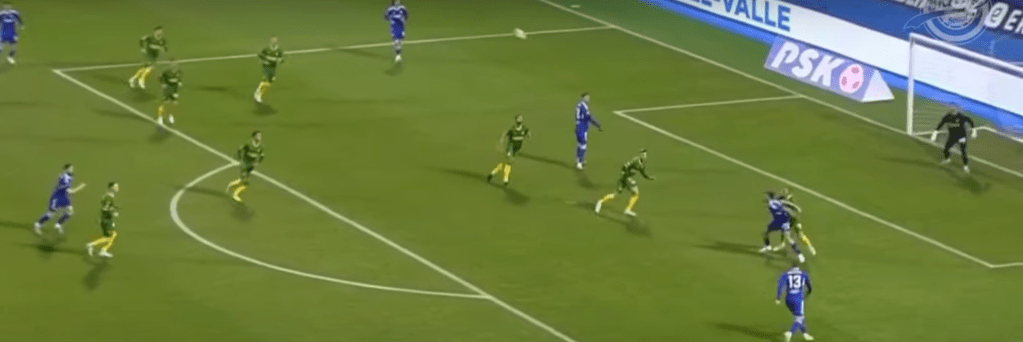
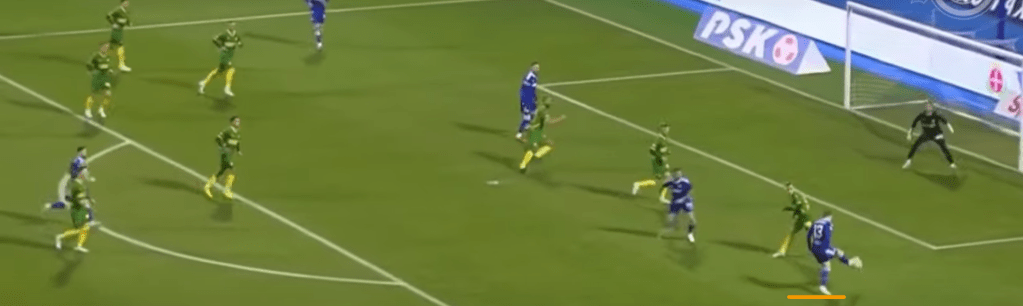
For example, in the image above, Baturina emerges with the ball wide-right with the opposition stretched, he dissects a sublime through ball for Luka Stojkovic at the other end to latch onto and score.

Judging by Baturina’s technical and tactical understanding, movements and selection of positions and space in the middle and attacking third, he is incredibly versatile and flexible in his approach.

It is quite difficult to pin him down solely as a #10 or a #8 but a player of the hybrid mould. To get more out of his game, a deeper role in the #8 seems the way to go for him, just like the great Modric evolved into as his career progressed.

Ball-carrying merchant

Baturina is an all-phase midfielder who likes to be as involved as possible, registering touches across the thirds. Considering he is among the most influential and involved players in his position and considering Zagreb’s possession-orientated approach, it doesn’t surprise us that the Split-born playmaker is also a good recycler and retainer of possession, as the numbers above show.

However, while he likes to come deep to get involved with the play, it wouldn’t be true to define him as an elite ball progressor. Certainly, he can do it, but the midfielder holds a strong preference in his game to receive the ball and beat his marker to break lines through carrying rather than passing – that’s where he probably differs from his potential predecessor, Modric.

Ranking in the 84th percentile of attacking midfielders for successful take-ons per 90, 85th percentile for progressive carries, 93rd percentile for progressive carrying distance and in the 99th percentile for carries into the final third per 90, it is easy to see why Baturina loves his ball-carrying and he is so graceful and classy with it.

Not only does Baturina hold similar characteristics to Modric, but he’s more of a Mateo Kovacic 2.0.

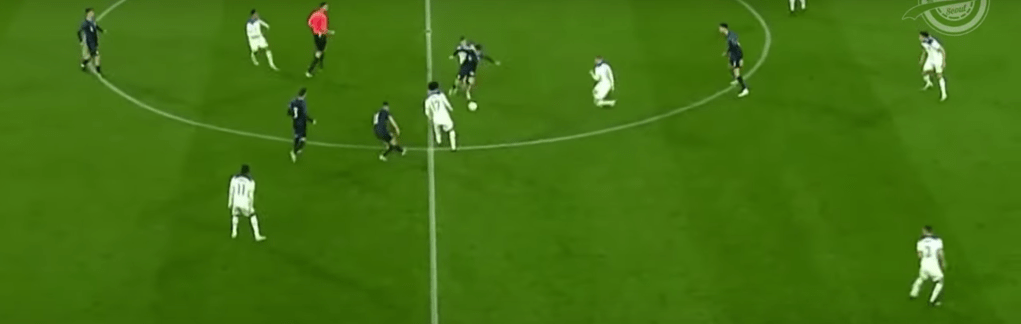
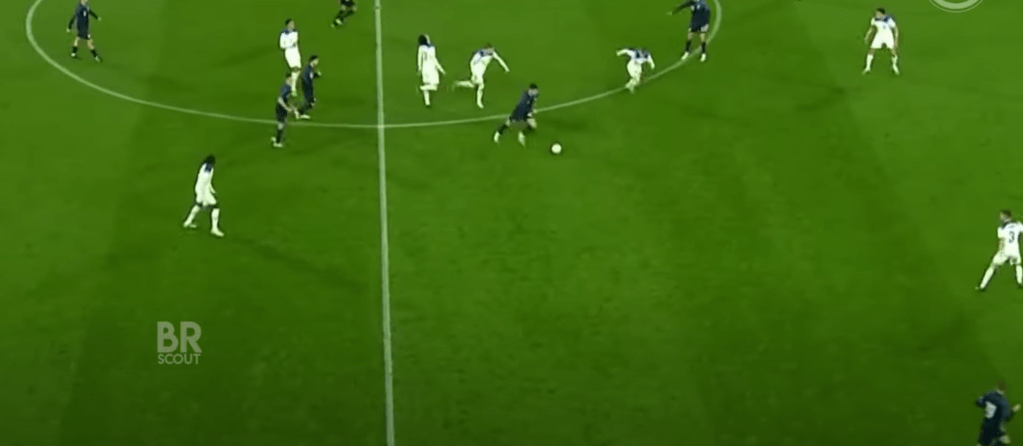
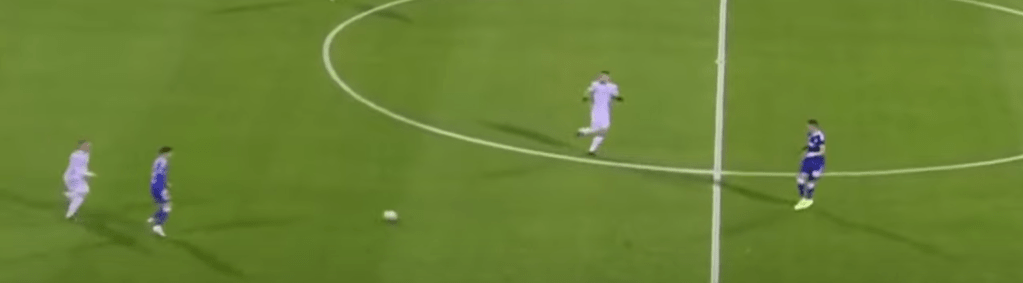
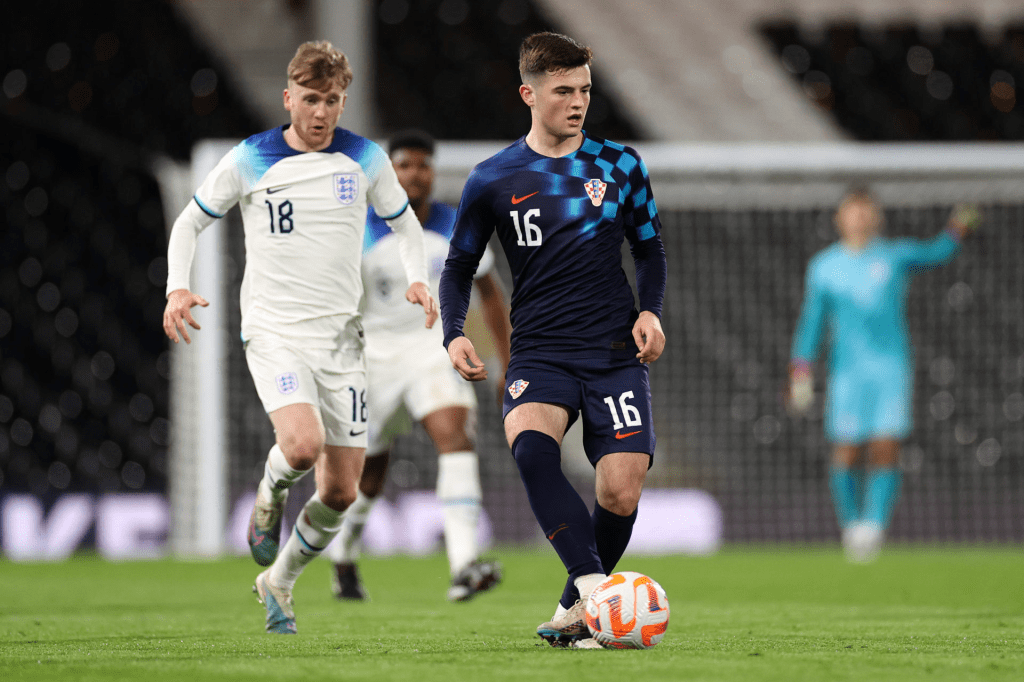
Take the below instance during a Croatia under-21 fixture against England under-21s, Baturina is surrounded by white shirts and looks like he’s about to be swarmed all over and dispossessed.

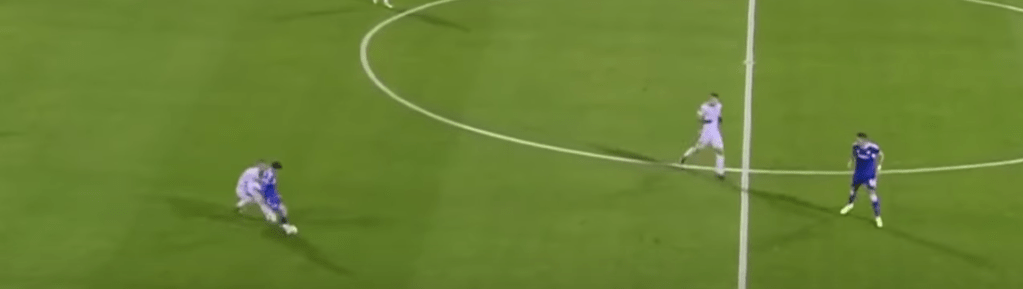
Given Baturina’s dribbling quality, ball control and press resistance, he’s able to weave his way out of the tight spot…

And drive his team into the final third with such class and finesse.

He is the player with the second-most total progressive carries in the 2023/24 campaign in Croatia (55) and third in progressive carries per 90 minutes (3.7) at the moment of writing.

The 21-year-old uses ball-carrying as a progression tool in deeper areas and as a creation tool in higher ones. While he’s clearly intentional and purposeful with his passing, it’s safe to categorize him as a dribble-first progressor.

He’s not only a tremendous dribbler, keeping the ball close to feint past defenders or change direction but he’s also quick, agile and his ball-carrying style is enhanced by his ability to reach top speeds within an instant and his low centre of gravity – it is extremely difficult to possess him, leaving the opposition with the only real option of fouling him.

As a result of these characteristics, Baturina has no problems whatsoever, receiving the ball with his back to goal.

He will twist and turn to evade the pressure, beat the marker and then conquer territory through his carries, as shown below.

The 21-year-old’s frame gives him agility and flexibility to outmanoeuvre his markers, akin to what Kovacic does so regularly at Manchester City in the Premier League and for Croatia.

It’s how Baturina performs these actions that will stand him in good stead when competing at the elite level every week.

Elite clubs in Europe are always on the prowl for midfielders like Baturina because of his pure and unique ability to evade pressure through the thirds – a very useful tool in disrupting mid-defensive blocks but also allowing for easy and swift access into the attacking third.

Ball progression must equal final-third creation

There’s a reason why Baturina is considered the complete advanced or free #8 package and that’s because of his excellence not just in his mode of ball-progression but that progression leading to goal-scoring scenarios.

He is an effortless creator as much as a unique outlet in his incisive dribbling.

First and foremost, not all of Baturina’s entries into the final third won’t always result in a chance or opportunity but he’s a player who picks his passes well.

The 21-year-old will sometimes carry the ball before linking up with a teammate out wide and then continue his run to provide the team with another advanced passing option.

Once he eventually receives in a high and wide position, his threat and ability in tight spaces usually means he attracts two markers before retaining the ball nonetheless and laying it off to a teammate who is now free thanks to his efforts.

Baturina is so crucial to Dinamo Zagreb’s progression tactics; he evades pressure, provides and creates advanced passing options, and successfully connects the thirds from deeper to higher zones of the pitch.

The advanced playmaker has a clear skillset to influence play and his team’s tactics higher up the pitch. This season, he’s racked up six goals and nine assists from all competitions, a drop-off from 7 goals and 13 assists from last campaign but his contributions and influence are absolutely clear.

Along with nine assists in all competitions, Baturina averages 2.3 key passes per game in the Croatian top flight, has created seven big chances and ranks in the 76th percentile of attacking midfielders in Europe’s next top 14 leagues for through balls.

While the 21-year-old cracks the top 30 in 1. HNL in total key passes played in 2023/24 (6), his per 90 return is not as impressive (0.4). He ranks 12th in the league for smart passes (9) and 15th in smart passes per 90 (0.6). 

We now know Baturina is a smart passer, a player blessed with tremendous vision and quickness of thought in the middle third, but how does that translate to where it matters most – the final third?

The two-cap Croatian international is pretty versatile in his final third distribution. Often, we will see him distribute from the deep and into the runners, but when he gets higher up the pitch, he has no issues breaking the lines and sending a pinpoint pass to the feet of his teammates.

More crucially, he’s proven decisive and influential with his passing in the attacking third.

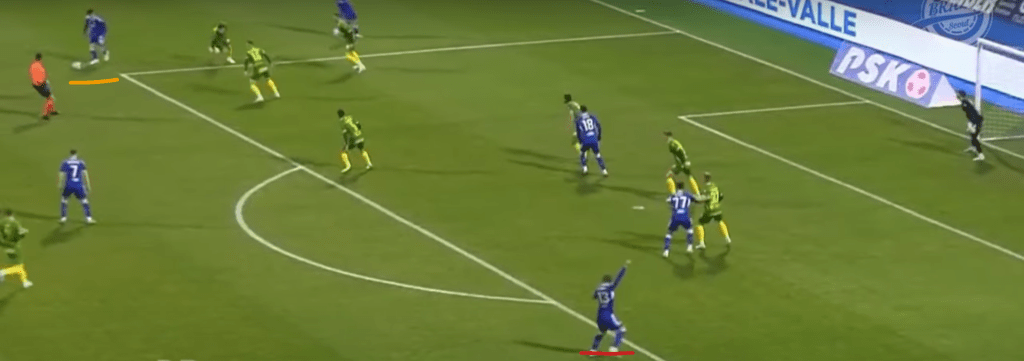
In the below image, for instance, Baturina (RED) receives the ball in between a crowd of players. Where some #10s choose to distribute it out wide, the Croat is looking for runners instead.

Baturina picks out Stojkovic (ORANGE) with a sublime dinked through ball…

This is what makes Baturina so special and an influential component in the Zagreb team, especially in the higher zones.

He’s not just capable of the penetrating, line-breaking carries through the thirds, but once he gets into the attacking third, he’s composed, agile and adept at selecting the right actions leading to shots. He ranks in the 73rd percentile of attacking midfielders for shot-creating live-ball passes per 90 (live-ball passes that lead to a shot).

The young Blue can also whip in delicious and dangerous crosses, either through set-piece routines or from open play.

Before the young playmaker gets into this crossing position, he once again finds an opportunity to drift out wide and pull the opposition’s defence to one side which leads to Stefan Ristovski ghosting into the box unmarked…

Baturina delivers a picture-perfect cross, evading every one of the opposition’s defenders…

Laid right on the money of Ristovski’s right foot to score beneath a sprawling goalkeeper…

Again, we see the technical acumen of the 21-year-old talent. He’s added so many creative strings to his bow during his two breakthrough seasons at Zagreb making him an attractive midfield proposition for several of Europe’s top clubs.

Shooting

Another strength of Baturina’s game is his long shots. Whenever he finds himself in space on the edge of the box, he’s never afraid to test the goalkeeper from distance, making him a deadly threat from the #10 position.

Whilst he’s more of a creative dynamo, his shooting technique certainly makes him an important factor for his team.

Baturina seems pretty good at finding decent positions to shoot from, and this should, in theory, also predict a positive net return in the near future. His shot type is pretty meticulous and intentional, trying to put some dip to fool goalkeepers and curl when faced with defenders right up in his line of sight as a tool to find the right trajectory and angle for his attempts.

The 20-year-old is very good at manipulating the ball in tight areas, turning and progressing into a good position to shoot from. This is another thing we have to mention that is impacting both his xG per shot and his total output – shooting from a distance.

Last season, he made 13 shots from outside the box in 1. HNL, hitting the target five times and rattling the inside of the net once from those five attempts; all things considered, a decent return.

This season, he’s attempted eight shots outside the box, hitting the target three times, but with no goals to his name. His conversion rate this season compared to last season may well have dipped, but playing in a team that regularly dominates the ball up against deep blocks, Baturina is doing what’s required – taking long shots when necessary, a tool incredibly useful in breaching stout defences.

Off-ball movement

Another tool in Baturina’s unique and heavy artillery is his off-ball movement.

As we’ve pointed out in this piece, Baturina receives the ball in deep zones, directly from the backline and then carries the ball for a certain distance before linking up with a teammate out wide.

However, as all great advanced midfielders do, they’re not supposed to stop there. The Croat possesses the presence of mind to continue his runs, exploiting gaps or little pockets in between the lines or half-spaces to operate in.

Apart from offering himself as a passing option, he also creates space by dragging his markers away, making a gap in the opposition’s defensive structure for his teammates to exploit.

The 21-year-old operates like a player certainly beyond his years, and it is why the comparisons to Modric and Kovacic are so stark and accurate.

He’s street smart, possessing stunning technical and tactical understanding but a raft of tools in his weaponry that also makes him such a decisive and influential player in the final third.

Forecast for Baturina’s Future

Better consistency with the Croat wonderkid’s output will surely take his game to the next level, but one thing is certain, Baturina will be the next big-money departure from Zagreb.

An exhilarating and tantalising footballing prospect who’s bound to leave Croatia to eventually join one of the European powerhouses, should his development continue following the current trajectory.

Arsenal and Juventus are the previous names linked with his services over the past year, but they certainly won’t be the only ones this summer.

Like many other hot talents, Baturina will need to pick his next destination with careful consideration, providing him with the appropriate and progressive conditions to thrive tactically, mentally and physically.

Joining clubs such as a Borussia Dortmund, Bayer Leverkusen, RB Leipzig, AFC Ajax or a similar-sized outfit in Serie A – where young talents can go to and perform every week without unnecessary pressure and weight of expectation might just be the perfect platform.

Given his burgeoning reputation right now within Croatian football, it will be easy for him to make the huge step to a big club so soon – one he must avoid. Nonetheless, playing within Europe’s top five leagues must be high on his agenda, then he’d be sure to get the international recognition his talents and personality deserve.

Modric 2.0 isn’t a far-fetched label for Martin Baturina. He truly is on course to become the next best thing to come out of Croatia.

The Remarkable Journey of Archie Gray: From Leeds United’s Academy to International Stardom

The Remarkable Journey of Archie Gray: From Leeds United’s Academy to International Stardom

The illustrious successes of the Leeds United academy at Thorp Arch means that every year one talent that graduates carries with them the expectations and hopes of becoming the club’s latest hot property.

The Whites have indeed had a few talents to get excited about over the past few years, youngsters such as Joe Gelhardt, Charlie Cresswell, Leo Hjelde and Lewis Bate who have now somewhat gone into unfortunate obscurity.

While most Leeds fans will be left wondering what might have been for those two, their attention has been swept considerably by the emergence of one Archie Gray.

Throw in a surname like Gray in and around the West Yorkshire camp and the expectation to become a superstar on the shores of Elland Road instantly increases.

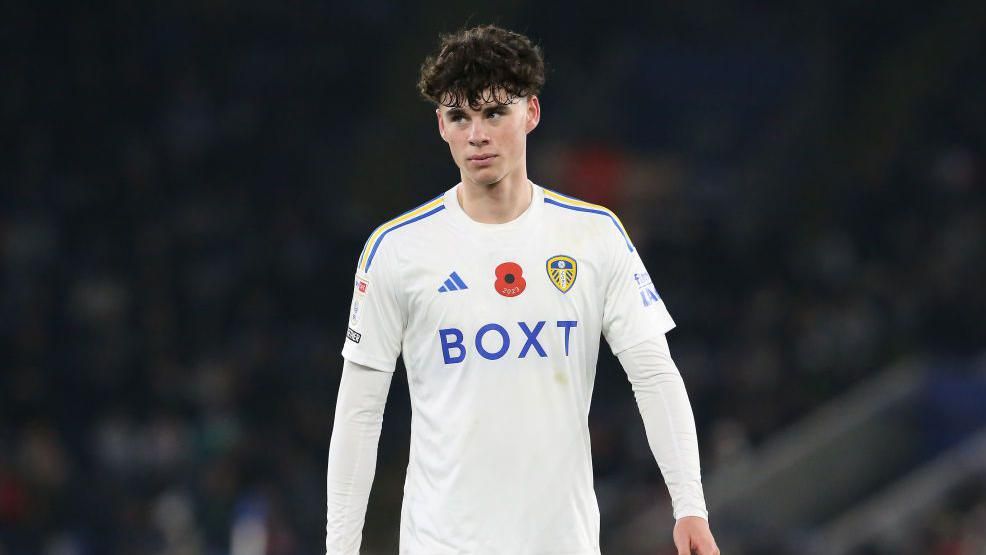
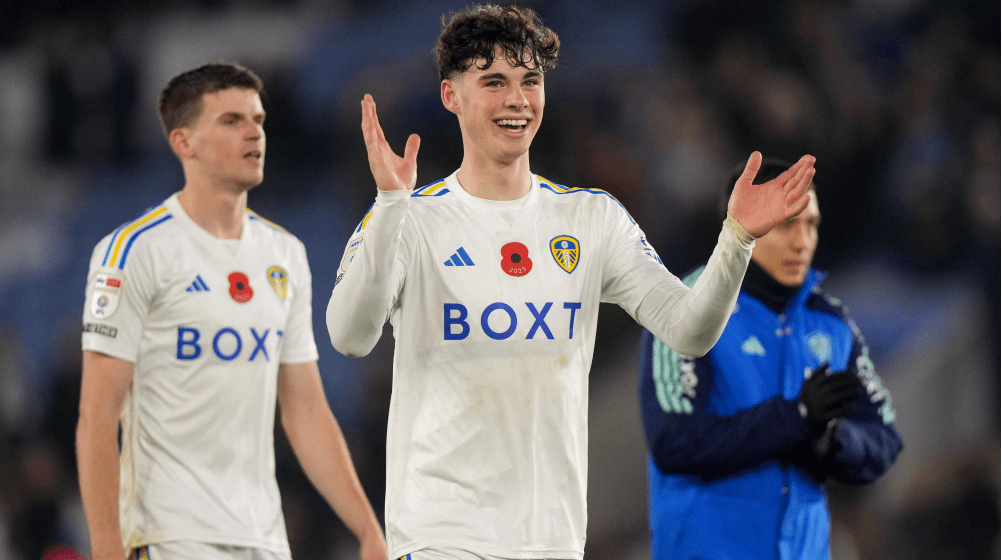
Son of former striker Andy Gray, grandson of ex-defender Frank Gray and great-nephew of club icon Eddie Gray, the 18-year-old is the latest edition of the renowned dynasty synonymous with the historic West Yorkshire club.

Certainly, Archie has a long way to go before he’s matching the heights of his decorated bloodline. Indeed, he’s only 18 and not even a year of first-team football at Elland Road has passed. However, the way he’s performing consistently for Leeds United right now, Gray is on his way to writing his own story and fulfilling his own glowing destiny.
After 40-odd games for the first team, the young Englishman has catapulted himself to become one of the country’s most exciting and highly-regarded teenage talents, leading to plenty of interest from the likes of Liverpool, Newcastle United, Everton and Crystal Palace in the recent past.

The Whites moved swiftly to quell all the noise regarding his future when they tied him down to a new long-term contract in January, putting pen to paper on a deal running until 2028 (LUFC official website, 16 January).

It’s no surprise that he’s been named in Goal.com’s annual NXGN list for 2024 which was released last week and he only went and followed that up with his first cap and goal for the England Under-21s against Azerbaijan on Friday (22 March) – making him the fourth youngest goal scorer in Three Lions under-21 history.

So how has Gray got to this lofty position so early in his relatively short career? Let’s delve in.

Who is Archie Gray?

Born in Durham, North-East England, Gray joined Leeds United at under-9 level.

He is the fourth Gray across three generations to represent the club, with his father, Andy Gray, having come up through the Leeds Academy and enjoyed two stints as a player at Elland Road.

Archie is the grandson of Frank Gray, who played for the club in the 1970s and 1980s, and he is the great-nephew of Eddie Gray, one of the finest players in the club’s history, who also went on to manage the team. Archie’s brother, Harry Gray, is also currently associated with Leeds’ youth academy.

He advanced quickly through the academy, and at the insistence of then-manager Marcelo Bielsa, an arrangement had to be reached between Leeds United and Gray’s school, the St. John Fisher Catholic High School in Harrogate, for Grey to miss classes so he could to practice with the senior squad.

For a 15-year-old experiencing an unexpected advancement in his development, Gray’s weekends balanced GCSE revision with a place on a Premier League substitute bench; mock exams during the day, and 35-yard strikes against Manchester United U23s by night.

The midfielder boasts an impressive record in youth competitions for Leeds, featuring in 37 matches, finding the net in 5 instances, and providing 7 assists along the way.

Grey was added to the squad for a Premier League match against Arsenal on December 18, 2021, at 15. If he had featured that day, he would have surpassed Peter Lorimer’s 1962 milestone as Leeds United’s youngest-ever player.

In the 2021–22 campaign, he was on the bench five more times but failed to play. The following campaign, then manager Jesse Marsch gave him his first-team bow in pre-season, featuring in a 4-0 win over Blackpool in July 2022, just a few weeks before he received his GCSE results.

It was a display of intent from the teenager and the following 70 minutes reinforced the belief within the squad at Thorp Arch: he is no passenger in senior football.

Former Leeds United manager Jesse Marsch

Marsch thought as much, giving the teenager high praise afterwards:

“I consider Archie a first-team player at 16.”

“He has cleverness, the flexibility to play in multiple positions, he can run, he sees things quickly, he’s aggressive against the ball and he’s fearless. I think he’s got the full package.”

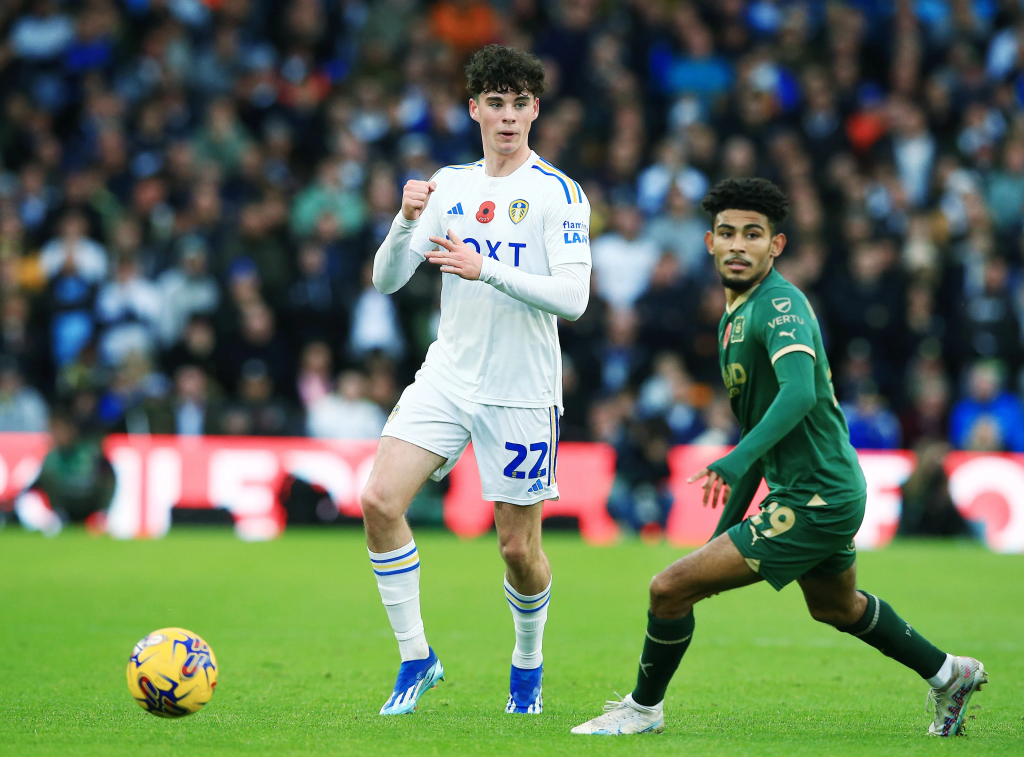
His senior debut came at the onset of the 2023/24 season, and since then, he has become a consistent name in Daniel Farke’s starting lineup, featuring in an unfamiliar role at right-back – a position he has now brilliantly made his own and an experience which will certainly aid his development and learning once he does take on a midfield role full-time at Elland Road.

Gray has represented England at every youth level and now under-21 level as of Friday 22 March 2024 but is still eligible to represent Scotland who have previously been interested in touting his services.

The Thorp Arch academy graduate featured in every game for the Young Lions at the UEFA European Under-17 Championship over the summer, as England bowed out at the quarter-finals stage. He would then go on to grab his first international goal in a 4-2 World Cup play-off win against Switzerland.

Having already stepped up to the England U19 squad, Gray made his U20 debut on 16 November 2023 during a 3–0 defeat to Italy at the Eco-Power Stadium before being fast-tracked to the under-21s and it only took him five minutes to grab his first goal in a 5-1  2025 UEFA European Under-21 Championship qualification win over Azerbaijan in Baku.

The striker made him the youngest Leeds United player to score for the England U21’s (18 years, 10 days), breaking the record of Alan Smith in October 1999 against Denmark (18 years, 345 days).

What is Gray’s style of play?

This is a footballing talent with a plethora of strings to his decorated bow and it is why he should go on to become one of the most prestigious and complete midfielders of his generation.

The likes of Liverpool haven’t been hot on his trails for no reason – this is a kid destined for great things just like his historic bloodline.

When Gray looks back on his career in future, he’ll look back on the 2023/24 Sky Bet Championship campaign as the season that provided him with the springboard he needed to flourish into becoming the complete and all-round central midfielder he was destined to be when he made the grade at Thorp Arch.

One manager he’ll greatly appreciate for his early development in Daniel Farke and the sole reason for that was the decision to deploy him regularly as a right-back rather than his customary midfield role.

In fact, the young Englishman was handed his first team debut at the start of the season playing alongside Ethan Ampadu at the heart of the Leeds United midfield against Cardiff City and Gray performed like a seasoned professional.

The teenager was assured and assertive with his passing whilst also thriving without the ball in a thrilling 2-2 draw at Elland Road.

Since then, Farke’s utilisation of Gray has not only been intriguing but incredibly meticulous, not only benefitting Leeds United’s tactical flexibility but with Gray’s development and learning very much in mind.

German tactician and Leeds United boss Daniel Farke has significantly aided Archie Gray’s development this season.

First and foremost, it was never Farke’s intention to deploy Gray as a full-back.

The Whites had three senior and capable options in the role once the campaign kicked off with veteran Luke Ayling, Djed Spence, signed on loan from Tottenham and another addition Sam Byram – who could also fill in a left-back – all quality options for Farke to choose from.

It looked as if Gray would be a regular in his usual midfield role, especially from the first ten games of the campaign:

Image provided by Transfermarkt

However, due to recurring injuries and the departures of Spence and Ayling in the January transfer window, Farke thought it’d be best to deploy Gray as part of his back-line and the 18-year-old has rarely looked out of place ever since.

Before picking out Gray’s influence and progression in the position, it’s important to pick out his most impressive and unique attributes which have made him one of the most hugely coveted teenagers in the country.

Such characteristics have elevated him to become an instant success story in what’s been a brilliant campaign under Farke’s guidance, with the Whites currently maintaining a strong push for automatic promotion back to the Premier League.

When watching Gray, you’d find that he is very well suited to the defensive midfield or #6 role – but also possesses the attributes to strut his stuff higher up the pitch.

The tools and attributes of a deep-lying playmaker revolve around controlling the game or “pulling the strings” if you’d like. This involves dictating the tempo and maintaining possession so that the team is always managing the game in their favour.

These attributes include; a high footballing IQ, confidence with the ball, a range of passes, technical dribbling and vision – all of which Gray possesses in his weaponry.

However, nowadays the role transcends beyond the understanding of just dictating the tempo of a team’s style of play, they are also expected to receive the ball well under pressure from goalkeepers or centre-backs, play with their back to where their team is shooting as well as screening their back four and protecting it.

Gray can certainly hold his own when receiving under pressure or operating amidst relenting pressure from his opponents.

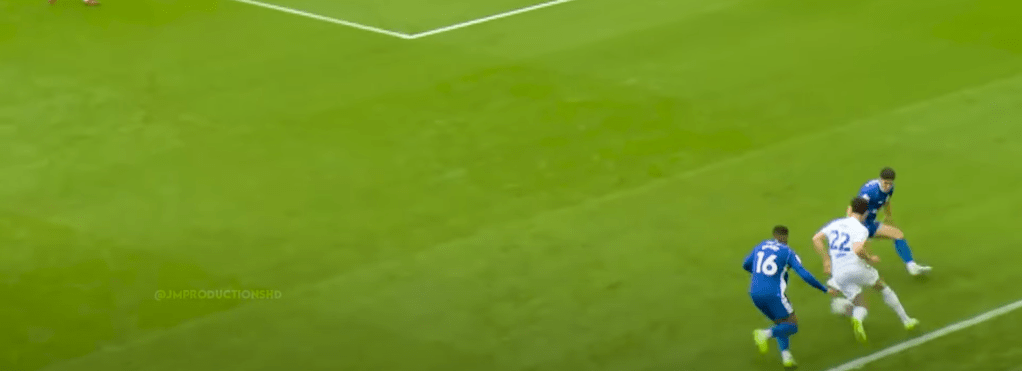
In the image below, Gray receives a pass in his own penalty area from goalkeeper Ilan Meslier, with two opposition players aiming to win the ball with a high press:

It’s important to note that Meslier doesn’t hand possession to Gray amidst the opposition press just to get rid of it. No, the French goalkeeper plays it to Gray in a pressurised area, confident in the teenager’s ability to evade it and drive Leeds up the pitch, and that he does.

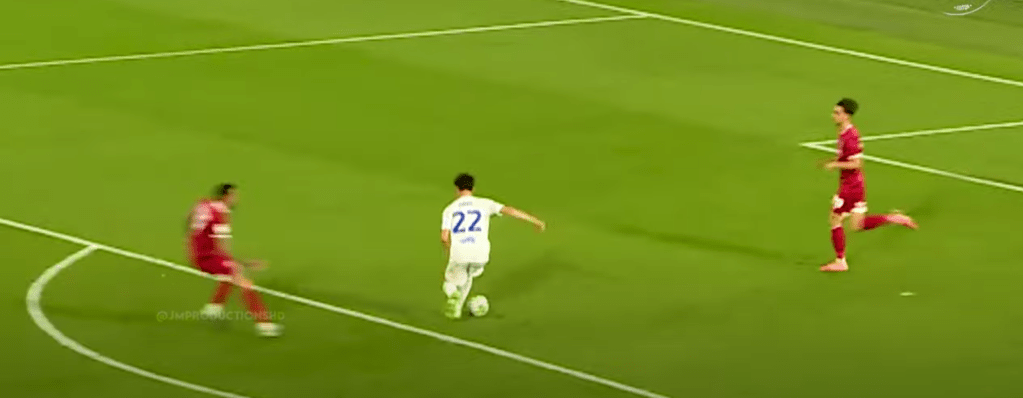
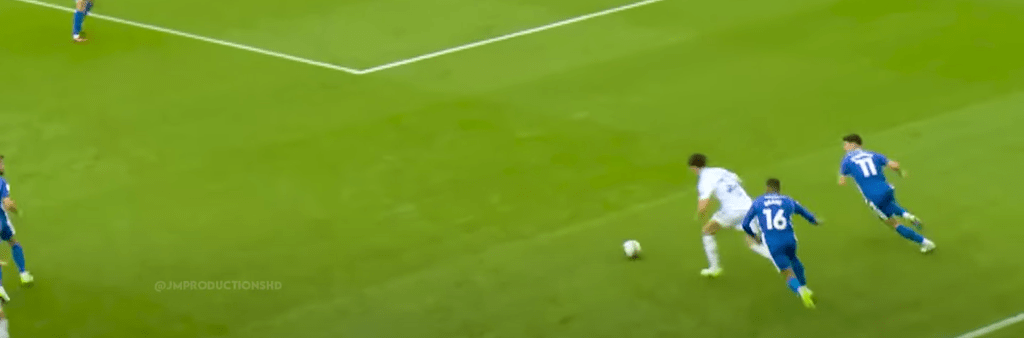
The teen sensation displays superb deceptive movement with his body to fool the player behind him, feinting one way with his right foot over the ball before forcing the ball with the outside to advance the opposite way:

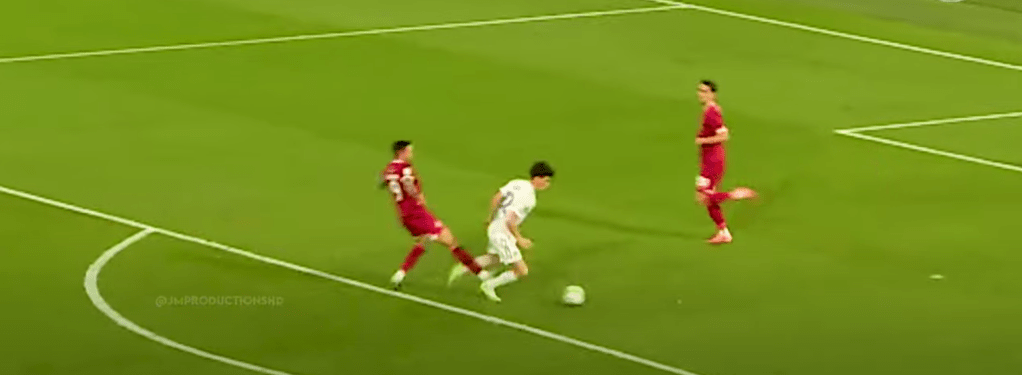
With this nimble and deceptive manipulation of his body and the ball, Gray evades the pressure and is able to progress the ball into midfield with excellent ball-carrying and close control:

Despite having a lanky frame, Gray possesses quick feet which enables him to wriggle out of tight spaces, creating room, to increase his passing options and progress play, manoeuvring his way out of pressure and advancing possession.

He performed similar actions against Premier League outfit Chelsea in their FA Cup fifth-round tie at Stamford Bridge in a 3-2 defeat on 28 February (see tweet below).

Gray superbly evaded Mykhailo Mudryk’s and Nicolas Jackson’s pressure to progress the ball up the pitch for his team, ultimately leading to the Whites’ equaliser from fellow academy graduate Mateo Joseph.

To become an elite operator in the role, all of the above characteristics must be performed to a consistent and measured level. While Gray still has some way to go before matching those elite levels, his qualities are those of a player who embodies such unique attributes.

A technically gifted central midfielder who is efficient and assured on the ball but also possesses a hunger and drive to win the ball back for his team, Gray is a special player with a very high ceiling, boasting an immense passing ability.

He’s a great ball carrier who is aggressive in physical duels and holds his own in terms of keeping his side compact out of possession, and whilst he is capable of being moulded into a #6, #8, or #10, he could even perhaps be best suited to a left-sided #8, an interior midfielder.

As stated previously, Gray possesses stunning vision to see passes before everyone else. With all the passes or through balls you’d expect from an advanced midfielder, the 18-year-old can also perform with superb efficiency.

Take his assist for Crysencio Summerville against Blackburn Rovers in Leeds United’s 2-0 win in December, in the image below:

Before the assist, Gray possessed the mind and intricate attributes to get out of a tight spot by playing a lovely one-touch pass and move with Georginio Rutter, buying him the room and the opening of a passing lane, disrupting Blackburn’s defensive line to thread a perfectly weighted pass for Summerville to finish.

While the above pass may seem easy to the untrained eye, it really isn’t. Many players of Gray’s age and profile may take an extra touch which could allow defenders to block the space, or they could perform an overweighted or under-weighted pass which Summerville can’t run onto.

For Gray, he knows the exact time to play the pass and the weight needed for Summerville to take just two touches to score.

The 18-year-old’s mental fortitude, maturity and unbelievable technique are of elite potential. The way he carries himself on the pitch even in unfavourable situations for Leeds is quite staggering. Such characteristics and mentality coupled with his level of understanding as a deep-lying midfielder have allowed him to perform expertly as a right-back.

Credit must go to Farke for identifying the role for Gray to refine and mature his game even further and it’s worked to such tremendous aplomb.

While performing in defence, Gray has been able to work on his positioning, defensive concentration, and marking but also the ability to problem-solve in possession, identifying different angles for a pass – attributes which will make him an even better midfielder once he’s deployed there permanently.

The role of a modern-day full-back has evolved massively.

Not only are they tasked with the responsibilities to defend well and guard against opposing wingers, they are now crucial and instrumental in many teams’ attacking play; providing width, final third penetration and are used as decoys in order for wingers and wide forwards to perform their best work in attacking scenarios.

Not only that, but elite coaches are now deploying their full-backs as auxiliary midfielders, taking up roles alongside a defensive midfielder when building up from the back in possession, overloading the opposition in the middle third and also providing an option in the half-spaces in the final third.

Because of Gray’s incredible technicality and understanding tactically, he can perform both responsibilities right down to a tee.

As pointed out earlier, Gray is press-resistant which means he can come inside from his right-back and consummately aid his side in progressing the ball into the final third but he’s also a tremendous outlet when Farke needs attacking width.

One of the biggest factors into why Archie’s so versatile/tactically flexible is his ability to play across all angles — while being receptive to his surroundings – it all leads to him becoming so ‘precise’ and meticulous with his actions.

The England under-21 international turns & spins so fluidly, but as addressed earlier in this piece, he’s able to manipulate and bend tight situations to his advantage through nimble footwork, close control and his rangy build.

As seen in the image above, he comes up against two Cardiff City defenders, with the aim of forcing play into the final third for Leeds United.

It seems an impossible situation and a tight spot for plenty of right-backs to escape.

NOT FOR GRAY.

Gray’s dribbling and ball-carrying are of a quality standard and it is what will make him an elite midfield component in future – the Englishman holds a dribble success rate of 54% and also ranks in the top 19 per cent of midfielders for progressive carries outside of Europe’s top five leagues, whilst also ranking in the top 24 per cent for successful take-ons.

In a progressive and possession-orientated system, Gray will be handed the conditions to thrive consistently and his development and learning have been hugely boosted by Farke’s flexible, fluid and expansive style at Elland Road.

A standout trait of Archie’s is his passing.

The Durham-born wonder possesses a top variety of passing — whether that be slick 5-yard passes round the corner, a 20 yard passes to dissect the lines and locate players in the half-spaces or even ping a 40-yard cross-field ball, he can do it…

The 18-year-old talent is ambipedal – incredibly adept at distributing the ball with both feet. As seen in the image above, for the England under-20’s, he picks out an attacking teammate in space with a delicious left-footed cross-field pass, despite his penchant for using his right.

Another part of his game that makes him so complete already despite his tender age, is his tackling. He times his tackles very well, loves to be aggressive in winning the ball back and excels in slide tackles.

Defensive midfielders with rangy, long-legged attributes, supreme athleticism and physical attributes but also with the ability to be adept and assured in possession have become a dying art in recent years but will soon be coming back into fashion once more.

Gray is yet to reach that profile and still has plenty of time to grow into one but already, the way he performs, it won’t be long before he’s in that company of unique physical midfield profiles.

Championship football certainly is aiding that progression. His rangy frame and long legs boost his ball-winning attributes, and he’s become one of the best defensive full-backs in the division. Gray ranks third in the Championship for dribblers tackled (56) and ninth for tackles won (55) (FBRef).

The English talent, however, has been susceptible to the odd lapses in his defending this season.

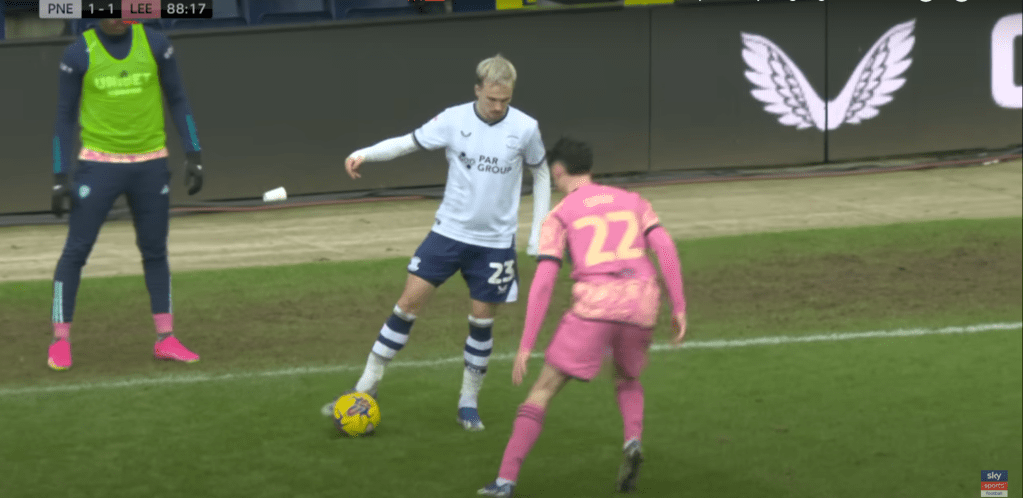
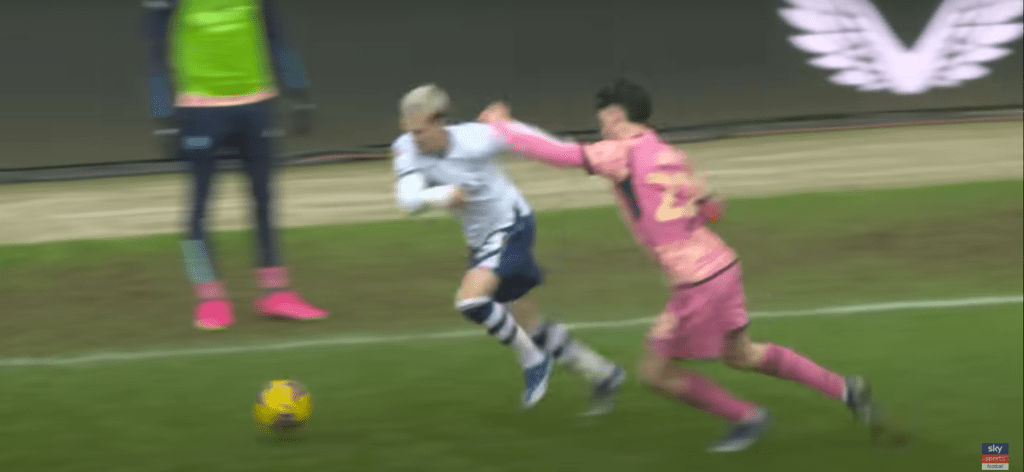
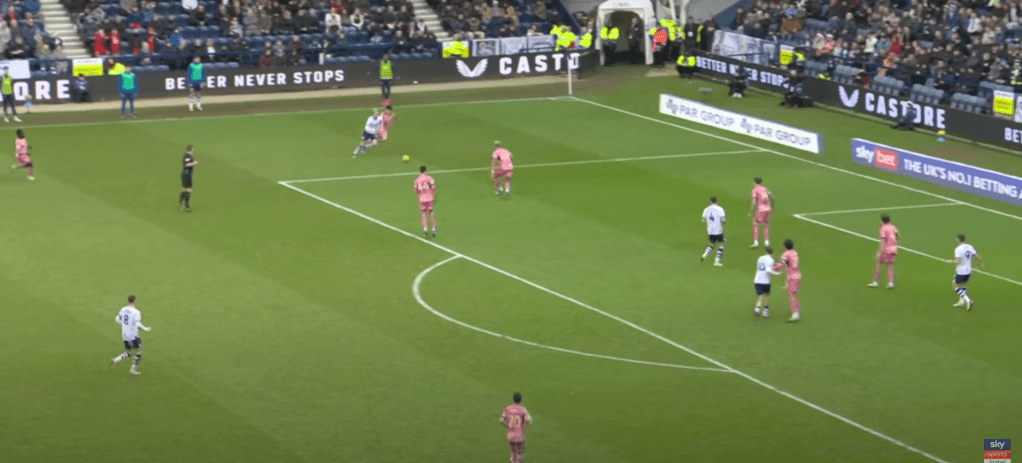
Take the game against Preston North End on Boxing Day. The Whites suffered a dramatic late 2-1 defeat at Deepdale, with Liam Millar grabbing the winner after being allowed to cut inside Gray before unleashing an unstoppable drive into the top corner.

As a full-back, you’re always taught when facing up against an inverted winger (wingers who work best when the player’s strongest foot is opposite to the side of the pitch he’s playing on), to ensure that they do not cut inside to perform a shot or a cross, but force them onto their weaker foot.

In this case, Gray’s positioning and standing frame up against Millar were all wrong.

Millar reads it and is allowed the freedom to cut inside onto his stronger right foot, which he does brilliantly but Gray allows him the room to do that when he should be using his body positioning to show him outside instead.

Because of his positioning, Millar takes advantage of the room and space to move onto his right foot and carry inside the penalty area, leaving the teenager in his wake…

It’s those small details and lapses that allowed the Preston winger to grab the winner. That was early into Gray’s reign as a right back but he has gone on to make significant improvement ever since. However, it is something he will face relentlessly as a midfield player in future – a probable weakness that could well crop up again.

Given Gray’s mental fortitude on and off the pitch, and his willingness to learn and improve, he will iron that out with minimal fuss – such is the talent England have once again at their disposal.

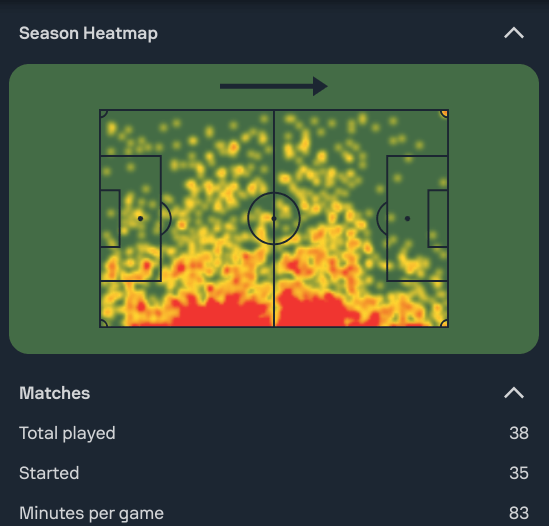
The 18-year-old is not only garnering a reputation for his technical ability and work off the ball but also his superb engine room. We’ve touched on his impressive athleticism for a player so young, but Gray is a player who can run for hours, and that is evident in his admirable versatility and assuredness in fulfilling multiple roles for Farke and Leeds United.

The stats certainly back it up in the image above (SofaScore). Gray averages a whopping 83 minutes per game and has featured in 38 of Leeds’ 40 games in the Championship so far.

Gray is one of the first names on the team sheet for Leeds United, even when he’s tasked with fulfilling duties in midfield from time to time – a true measure of his tremendous impact but unbelievable growth and maturity at just 18.

What does the future hold for Archie Gray?

There’s no doubt Archie will go on to fulfil his enormous potential but that may not be at Elland Road like his aforementioned bloodline, with plenty of the elite clubs around Europe already keeping watch over his stunning progression.

According to HITC journalist Graeme Bailey (2 April), both Real Madrid and Bayern Munich are currently scouting the Durham-born teenager. Not to mention, he’s already being watched – according to previous reports – by Liverpool and Newcastle United.

Whether those interests lead to a formal approach once the season comes to a close remains another matter, because should the Whites go on to claim their return to the top-flight next season – currently fighting both Ipswich Town and Leicester City for the Championship title – Gray will surely still be a Leeds United player.

It’s why the West Yorkshire outfit are hell-bent on fulfilling their ambitions, so they don’t lose their star players such as Gray, Crysencio Summerville, Wilfried Gnonto and Georginio Rutter.

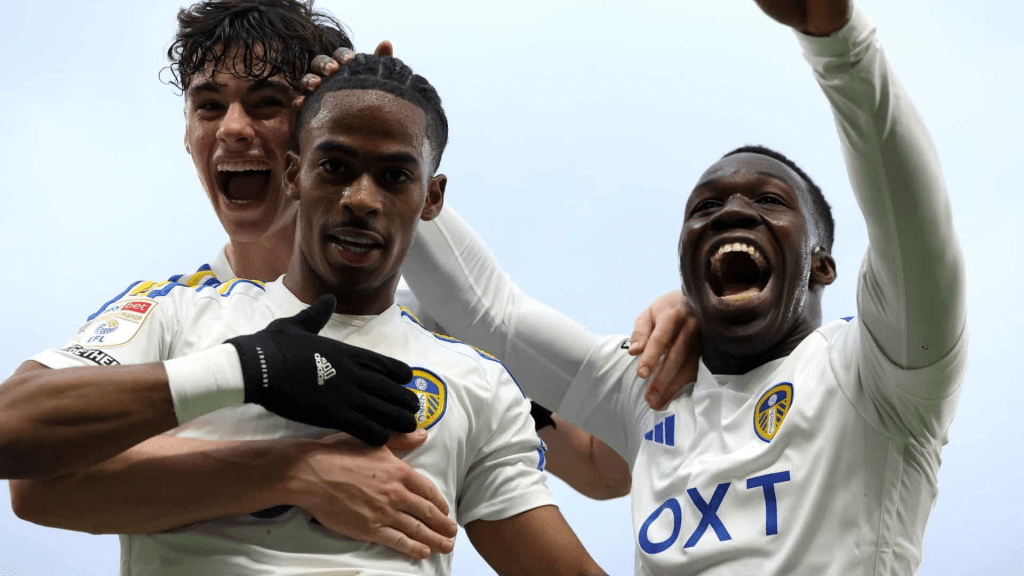
Three of Leeds United’s most prized assets: Archie Gray, Crysencio Summerville and Willy Gnonto.

Premier League status means they won’t be under pressure to lose them, can claim hefty fees as well as those players being convinced that another season developing in the top-flight would be beneficial.

For Gray though, another season or two at Elland Road would do him the world of good. An opportunity to further refine his craft playing regular football rather than a development benchwarmer at a big club should be at the top of his future agenda.

The big clubs will always be there for him to choose from. For now, development is the name of the game for the 18-year-old sensation because the way things are looking right now, he could well become the best of his historic family line.

10 Talents to Watch in the UEFA Champions League Knockouts 2022

10 Talents to Watch in the UEFA Champions League Knockouts 2022

The UEFA Champions League is back on screens this week.

How we’ve missed that awe-inspiring, harmonious and breathtaking Handel-inspired Champions League anthem on our speakers, but we’re so glad its back as we look forward to another year of juicy European ties.

It might have taken two attempts to complete the draw in December but the round of 16 has certainly pulled out some exciting fixtures, with some of Europe’s heavyweights and a few of the most decorated up and coming clubs on the continent go head-to-head.

Other than the usual suspects like Lionel Messi, Mohamed Salah, Kylian Mbappe, Karim Benzema and Robert Lewandowski, who are some of under-the-radar players to look out for?

#AnthonyScouts picks out nine exciting footballers enjoying stellar campaigns, who could make their name on the grandest European stage…

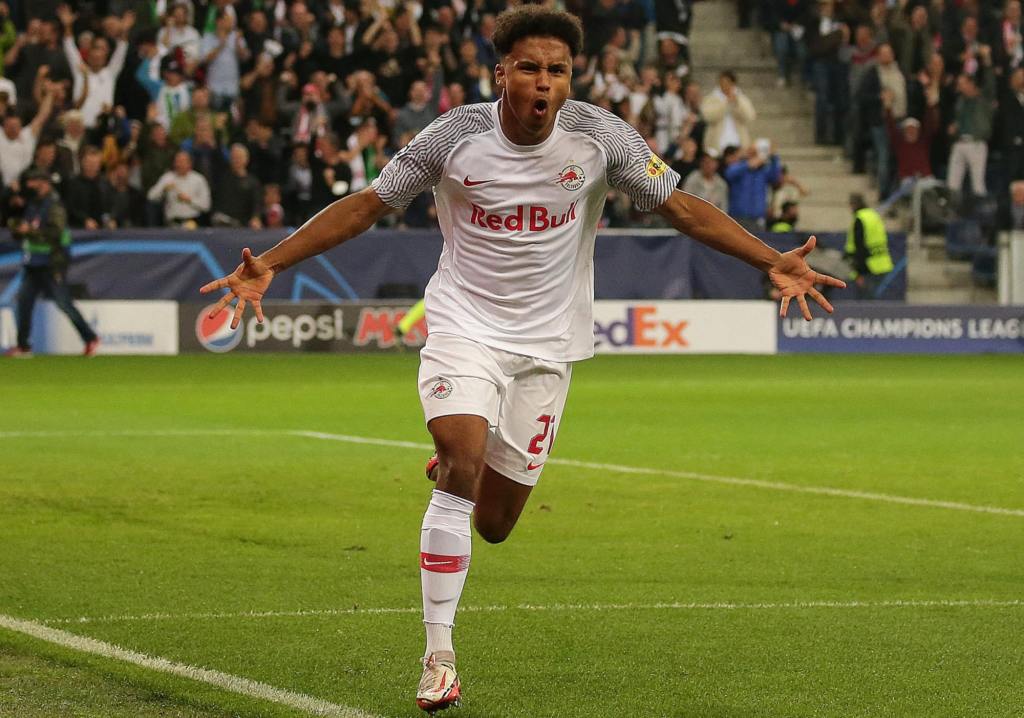
Karim Adeyemi, Red Bull Salzburg

This will be RB Salzburg’s first-ever Champions League knockout tie after negotiating a tricky and exciting group containing Wolfsburg, Sevilla, and Lille.

The Austrians possess a decorated history in bringing through bright, young talent, including Takumi Minamino, Patson Daka, Dominik Szoboszlai, Naby Keita, Sadio Mane and Erling Haaland in recent years. 

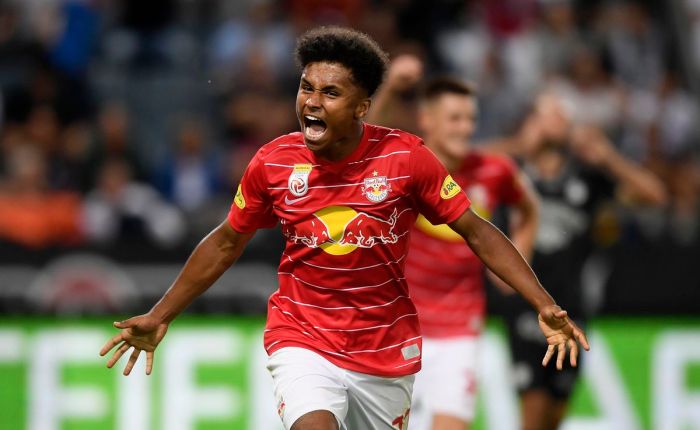
Though, the current jewel in their crown and arguably Europe’s most exciting young striker is 20-year-old Karim Adeyemi, who has lit up the Austrian Bundesliga so far this season and looks well equipped to become one of Europe’s biggest stars.

Adeyemi is reportedly on the radar of a number of clubs on the continent including Barcelona, Liverpool and Borussia Dortmund, and he could well be on his way the latter with the German giants reportedly close to securing Adeyemi’s signature for next season.

The Germany international has consummately sharpened his attacking output with an incredible 14 league goals in 18 games for RB Salzburg in 2021-22, eclipsing his return of eight goals and seven assists in his first full season last year. In eight UEFA Champions League games this season, including the early qualifying rounds, Adeyemi has notched 4 goals.

Besides possessing a unique eye for goal, Adeyemi is a stunning player to watch, a flawless young forward, blessed with such searing pace and acceleration, incredible close control and amazing trickery making him an absolute nightmare for opposition defenders. He regularly looks to pull wide and attack the penalty area with his low centre of gravity to make space for a shot.

Two of his three goals in the Champions League have come from the penalty spot and Adeyemi will be eager to add to his tally in Europe. Salzburg have been handed a very tough draw against Bayern Munich but Adeyemi’s incentive to impress on the grandest stage will be heightened by the fact he was released from Bayern’s academy at the age of 10. They are also one of the clubs that have been most heavily linked with a move for him in the summer.

This could well set up to be one of the most captivating headlines of the campaign.

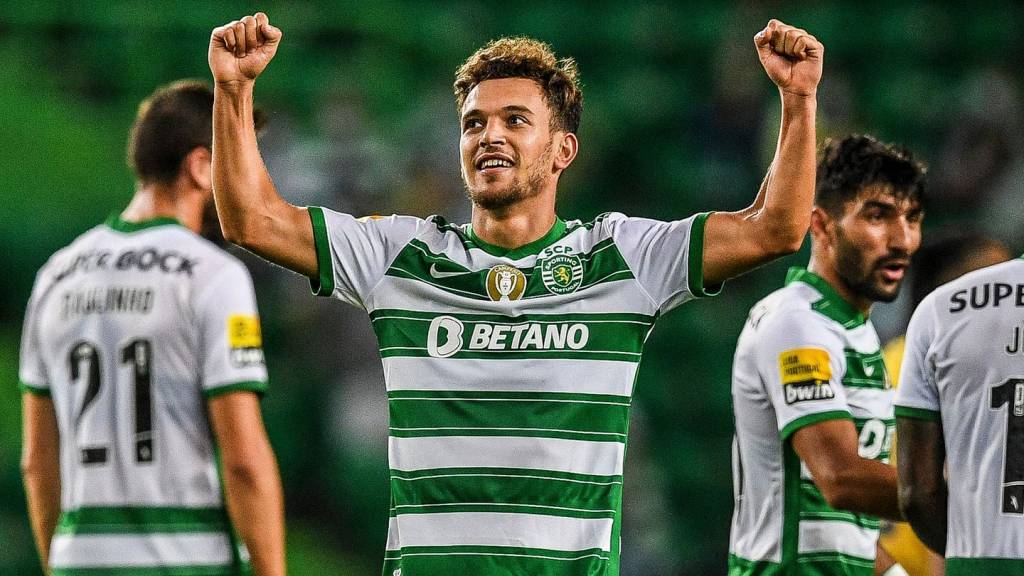
Pedro Gonçalves, Sporting Lisbon

One of Portugal’s hottest prospects and a player certainly on a mission to force his name in the European headlines is Sporting Lisbon’s incredibly gifted forward, Pedro Gonçalves.

The former heir to Manchester United midfielder Bruno Fernandes’ throne at the José Alvalade Stadium, has, incredibly, proven even more prolific for the Portuguese champions than the Manchester United ace.

Gonçalves was an integral figure in helping Sporting win their first Primeira Liga title for 19 years last season, finishing as the league’s top goalscorer with 23 goals from a scarcely believable xG total of 11.6. 

Fernandes had a stupendous season in 2018-19 for Sporting, scoring 20 league goals, but Pedro Goncalves outdid him last season.

In doing so, he became the Primeira Liga’s first Portuguese top scorer since Domingos back in 1996.

This goalscoring feat is made all the more impressive given the 23-year-old’s position. Sporting operate in a 3-4-2-1 formation with Goncalves as a hybrid attacking midfielder/forward between the lines — often drifting to the right-hand side. His ability to locate spaces in between the lines and in the half-space is incredible and highlights his wealth of tactical knowledge and super versatility.

His finishing isn’t too bad either, as his phenomenal stats show.

Naturally right-footed, Gonçalves is capable of clinical strikes with his left foot as well, and his great form has continued into this season.

Pedro Gonçalves, nicknamed “Pote” has netted six times in the league so far and added two braces versus Besiktas and Borussia Dortmund in the Champions League as Sporting survived defeats in their opening fixtures to qualify for the last 16. He’s also recorded five assists in the league highlighting his wonderful gifts in not only scoring goals, but creating them too.

Gonçalves was previously on the books at Wolverhampton Wanderers, and his impressive performances in the Champions League will no doubt have caught the eye of more Premier League sides with a view to bringing him back to England in the very near future. 

It could be the perfect audition, given that Sporting play Manchester City in what could potentially be a tasty tie in the round of 16. Pep Guardiola’s men are likely to be strong favourites, but Pote could make life difficult — and maybe make Pep take notice too.

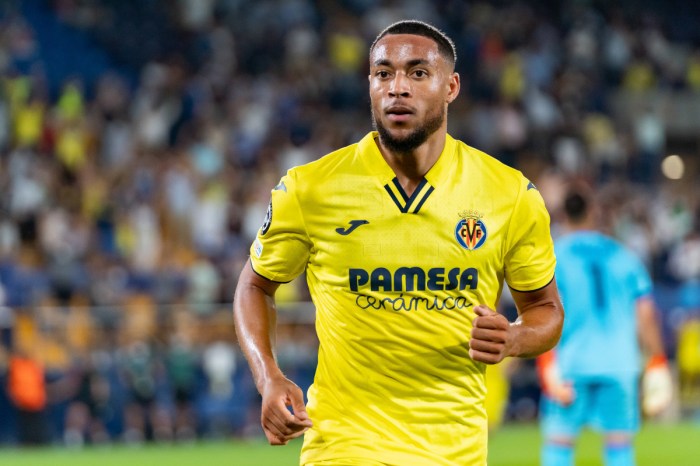
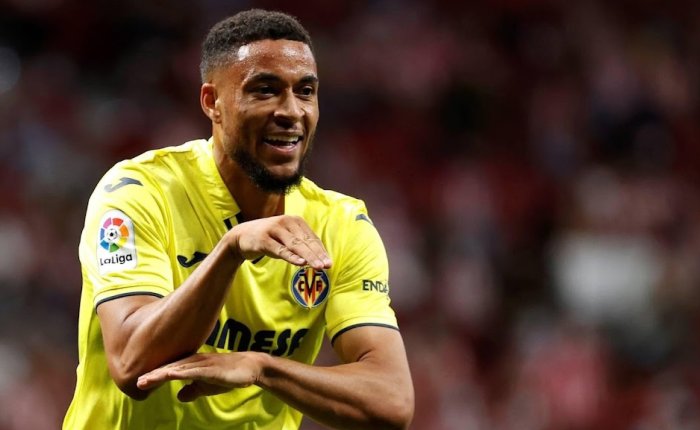
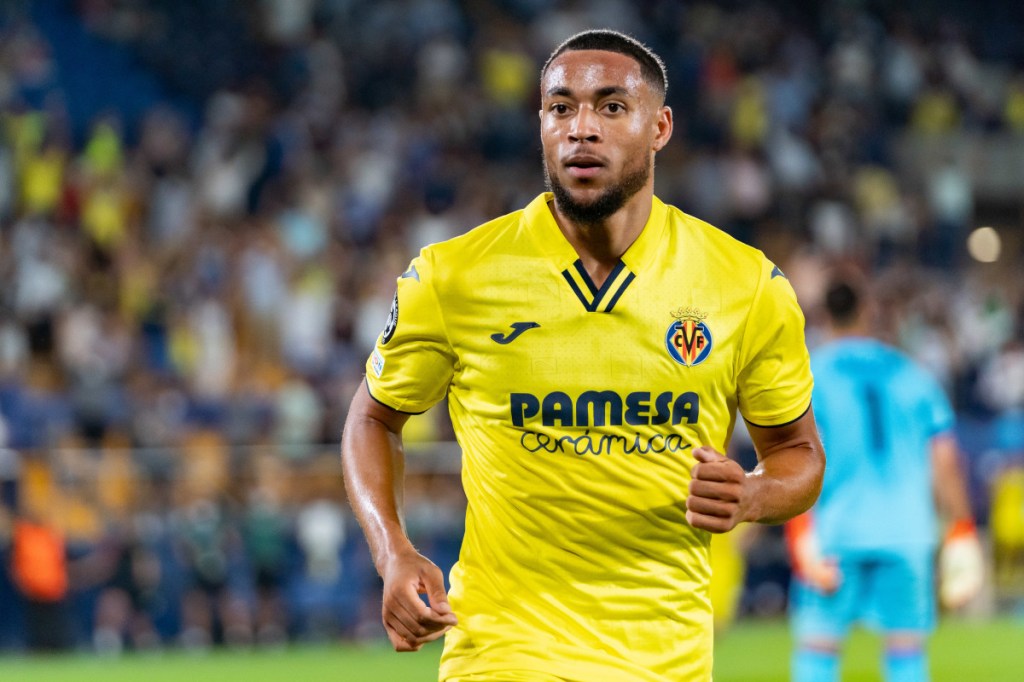
Arnaut Danjuma, Villarreal

When Arnaut Danjuma joined Villarreal from AFC Bournemouth last summer for €25m, little did we know he’d make such a telling impact in Unai Emery’s progressive side so soon.

A few months into his Spanish top-flight career and the recently-made Netherlands international has become one of La Liga’s blossoming individuals so far this season.

After hitting 17 goals and 7 assists in the Sky Bet Championship last season, the former Club Brugge forward was always destined for bigger and better things but many thought he’d make that step up in the Barclays Premier League rather than beyond borders.

With several clubs interested in his services last summer, it was Villarreal who took a punt on his flawless abilities, and its safe to say the 24-year-old hasn’t looked back.

20 appearances, 9 goals (5 in La Liga, 4 in the Champions League), and 3 assists, Danjuma has certainly showed he is good enough and ready to cut it amongst the most elite footballers in Europe. The slippery Dutchman has gone from the Championship to the Champions League without batting an eyelid at the transition.

Danjuma’s trajectory over the past year has been nothing short of sensational, and already he is showing his talents on the most prestigious of footballing stages in the UEFA Champions League.

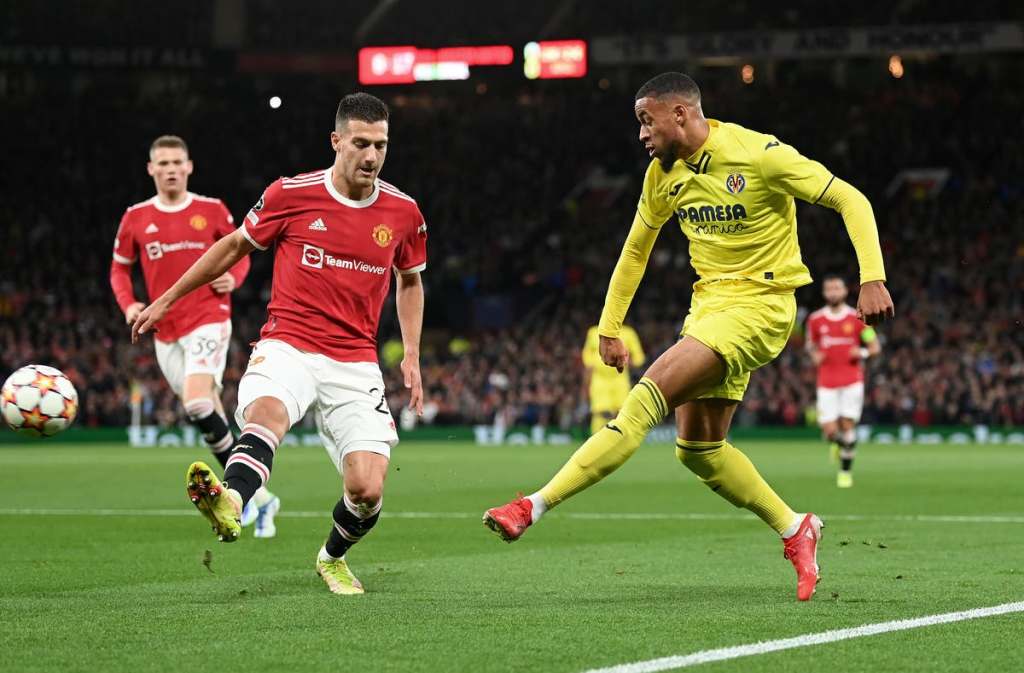
If you need any pieces of evidence as to how good he is, not only that, but how invaluable he’s become to Unai Emery’s side in short space of time, check out his performance against Manchester United at Old Trafford in the group stages.

It was simply jaw-dropping, giving full-back Diogo Dalot a torrid evening.

Danjuma may have been one of La Liga’s most expensive transfers this summer, but is currently proving he’s worth every penny spent. The Europa League winners were looking for a player who could help them jump forward to the next level tactically and in attack and Danjuma is keeping his part of the bargain.

Unai Emery’s men are clearly more efficient, potent and exciting on the attack and much of that is down to Danjuma’s unpredictable nature on the left-flank.

Villarreal have a tough fixture against Juventus in the knockout stages, and they will need Danjuma firing on all cylinders after his return from injury to have any chance of causing yet another Emery-European-upset.

Jonathan David, LOSC Lille

Since his move to Lille from Belgium outfit Gent in the summer of 2020, Canadian Jonathan David has come on leaps and bounds, although he did endure a difficult start – going on a run of seven games without a goal.

However, in the second half of last season, his form picked up.

Eleven of his 13 league goals in 2020-21 came after the turn of the year, as Lille done the unthinkable, finishing the campaign as French Ligue 1 champions.

This season, Lille have struggled to maintain their form as they currently sit in mid-table in Ligue 1. However, Jonathan David has continued his tremendous development. He is Ligue 1’s second top scorer with 12 goals from 19 appearances, just two goals behind AS Monaco’s Wissam Ben Yedder.

In a league including Kylian Mbappe, Neymar and Lionel Messi, that is a superb feat.

An extraordinary unique forward, blessed with great pace, skill, tenaciousness, trickery and acceleration. The Canadian is tremendously versatile too, capable of playing anywhere in attack; as a no.9, right-winger, left-winger, and a no.10. If fast and speedy players are your type, then Jonathan David is your man.

A player whose game is based on an exciting blend of technique, mental sharpness and tremendous physical attributes.

The Canadian has excelled in his work-rate and off-the-ball attributes. So far this campaign, he is recording 5.39 successful pressures per 90minutes. He is in the top 10 percent of forwards in Europe’s top five leagues when it comes to pressures off the ball owing to his tremendous energy, enthusiasm and work rate. David has traded off some of that defensive work, and remodeled himself as a poacher in front of goal. A record of 0.48 non-penalty goals per 90 is brilliant and is simply going to get better.

David’s scoring form in Ligue 1 over the past two seasons, and for Canada where he’s been the top CONCACAF scorer in World Cup Qualifying, suggests he could score more goals for any of Europe’s top clubs, and with his name reportedly in the headlines for a number of top European outfits this summer, he could well be on the move.

First he’d have to help Lille navigate through a tough fixture against last season’s European champions Chelsea, and there is no doubt that the young Canadian forward will be central to any potential upset.

Jurrien Timber, Ajax

Ajax’s youth academy has been providing Europe’s biggest clubs with elite talent for decades now and with the likes of Jurrien Timber emerging the trend is not slowing.

There’s been no change in the Ajax philosophy ever since: they invest tremendously in youth, making sure that the players receive the best physical and mental development, and even more importantly, that they are granted the earliest possible trust at the highest level.

Timber is the latest of those entrusted with significant responsibility in the first team, and is thriving as a result.

The youngster earned Erik ten Hag’s trust with his composure and vision as he reads the game well and fits Ajax’s strategy perfectly. His displays granted him a regular starting spot which he hasn’t taken for granted and has used to prove his qualities while becoming one of the team’s key players.

While they have always been successful in attack, this term their defensive performance has been exceptional. At the time of writing, Ajax have only conceded FIVE league goals in 22 games, which is a remarkable record and underlines the importance of their defensive players.

Ten Hag’s side also made history in the Champions League by winning all their games in the group stage, outplaying Sporting CP, Borussia Dortmund and Beşiktas.

Ajax are currently the best performing team in Eredivisie, displaying high awareness, composure and consistency. The team’s well-measured actions and anticipation skills result in a high success rate in almost every aspect. 

The Ajax players are proficient in winning their challenges clearly, despite actually having the highest challenge intensity (duels, tackles and interceptions per minute of opponent possession) in the league. They are first in the league in terms of successful actions with 66.9% of won defensive duels on average.

Despite the lack of experience, Jurrien Timber has successfully contributed to Ajax’s unbreachable defence possessing impressive composure in defence which puts him ahead despite his lack of physicality and height. His technique and confidence on the ball allow him to dive into challenges and escape pressure through dribbling which helps the team in retaining possession.

His composure results in winning 76.2% of his defensive duels, which is a better percentile compared to his centre-back partner, Lisandro Martínez (73.5%).

What makes him successful defensively, though, is his positional sense. Timber’s ability to read the game helps him in anticipating the oppositions’ movement and move into spaces so he can pressurise his opponents and block their attacking efforts. He contributes with 13.35 recoveries per game and roughly four of them are in the opposition half.

This underlines his strong positioning and anticipation skills, although it also indicates the whole team strategy, which has the defensive line positioned high in possession.

The key qualities that have led to his valuable contribution are his concentration and work ethic. The 20-year-old is constantly aware of his surroundings and it is difficult to catch him out of position and unprepared. If their opponents Benfica are to triumph in this tie, they will have to do incredibly well to bypass Jurrien Timber and his resilient defensive counterparts.

Ridle Baku, Wolfsburg

Ridle Baku has enjoyed a seismic rise over the past 18 months, swapping relegation-threatened Mainz 05 for Champions League football at the Volkswagen Arena. 

At an age where many of his peers are just beginning to take their first steps in the Bundesliga, Baku has already started over 100 topflight Bundesliga matches, won a U21 European Championship, and narrowly missed out on Germany’s Euro 2020 squad.

With summer interest from PSG & Bayern, and Tottenham Hotspur it won’t be long before Baku is tearing up the pitch for Hansi Flick’s national team and competing for silverware at one of Europe’s elite outfits.

The right-sided midfielder, come right-back is an incredibly astute, tactically aware and all-round footballer.

The young right-back was an influential piece in the Germany U21 side that won the European Championship in June and as a result, is already attracting significant interest from clubs around Europe. Baku was named Player of the Match in the U21 final against Portugal and even concluded the tournament with the highest assists (3).

In the 38 appearances Baku made for German side Wolfsburg last term, he recorded an impressive 16 goal involvements, recording 6 goals and 6 assists in the German Bundesliga.

This season, he has continued his fine contribution to Wolfsburg’s goal threat, with two goals and two assist whilst also scoring in the Champions League group stages against RB Salzburg in November.

The 1.76m-tall defender, who can even be deployed as a midfielder, lead the ranking for the Bundesliga with 1,061 sprints last season. This season’s tally may have decreased, but he’s still within the top 10 sprinters in the division with 598 sprints. Few players covered a greater distance last season than him. He was the 10th-best runner with 351 km run on the field.

The 23-year old is always more than willing to make lung-busting runs forward as well as make the hard yards back to rescue a situation defensively.

Baku is highly versatile too having already played in all possible positions on the right-flank for the team. He’d prove a valuable asset for any top outfit in Europe owing to his incredible versatility but also providing his side with the opportunity to be tactically flexible. Wherever he is deployed, Ridle Baku will give his utmost.

With quick changes of direction, a glue-like control, and fluid movement, Ridle Baku is able to wriggle free from any lunging challenges and create the attacking impulses which have made him such a resounding success at the Volkswagen Arena.

The 23-year-old has brought lofty comparisons to Germany and Bayern Munich icon Philipp Lahm, showing what a generational talent Wolfsburg have on their books.

Though Ridle Baku has a long way to go before winning 113 national team caps, and 17 major titles, the intelligence in his positional play is right in line with FC Bayern’s former captain. Whereas Lahm made the switch from rightback to defensive midfield in the latter stages of his career, Baku has undergone the opposite transition, playing primarily as a midfielder for Mainz before operating almost exclusively on the right flank at Wolfsburg.

Just as Lahm was adept at moving inside from right-back or dropping into the wide channels from a midfield role, Baku’s ability to drift into the half-spaces have made him an absolute nightmare for opposition fullbacks. The Under-21 European Championship were perhaps the best example of this. Baku, operating primarily at right midfield in a classic 4-2-3-1, was electric from start to finish, ending the competition with the most goal contributions as Germany lifted the title with a 1-0 victory over Portugal.

Baku completed the 5th most crosses of any Bundesliga fullback last season, routinely searching for the head of new Burnley striker Wout Weghorst or providing a driven ball into the run of an advancing midfielder. Whilst he may not be as prolific as either Borna Sosa of Stuttgart or Filip Kostić of Frankfurt, the variety of ways Baku can hurt an opposition defense makes up for his somewhat inconsistent crossing.

Ridle Baku may have only registered 2 assists from the wide right channel this season, but when afforded time and space he is more than capable of finding his target.

Nuno Mendes, Paris Saint-Germain

Nuno Mendes has been getting rave reviews since making the move from Lisbon to Paris last summer as PSG’s new left-back.

At just 19 years old, Mendes has adapted well from a wing-back role in a 4-3-2-1 at Sporting Lisbon to a full-back role within PSG’s 4-3-3, but his skill set remains unchanged.

The Portugal international has made 15 appearances for Mauricio Pochettino’s side in Ligue 1 this season, alongside his six appearances in the UEFA Champions League. Touted as one of the finest talents of his position on the continent, Nuno Mendes is certainly on his way to world-wide stardom.

Last season at Sporting, Mendes cemented his status as the finest left-back in Portugal thanks to a deadly combination of speed, explosive movement, and close control which allows him to create danger either from a standing start or whilst on the counter-attack.

Apart from his dribbling, Mendes boasts an excellent crossing ability whether tightly marked or open in space, and his physical prowess allows him to beat out opponents to the ball either with his speed or strength.

Despite boasting such incredible speed and strength through his lambasting runs, he’s only successfully completed 0.88 dribbles per90 so far this season, but that will only increase with more playing time and development. However, he is relatively still creative with his contributions in attack, averaging 0.98 key passes, and 3.43 final third passes per90 whilst also possessing 2.64 shot-creating actions per90. He’s al an adept defender, boasting a SmarterScout defending intensity rating of 95 out of 99.

Given his speed and imposing size, he is able to recover well whenever he might be slightly out of position, frequently nicking the ball away from the opponent and often blocking crosses into the box. He averages a very good 4.12 tackles + interceptions reading per 90 minutes. For ball recoveries and interceptions, he is rated by SmarterScout 97 out of 99.

His 3.3 dribbles attempted per 90 put him in the top 10 per cent for full-backs in Ligue 1 this season, and he can be crucial in opening up space for his team-mates to exploit.

Mendes is still in the category of a raw and unpolished talent but he has all the materials and skills required to be one of the leading left-backs in world football. The pace of Mendes and Kylian Mbappe down PSG’s left-hand side is enough to give any opponent nightmares, even their knockout opponents Real Madrid. Be prepared for an enthralling tie.

Vinicius Jr, Real Madrid

It’s completely safe to say, Vinicius Jr is enjoying his best season in a Real Madrid shirt.

His 12 league goals are bettered only by team-mate Karim Benzema, with the pair contributing to a high proportion of his team’s attacking output this season as Los Blancos lead the way in La Liga, by four points.

Vinicius’ turnaround and maturity in his decision-making and all-round game over the past year or so has been nothing short of phenomenal. In 2020/21, he underperformed xG by a remarkable 3.82. For context, that’s twice as bad as anyone else in the Real Madrid squad. In 2021/22, he’s overperforming by 3.1 xG, a figure more than twice as good as anyone else, excluding Karim Benzema.

Benzema-dependencia, as the Spanish media like to call Real Madrid’s reliance on Karim Benzema for goals, well that phrase has been thrown out the window as a result of Vinicius Jr’s sudden purple patch. Now, Karim Benzema who didn’t approve of the Brazilian over a year ago, simply cannot perform without him.

While its a testament and credit to the 21-year-old, the credit must also be given to Carlo Ancelotti who has totally unleashed the Brazilian with undying belief and faith in his abilities.

He is a double threat from the left wing, scoring goals as well as creating them (8 assists so far this campaign) — largely owing to his direct play when the ball is at his feet. No player in La Liga can top his rate of 7.3 attempted dribbles per 90 this season, and goes to show how often he looks to commit defenders which can open up space for others, such as Benzema.

In this season’s Champions League, Vinicius’s 18 chances created in open play is more than any other player in the competition, as he frequently drives into dangerous areas to pull a pass back for an oncoming team-mate.

Vinicius is no longer that naïve, overconfident and inexperienced raw talent that arrived through the Real Madrid doors in 2018. He’s now more an assured, mature and decorated performer, still possessing bags of potential to become even greater and that spells such great news for Real Madrid, a healthy return on their risky investment.

Vinicius has shown this season whatever the situation, he can and will create – whether it be scoring or assisting, he is quickly becoming a central protagonist within Carlo Ancelotti’s side.

Real Madrid’s upcoming blockbuster clash with PSG is arguably the pick of the last-16 matches. Having won the competition in three successive seasons from 2016-2018, Real have gone out of the Champions League at this stage twice in the last three seasons.

If they are to correct that slide, they will need Vinicius Jr at his flawless best as he’ll be coming up against the likes of Kylian Mbappe, Neymar, Di Maria and Messi. Pick your poison.

Antony, Ajax

Already an Olympic gold medalist, Antony has enjoyed a spectacularly successful rookie season at Ajax. The Brazilian right-winger is known for his rapid dribbling, amazing ball-trickery as well as his unique eye for goal.

The fact that Ajax have two talents on this list once again highlights their incredibly bright youthful roster, and a potential prediction that they could yet again take the UEFA Champions League by storm like they did in the 2018/19 campaign.

Whilst Sebastien Haller has been the pick of a talented bunch, Brazilian wing-wizard has arguably stolen the spotlight through his showstopping performances for Ajax in this year’s Champions League.

The 21-year-old has recorded 2 goals and 5 assists in 5 games, possessing a phenomenal xA average of 2.0 placing him the top 6 of players throughout the competition. The Brazilian also ranks first in the Champions League for goal-creating actions (9) and goal-creating actions per90 (2.06). He also ranks sixth for progressive carries (52).

The Brazilian is an inventive and intelligent player. With nine goals and eight assists in his first 1,200 Eredivisie minutes, there is unlikely to be a better rookie in the Dutch top-flight this season. Antony has taken to life excellently at Ajax, and has his gifted and mastery left foot to thank.

Much of the time, Antony enjoys hanging wide on the right so he can gain momentum after picking up the ball by driving inwards. His acceleration from a standing start is explosive; his elite balance and lower body strength allows him to remain on his feet even under heavy pressure – he is a worker with great endeavour, the type of player to clean up his own mess.

In Brazil, Antony relied more on ingenuity to create his moments, and there is still an element of that to his game. Now though, after just a matter of nearly a couple years in Europe, he plays with a calculating maturity and sensibility, while retaining that endearing unpredictable streak.

As with most Ajax players under the age of 25, the Johan Cruijff Arena will not be the last stop on the Antony Express. Slotting into elite European competition without skipping a beat is a sure-fire way of alerting Europe’s financially well-endowed sporting directors.

Who knows, some more scintilating performances in the knockout rounds will certainly push him closer to one of Europe’s elite clubs, probably this coming summer. The continent is certainly Antony’s oyster.

Alessandro Bastoni, Inter Milan

Italy is without doubt the home of defending. The list of renowned defenders from Bel Paese is endless. Paolo Maldini, Franco Baresi, Gaetano Scirea, Fabio Cannavaro and Alessandro Nesta are just some of the legendary names that have represented Gli Azzurri. 

As a new generation approaches for Italian football, their next great defender seems to already be turning heads across the continent.

Alessandro Bastoni was born in the small town of Casalmaggiore, Lombardy. At the age of seven, he joined Atalanta’s renowned youth sides. The young defender made waves at the Bergamo club, eventually earning himself a €31million move to one of Italy’s biggest clubs; Inter Milan.

After spending spells on loan to both Atalanta & Parma, Bastoni has now finally secured his place in the starting XI for the Nerazzurri. Currently touted as one of best defensive talents of this generation, Bastoni has immersed himself as one of Inter Milan’s most prominent figures for Antonio Conte in the title winning side last season, and for current manager Simone Inzaghi.

Bastoni’s defensive statistics aren’t spectacular, but they are exactly what you’d expect and want from a CB at a top club. He ranked 6th overall amongst Serie A defenders when defending vs. the dribble.

This season, he continues to impress within a well-rounded, cohesive and organised system in Simone Inzaghi’s 3-5-2 shape, a continuation of Conte’s title-winning formula last season. Batoni averages 3.10 tackles + interceptions per90, an improvement from last season (2.49), 2.93 clearances per90, 1.30 blocks per90 and wins an outstanding 67.8% of his aerial duels owing to relatively tall, lean and imposing frame.

Alessandro Bastoni’s defensive ability is incredible for his age. Inter Milan have kept the 2nd most clean sheets (10) and have conceded the second least goals (20) in Serie A this season. Bastoni has been a key part of that defence, playing in 21 of their 25 of league games.

One of the areas that the Italian thrives is on the ball. Bastoni has long been regarded as one of the best ball-playing centre-backs in the division. He completes 4.62 passes into the final third per 90 – amongst the best for defenders in the league. He is not only progressive on the ball, he’s very secure with it too. He has completed 93.6% of passes this season so far. Bastoni is not someone who shies away from the ball either, averaging the third most touches of Inter’s starting XI per 90 (79.7).

The Italian is clearly an incredible young defender, anybody who has watched Inter Milan this season will know this. With a tough fixture against Liverpool to come, Inter will need their stunning young centre-back in his best form if they are to stop the likes of Diogo Jota, Mo Salah and Sadio Mane from wrecking havoc.

Vinicius Jr the Young Star Real Madrid Can Now Rely On

Vinicius Jr the Young Star Real Madrid Can Now Rely On

It was exactly over a year ago – at half-time in Real Madrid’s UEFA Champions League group-stage tie against German outfit Borussia Mochengladbach – that Karim Benzema complained to teammate and French counterpart Ferland Mendy and instructed him not to pass to Brazilian Vinicius Jr as a result of the youngster’s greed and immaturity in the final third.

As ruthless and as rude as it was for Benzema to behave in such a way, the incident reflected the difficulties and struggles Vinicius Jr endured at this period in his Real Madrid career.

Certainly, he’s young, showing levels of immaturity at such a level, over-exuberant at times but it was expected especially in the context of where he came from, the branch offices of Flamengo, in the neighborhood of Mutuá, in São Gonçalo.

An area where he was taught to showboat, to express himself and to become the best trickster no matter if it came at the cost of his own team.

When Vinícius Júnior joined Real Madrid, he had it all. Well, almost. His all-round game was exciting. Dribbling second to none. Pace better than any of his opponents. Skill-set unmatched. No-one could keep up with him.

That’s who we was, a flamboyant footballer who always tried the audacious tricks, shots and pieces of skill not knowing how it could affect his teammates around him, and you’d be sure a player as experienced and decorated as Benzema is, he’d understand the nature of such a footballer seeing as he grew up in similar circumstances in France.

But when you’re as celebrated and successful as Benzema is, you expect the players around you to be hold similar mindsets and a winning mentality and it was evidently clear Vinicius Jr didn’t, which was no fault of his own.

It’s as if every time the Brazilian got to the final third, he’d slip up, either by shooting wayward when a pass to a fellow teammate would have sufficed or his over-exuberance getting the better of him attempting one or two tricks too many.
It was a recurring theme in Vinicius’ game, proving a tough cycle for him to grow out of.

But, things are much different now, fast forward a year and a month or so, you’d be delighted at the growth and maturity that the former Flamengo wing-wizard is currently performing at.

Under new coach Carlo Ancelotti, the change in his game has been magnificent, spellbinding, fearless, you name it. Vinicius Jr is a different animal and Karim Benzema now cannot get enough of him.

With ten goals and five assists in 17 appearances in all competitions, Vinicius has already surpassed his best goals and assists tally in just 17 games, only a third of the number of appearances he made in the 2020/21 season with Zinedine Zidane.

(Photo by Quality Sport Images/Getty Images)

In truth, the turnaround and maturity in his decision-making and all-round game has been nothing short of phenomenal. In 2020/21, he underperformed xG by a remarkable 3.82. For context, that’s twice as bad as anyone else in the Real Madrid squad. In 2021/22, he’s overperforming by 2.04 xG, a figure more than twice as good as anyone else, excluding Karim Benzema.

Benzema-dependencia, as the Spanish media like to call Real Madrid’s reliance on Karim Benzema for goals, well that phrase has been thrown out the window as a result of Vinicius Jr’s sudden purple patch. Now, Karim Benzema who didn’t approve of the Brazilian over a year ago, simply cannot perform without him.

While its a testament and credit to the 21-year-old, the credit must also be given to Carlo Ancelotti who has totally unleashed the Brazilian with undying belief and faith in his abilities.

This is what the Real Madrid faithful had been waiting for all along, even more so, president Florentino Perez who initially desired Neymar to fulfil his galactico-type gratification but instead had to make do with Vinicius Jr.

Vinícius scored five in La Liga’s opening five games. By matchday six, he’d already been involved in eight goals and was stepping up as one of LaLiga’s most influential players, while also racking up six goal involvements in four Champions League appearances.

Injuries have played their part. Rodrygo Goes, Eden Hazard and Gareth Bale have all struggled with fitness, while Vinícius has shone on the field while staying fit. While all three have had long-term issues, Vini has only missed one game since May 2019, but his improvements have gone far beyond just keeping fit.

I think Vinícius has a lot of quality in one-on-ones,” the Italian coach said after the 21-year-old single-handedly tore apart Alavés. “I’ve told him that to score goals he has to take one or two touches, it’s difficult to score with four or five touches. He’s a very young player, he’s going to improve.

It’s become a common theme so far this season; the Brazilian wing-wizard tormenting defences and tearing apart opposition defenders with peerless pieces of skill, but all of that is down to the confidence rewarded to him from players like Benzema, but more importantly the extra training sessions and his ability to heed to the advice given to him by his coaches.

Vinicius is no longer that naïve, overconfident and inexperienced raw talent that arrived through the Real Madrid doors in 2018. He’s now more an assured, mature and decorated performer, still possessing bags of potential to become even greater and that spells such great news for Real Madrid, a healthy return on their risky investment.

Vinicius has shown this season whatever the situation, he can and will create – whether it be scoring or assisting, he is quickly becoming a central protagonist within Carlo Ancelotti’s side.

Since the departure of Cristiano Ronaldo, Real lacked a character that was the focal point, a player who constantly threatened the opposition, and a target for opposition supporters. For all the brilliance of Benzema, the Frenchman is in actual fact universally loved and respected for his more silent and respectful demeanor.

Many thought it’d be Eden Hazard when he arrived from Chelsea, but his move hasn’t quite worked out because of injuries and lack of fitness. Gareth Bale was supposed to be the chosen one after Ronaldo left, but fans haven’t still taken quite a liking to him.

Vinicius looks the perfect candidate, he thrives in the chaos he creates, he’s comfortable with the attention he is garnering. The Brazilian is willing to stand up and wave the flag for the club, whether it be at the Mestalla, Wanda Metropolitano or Camp Nou.

The Clàsico earlier this season proved the perfect example of the mentality monster Vinicius has become. In enemy territory, in the face of much abuse, booing and jeering, he proved all-throughout to be a thorn in Barcelona’s side.

The Brazilian destroyed Barca’s right-hand flank, so much so that former boss Ronald Koeman withdrew Oscar Mingueza at halftime as a result. He may not have registered a goal or an assist, but it was clear throughout his time on the pitch, Vinicius was at the centre of Real’s attacks – a constant outlet and his teammates thrived off it.

Against Granada over the weekend, Vinicius stepped up when Real needed him most. Los Blancos were seemingly unsettled by the hosts, struggling to create and break through their stubborn backline. After the half-time break, it was Vinicius who proved the decisive contributor once again.

He played a part in a move which he finished off, within ten minutes of that, he had forced Monchu to desperately lunge at him after the Brazilian left him in his wake. The Granada midfielder was correctly sent off as a result as Vinicius lay on the turf, a smile on his face winning the battle and making his contribution toward winning the war.

All of that came just seconds after the Brazilian completed mazy jinking run ghosting past a hatful of Granada defenders, and fouling him in such a manner is now the only way defenders can stop him, yet the Brazilian would always finish the game having the last laugh.

The Brazilian finished the Granada match with a goal, 61 touches, a key pass, five dribbles, 3 shots on target with a WhoScored rating 8.58. Those stats only merely scratch the surface when analysing the kind of influence he is having on his teammates.

Amongst players in La Liga, Vinicius Jr ranks first for progressive distance carried per 90 (250.9), first for progressive carries (13.3), first for carries into the final third (3.67) and first for carries into the penalty area (3.94) highlighting his amazing dribbling efficiency but also incredible knack of taking on the responsibility in driving Real Madrid up the pitch.

He ranks second for goal-creating actions (9) and third for shot-creating actions (62) once again showing that he is being trusted with leading Real Madrid’s attacks and the growing responsibilities afforded to him.

This season, Vinícius is more incisive and clinical, no longer doubting, hesitating or waiting for that split second. While in both 2019/20 and 2020/21 he made an average of 1.2 shots per 90 minutes, the number has risen to 2.8 per 90 in 2021/22. Much of that is down purely to confidence and a greater sense of urgency in Real Madrid’s all-round play.

Vinicius Jr has certainly grown and matured into one of Europe’s most complete performers right now, and that is showing through his performances but also more importantly his goal returns have taken a huge boost and that’s a credit to him recognizing the areas in which to improve on in the final third, and its now reaping its just rewards.
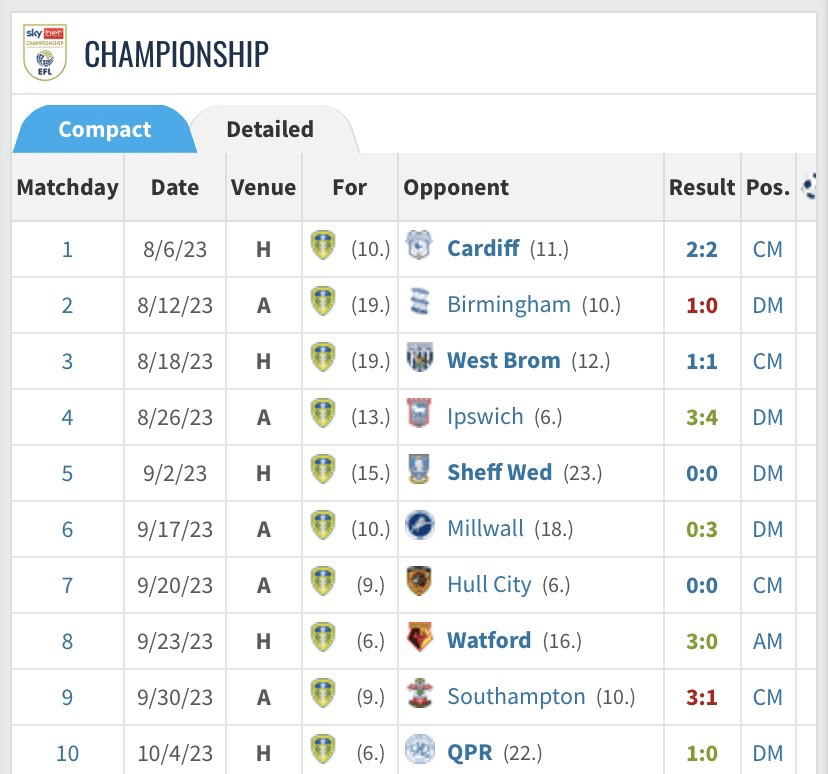
The question is now, can he translate this sort of form on a consistent basis for years to come or will it drown out like so many of other young talents before him? That’s for him to decide, but the ball is totally in his flawlessly talented court.

Those previous doubts surrounding Vinicius’ naivety and recklessness in the attacking areas are fading away. There can be little doubt over his raw talent. His passion and abilities is almost trademark Brazilian, and his drive is unrivalled in the modern game. His technical ability is magnificent, and he now appears to have the finishing skills to match. He’s proven that he’s more than a young winger with flair, he’s a man who can make a difference and win a game on his own.

Real Madrid have always possessed a talent capable of taking games by the scruff of the neck, and Vinicius Jr is now the latest in a very long line of decorated and pure footballing talents. Long may his stunning form continue.

Arnaut Danjuma proving a key figure for Villarreal

Arnaut Danjuma proving a key figure for Villarreal

When Arnaut Danjuma joined Villarreal from AFC Bournemouth last summer for €25m, little did we know he’d make such a telling impact in Unai Emery’s progressive side so soon.

A few months into his Spanish top-flight career and the recently-made Netherlands international is a man of fire, and one of La Liga’s blossoming individuals so far this season.

After hitting 17 goals and 7 assists in the Sky Bet Championship last season, the former Club Brugge forward was always destined for bigger and better things but many thought he’d make that step up in the Barclays Premier League rather than beyond borders.

With several clubs interested in his services last summer, it was Villarreal who took a punt on his flawless abilities, and its safe to say the 24-year-old hasn’t looked back.

He did state recently, he felt he was too good for the Championship and he needed to get out, and after his first few months under Unai Emery’s tutelage, Arnaut Groeneveld Danjuma’s has supremely backed up his lofty statement with some show-stopping, electric and superb performances for the Yellow Submarines.

14 appearances, 7 goals (5 in La Liga), and 3 assists Danjuma has certainly showed he is good enough and ready to cut it amongst the most elite footballers in Europe. The slippery Dutchman has gone from the Championship to the Champions League without batting an eyelid at the transition.

Danjuma’s trajectory over the past year has been nothing short of sensational, and already he is showing his talents on the most prestigious of footballing stages in the UEFA Champions League. If you need any pieces of evidence as to how good he is, not only that, but how invaluable he’s become to Unai Emery’s side in short space of time, check out his performance against Manchester United at Old Trafford.

It was simply jaw-dropping.

The forward was the most electric player on the Old Trafford pitch, despite sharing it with five-time Ballon d’Or winner Cristiano Ronaldo, Jason Sancho, Bruno Fernandes, Paul Pogba and other stars.

The former Bournemouth man had United full-back and Portuguese international Diogo Dalot on toast, cutting through him with such expert but thrilling ease. Solskjaer’s defence simply could not handle his pace, acceleration, unerring trickery and swift close-control and deceptive movement. He finished the game with an assist to his name, but also four shots, 2 key passes, 3 dribbles and with a WhoScored rating of 7.42.

There’s no doubt about it, Danjuma is amongst the most devastating forwards in Europe right now.

Danjuma’s instant impact in Spain has surprised many, but probably not coach Unai Emery, who asked club president Fernando Roig to sign the winger this summer.

The former Arsenal manager must have made a strong case because Villarreal splashed out €25 million (£21m) on the Bournemouth man – a large transfer fee by recent Spanish standards.

While giants Real Madrid and Barcelona picked up David Alaba and Memphis Depay on free transfers, Villarreal made Danjuma the second-most expensive signing in their history, behind Paco Alcacer.

Danjuma may have been one of La Liga’s most expensive transfers this summer, but is currently proving he’s worth every penny spent. The Europa League winners were looking for a player who could help them jump forward to the next level tactically and in attack and Danjuma is keeping his part of the bargain.

Unai Emery’s men are clearly more efficient, potent and exciting on the attack and much of that is down to Danjuma’s unpredictable nature on the left-flank.

The Dutchman is one of La Liga’s most aggressive and destructive dribblers in La Liga, averaging 2.4 dribbles per game so far this campaign, per 90 he completes on average almost 2 dribbles per game, 7.76 progressive carries, 1.34 carries into the final third and an outstanding 3.43 carries into the 18-yard box showcasing just how vital he is to Villarreal’s attacking phases of play.

Danjuma also averages 9.30 touches in the opposition’s penalty box, again highlighting that he is arguably La Liga’s most effective wingers alongside the rejuvenated Real Madrid Brazillian superstar Vinicius Jr. His non-penalty XG of 0.66 is in the 99th percentile amongst Europe’s top-five leagues making him one of the most efficient scorers so far on the continent.

The 24-year-old has certainly shown up for Emery so far this season, he netted in the thrilling 2-2 draw with Atletico Madrid at the Wanda Metropolitano – a stadium he knows well from his Club Brugge days – lashing past Jan Oblak in a 2-2 draw for his first goal for the club.

Clinically netting in a 2-2 draw with Atalanta in Villarreal’s Champions League opener, he was also a livewire against Elche in a 4-1 win, bursting through the defence and scoring after an hour, and also put in a brilliant showing at the Santiago Bernabeu against Real Madrid.

That was followed by two more in the 2-0 win over Real Betis, the first coming after he cut inside from the left and cleverly slipped the ball back inside the near post. He rounded the goalkeeper for his second, showing poise and good judgement. He again came to his side’s rescue against forcing a late leveller in the closing minutes against Cadiz in a 3-3 draw.

His tremendous form so far this season earned him a late Netherlands call up under Louis van Gaal in October, and the winger duly delivered.

“Can anyone stop Danjuma?” asked Spanish newspaper Marca after he dazzled from the bench in a 6-0 win for the Netherlands against Gibraltar.

The coach called him spectacular and pointed out that his team-mates still have to adapt to his explosive balls across the face of goal. 

“He had very nice and impressive dribbles, but his team-mates were not yet geared to his hard crosses,” said Van Gaal.

With time, things will only get better in that aspect, but its clear that Danjuma has given both Louis Van Gaal and Unai Emery reasons to stand up and take notice at his incredible gifts.

His Villarreal team-mates have already given him the nickname ‘Danjumagic’, although the player humbly credits his coach for his superb start in Spain.

“I need to give a massive thanks to Unai Emery,” he told Villarreal’s website. “The coach is very busy (working) with me and he really helps me perform.”

The 24-year-old has proven the star of the show at the Estadio de la Cerámica, but has most of all proven that he can be amongst the best forwards in Europe after the tremendous campaign he enjoyed last year in the English second-division. Arnaut Danjuma was always primed for much more, and he has his sights set on much bigger things which may cause some worry amongst the Villarreal fanbase.

“I came to Villarreal to prove myself again but I’m definitely visualising the next step,” he told Mail Online in September.

It’s no surprise that the forward is already drawing interest from Jurgen Klopp at Liverpool with the former Borussia Dortmund coach reportedly sending scouts to watch Danjuma in action, who knows, the flying Dutchman may well be Sadio Mane’s heir on that left-flank at Anfield, and he’s certainly good enough to take over the role.

Danjuma is serious joy to watch in action with his blindingly quick feet, deceptive body movement and jaw-dropping trickery so it won’t only be Liverpool scouring for his services in the near future. Villarreal have already taken kindly to the 24-year-old wing wizard, and they should enjoy his magic while it lasts because the sky really is the limit for such a truly decorated footballer.