Meet Matias Fernandez-Pardo: Yet Another Breakout Star From LOSC Lille’s Decorated Talent Factory

Meet Matias Fernandez-Pardo: Yet Another Breakout Star From LOSC Lille’s Decorated Talent Factory

French football is renowned for developing some of the world’s best players, at a level of both quantity and quality that few other nations can match. The club arguably most famed in the country for producing top-level talent who then go on to become superstars elsewhere is LOSC Lille.

In fact, the real secret behind Lille’s success in the transfer market lies in their ability to scout young players from elsewhere, develop them in Ligue 1, then sell them to richer clubs in England and Spain.

Of the club’s top 10 biggest sales, Leny Yoro, who joined Manchester United for £60m in the summer of 2024, Lucas Chevalier, who joined Paris Saint-Germain for just under £50m last summer and former Chelsea star Eden Hazard stand alone as the only players to have come through the club’s youth academy.
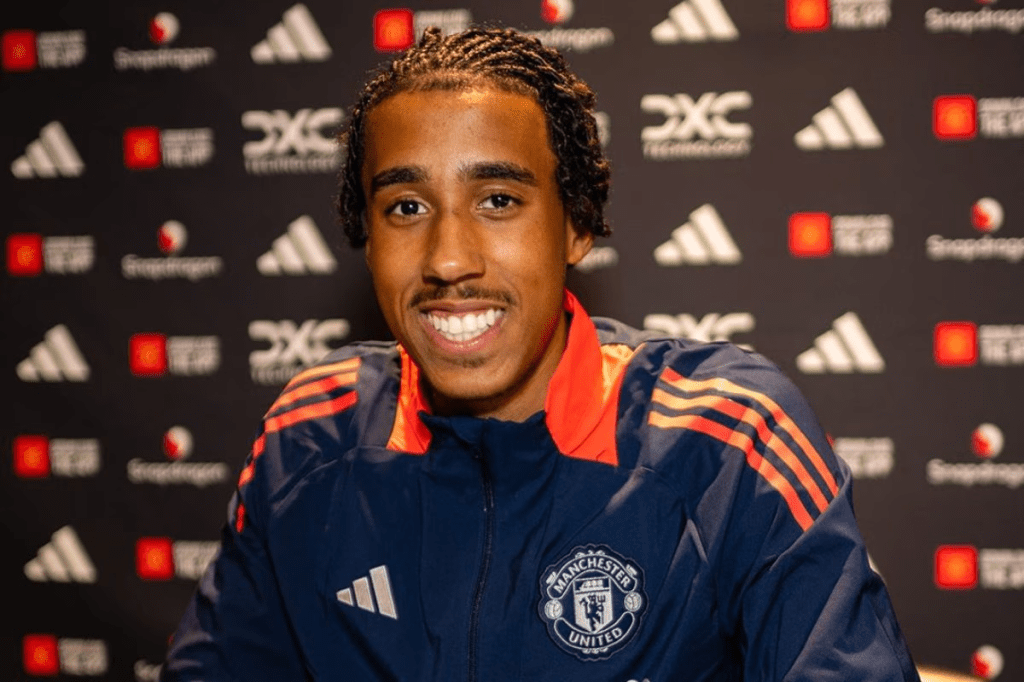
Leny Yoro’s £54m move to Manchester United in summer 2024 stands out as Lille’s biggest homegrown sale.

Whereas players like Nicolas Pépé (signed for €18m, sold for €80m), Victor Osimhen (signed for €22.4m, sold for €77.5m) and Rafael Leão (signed for €20.2m, sold for 49.5m) were all scouted from neighbouring countries and developed in France before moving on to forge their own lofty paths elsewhere.

The impressive list of players that LOSC Lille has successfully nurtured, developed, and sold for profit doesn’t end there; in fact, it is extensive. Among the most notable names are Gabriel Magalhães, Sven Botman, Amadou Onana, Carlos Baleba, Bafode Diakite, and even Yves Bissouma, if you recall.
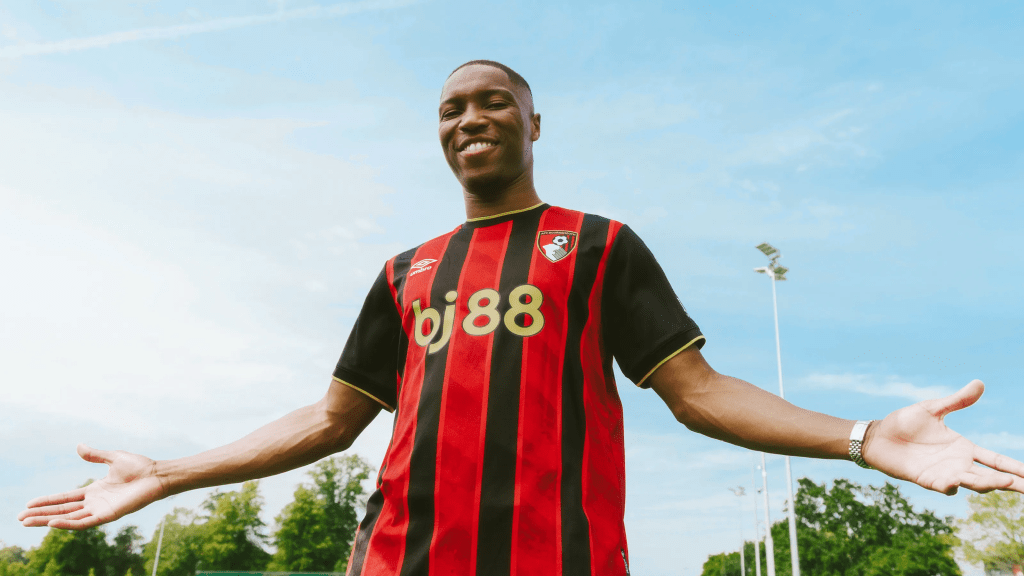
Bafode Diakite joined AFC Bournemouth from Lille for £34.6m in August and is already emerging as one of the signings of the summer in the Premier League.

Looking ahead, even more exceptional talents will emerge and move on to greater opportunities in the coming months. It’s reminiscent of a game of whack-a-mole; as soon as one star player is lifted from the club, another eager talent rises to take their place, showcasing the relentless talent pipeline at the Stade Pierre Mauroy.

Just a few names to watch out for at the club currently: Ayyoub Bouaddi, Hákon Arnar Haraldsson and Kylian Mbappe’s brother, Ethan Mbappe, are all sharing the limelight as Lille, under the tutelage of Bruno Génésio, looks to once again take Ligue 1 by storm.

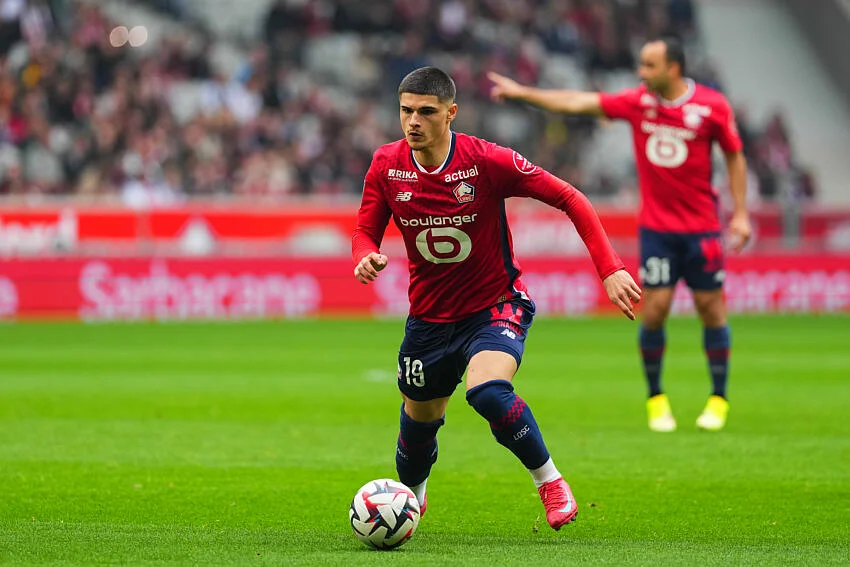
Another exceptional young talent who is currently proving central to those plans and has already garnered glowing admiration from some of Europe’s elite… step forward, young winger Matias Fernandez-Pardo.
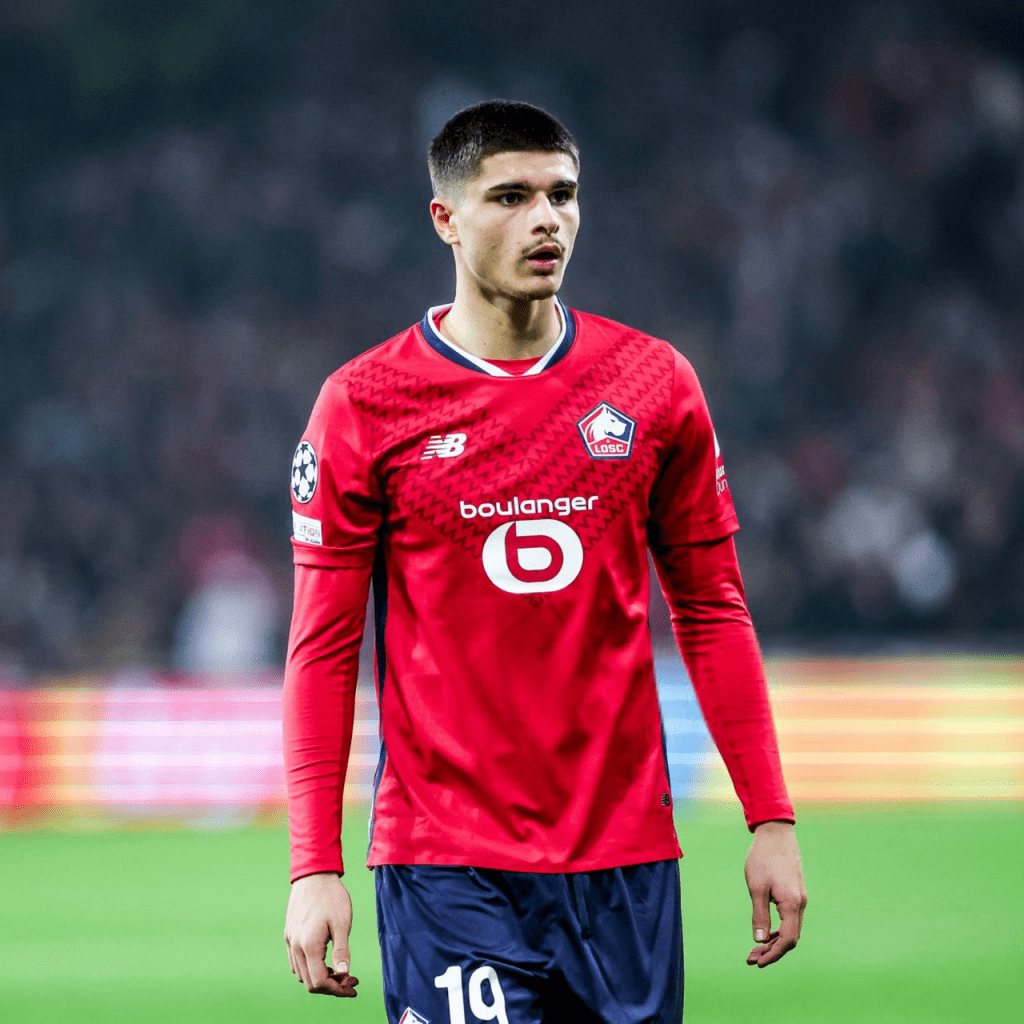
Matias Fernandez has experienced a remarkable, swift ascent to stardom in French football since rejoining Les Dogues from Belgian club Gent.

The now Spanish under-21 international is a product of both the Anderlecht and Lille academies. He left the French club to return to his native Belgium in 2020, but returned to France four years later after impressively making the grade at Gent.

It’s taken over a year for the 20-year-old to establish himself as one of Ligue 1’s hottest young attacking prospects, and his stunning trajectory attracted glaring eyes from La Liga giants Atletico Madrid over the summer, who initiated contact for his signature, as per Sky Sports Germany reporter Florian Plettenberg.
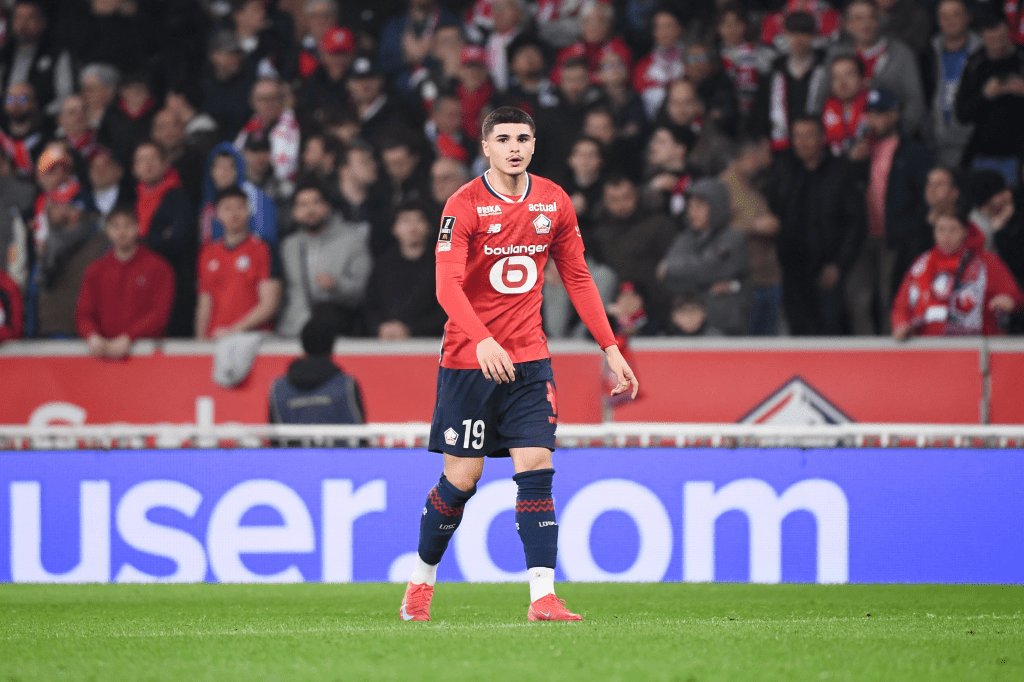
However, no move materialised, but that hasn’t stopped Fernandez from continuing his super development for the French side, enjoying a great start to the new campaign with two goals and four assists from 14 games in all competitions so far.

It certainly won’t be long before Lille are receiving several enquiries from Europe’s elite once again for Fernandez’s signature. So how has the young, Brussels-born superstar reached this level, and what exactly makes him such an attractive talent to acquire?

Who is Matias Fernandez-Pardo?

Born in Brussels to a family of Spanish and Italian descent, Fernández-Pardo began his career in his native country, with stints at the academies of Anderlecht and Mechelen, before joining Lille’s academy at the age of nine in 2014.

Despite spending six years with Les Dogues and making his debut for the Belgium U-15s, he returned to Belgium in 2020, joining the academy of KAA Gent.

The Belgian club is well-known to Lille fans, having been the club where club legend Jonathan David made his breakthrough before joining the Ligue 1 side, making his debut in 2020.

Jonathan David, like Fernandez-Pardo, successfully made the grade at KAA Gent before joining LOSC Lille in 2020.

From there, he went from strength to strength, impressing in the European playoffs in 2024, scoring seven goals in ten matches and helping his team reach the Conference League. After this strong showing, big-name suitors came calling, and he eventually joined Lille in 2024 for a rumoured €10M (£8.7m), having helped Gent navigate the playoffs. 
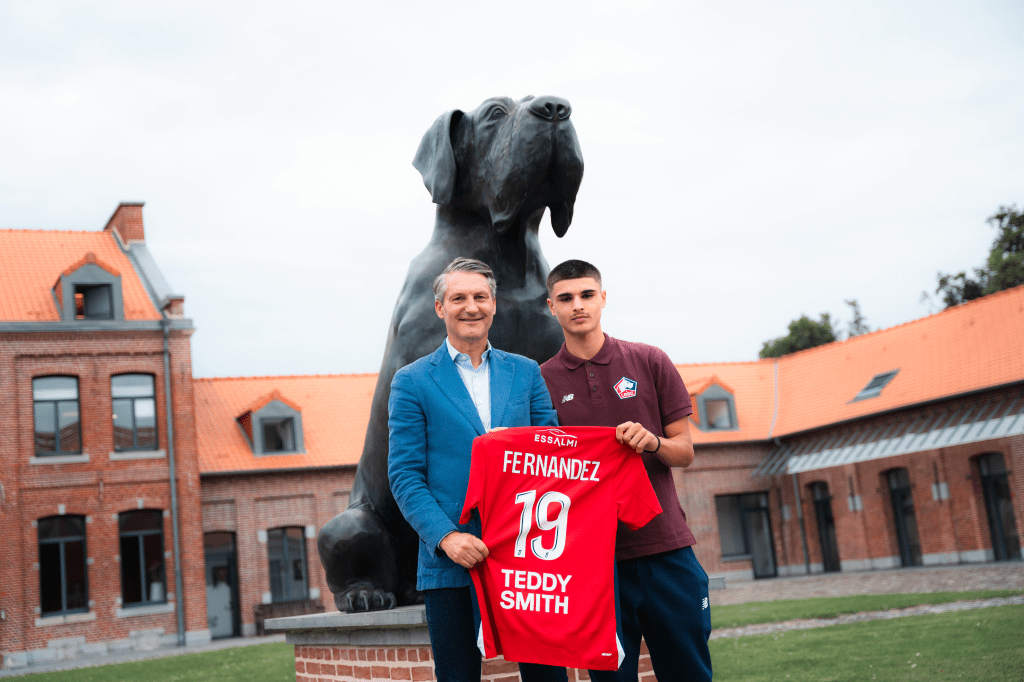
Having arrived late in the window, and facing strong competition from the likes of Rémy Cabella and Haakon Haraldsson, it would take some time for him to establish himself in the first team, but with plenty of opportunities as the team impressed in the Champions League, he began to feature regularly in the autumn, and scored his first goal in a draw with OGC Nice. 

Just as he was poised to become a regular starter, he injured his ankle against FC Nantes in January 2025 and was forced off, taking nearly two months to return.

Despite being fit again, he had been used only from the bench, with manager Bruno Génésio remarking that the player’s level in training hadn’t been sufficient for a starting berth. 
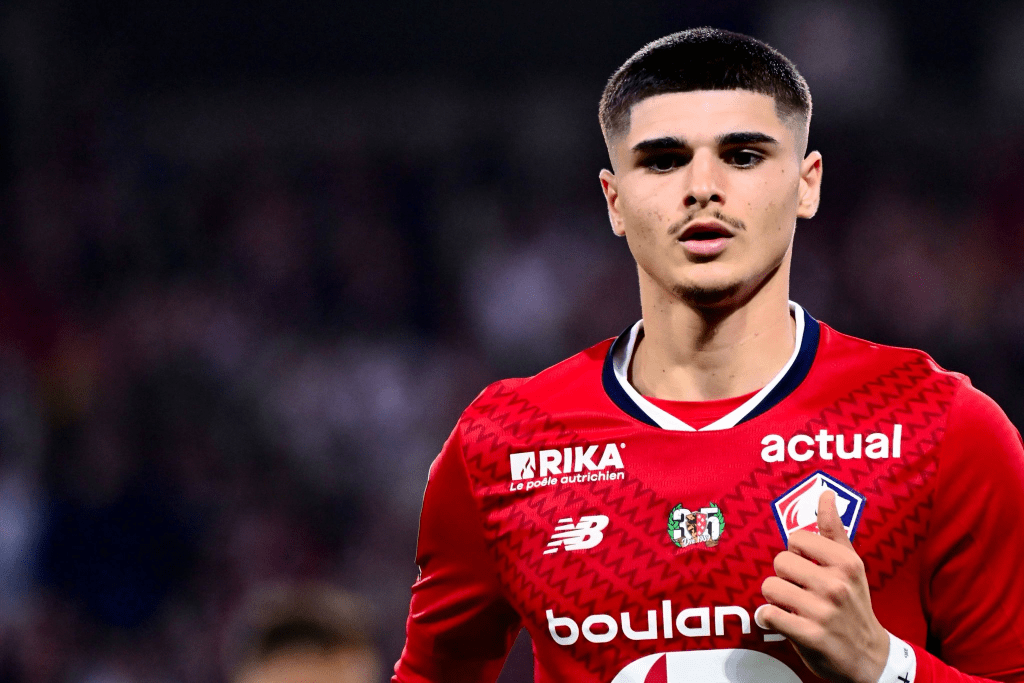
However, the 2025/26 campaign has proven a different story altogether, with Fernandez not only raising his performance levels and application but becoming a hugely decisive figure going forward, with six goal contributions from 14 games so far this season.

With his position at the club level now established, Fernandez has certainly been intentional in ensuring the same narrative at the international level, too.

After impressing for Belgium at various youth levels, the 20-year-old requested to switch allegiance to Spain, a request that was approved by FIFA in February.

However, he’s yet to feature for their under-21s despite being called up to a couple of their squads. One thing is for certain: it won’t be long before Fernandez-Pardo becomes a household name for La Rojita.

For now, he must continue his rapid development at LOSC Lille, so let’s explore why he’s so highly regarded and what makes him so special.

What’s all the Matias Fernandez-Pardo hype?

What do the stats reflect?

It’s essential to note that statistics do not provide a comprehensive picture of a footballer’s abilities. Still, they can certainly give an indication of how a player is performing currently and what areas need improvement.

For Fernandez-Pardo, it’s a different narrative. His numbers, in fact, tell the story of the kind of talent LOSC Lille have on their hands right now.
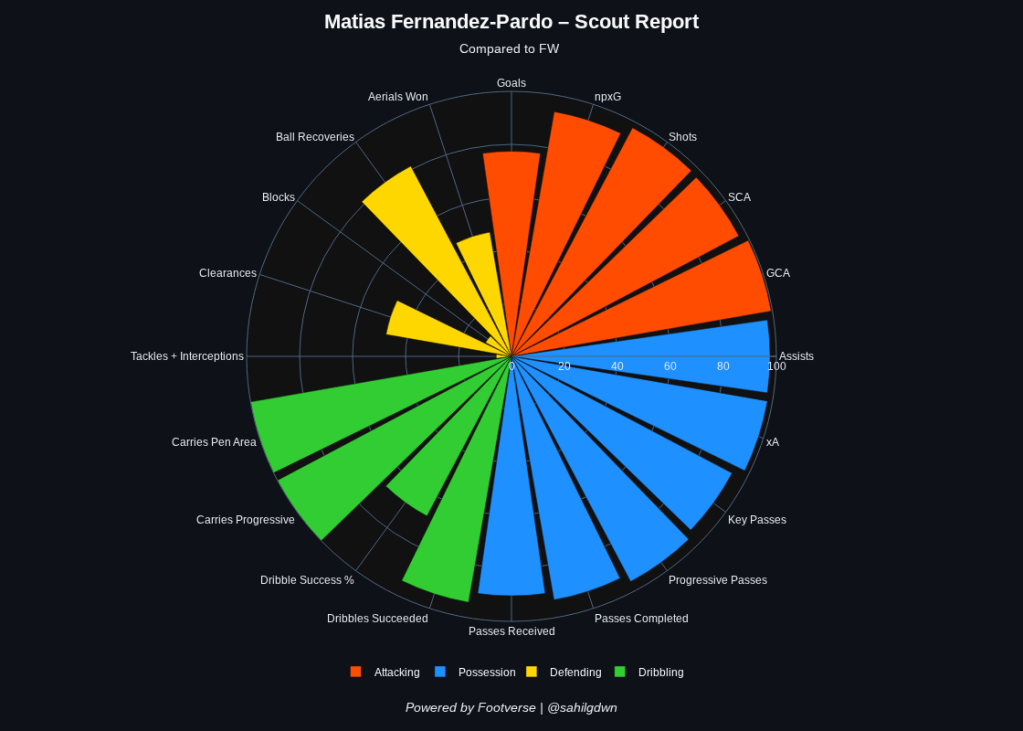
Looking at the graphic above (as per Footverse), we can see the Belgian-born wonderkid ranks highly amongst his positional peers in Europe for dribbling/ball-carrying and creativity in the final third.

Fernandez-Pardo ranks in the absolute top bracket of wingers/attacking midfielders in Europe’s top five leagues for touches in the attacking penalty area and carries into the penalty area.

He also ranks in the 98th percentile for passes into the penalty area, xA (expected assists), 96th percentile for progressive passes and 92nd percentile for key passes.

What kind of talent?

Through these various metrics, you can almost paint a picture of what kind of attacker Fernandez-Pardo is.

He’s not just an out-and-out touchline winger who excels in his 1v1 scenarios up against full-backs.

Still, he’s also a between lines or half-space creator, willing to receive the ball in those zones and create something out of nothing through excellent close control, balance and ball-manipulation in tight zones and the presence of mind to find runners and provide them with delicious through balls or delicate crosses.

The Spaniard is a dynamic, technically sound forward, comfortable playing across the front line and on both flanks. His ability to drift wide, link up with teammates, and attack space makes him a constant threat in transition, but he’s also very adept at dissecting low defensive blocks. But we’ll get to that.

Fernandez-Pardo is incredibly versatile. He’s not one of those attackers who are just wedded to their favourite positions and ineffective when tasked with another.
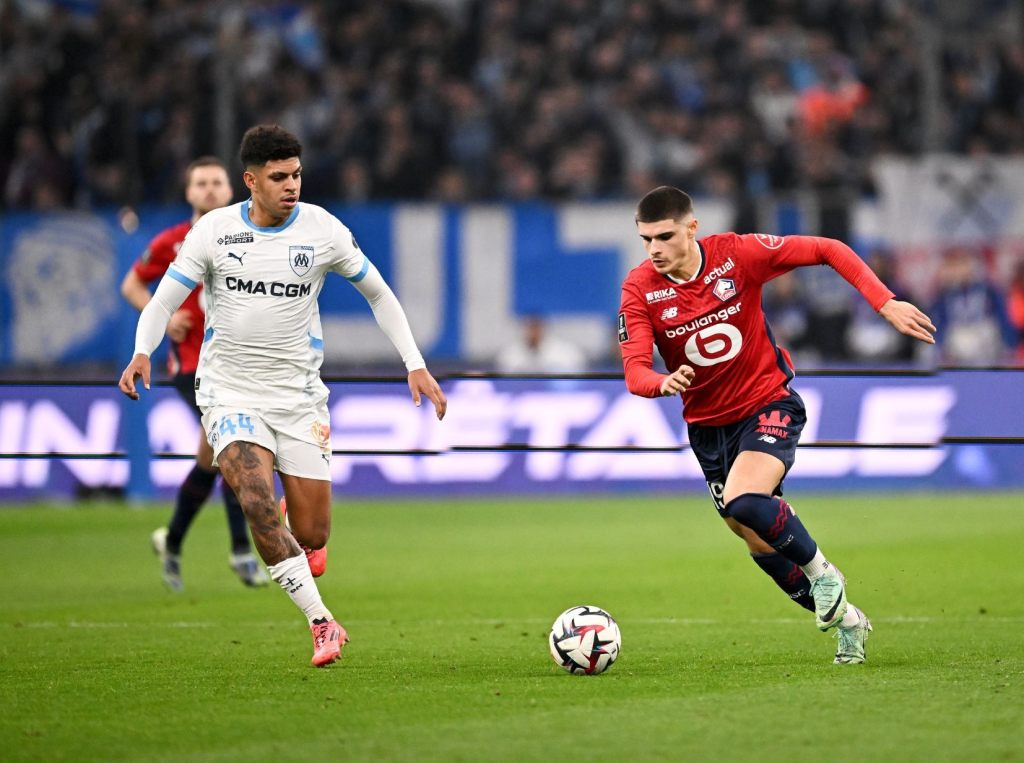
The 20-year-old wonderkid is as decisive on the right flank as he is on the left, but what’s even more unique about him is his ability to perform centrally at #10, if needed.

When you possess such a clean first touch, unique ball control and manipulation, excellent balance and flexibility when operating in tight areas or receiving the ball with your back to goal, have no angle bias and also possess the presence of mind to dissect defences with sublime passes, you can undoubtedly play anywhere across the attack; and that’s the level of talent and ability Fernandez-Pardo harbors.

He shows a high level of tactical awareness and adaptability. He reads the game well, positions himself intelligently in the final third, and understands when to drop deep to aid progression or stretch the back line with his undeniable 1v1 ability.

LOSC Lille coach Bruno Genesio adopts a 4-2-3-1 shape at the Decathlon Arena – Stade Pierre-Mauroy, which provides the Spaniard with a platform to showcase his versatility, skill set and tactical awareness.

Lille’s tactical setup in their 6-1 Ligue 1 win over Metz on October 26

His versatility also enables him to adapt to various systems should Genesio choose to shift formation, whether dropping as the deeper forward in a front two, playing as a false-nine striker, or, more crucially, playing in any of the wide roles.

So, let’s delve into his suitability and quality in performing the latter, and at #10, arguably his best positions.

Touchline-winger

As previously noted, the Lille forward demonstrates excellent positional awareness. He knows when he needs to sit high and wide on the touchline to stretch the play, and knows when to drop into the half-spaces if he realises his full-back is the one fulfilling those duties.

Matías Fernández-Pardo is known for his electric, elusive dribbling in one-on-one situations out wide. His footwork is not only agile but also artful, allowing him to glide past defenders with remarkable ease and finesse.
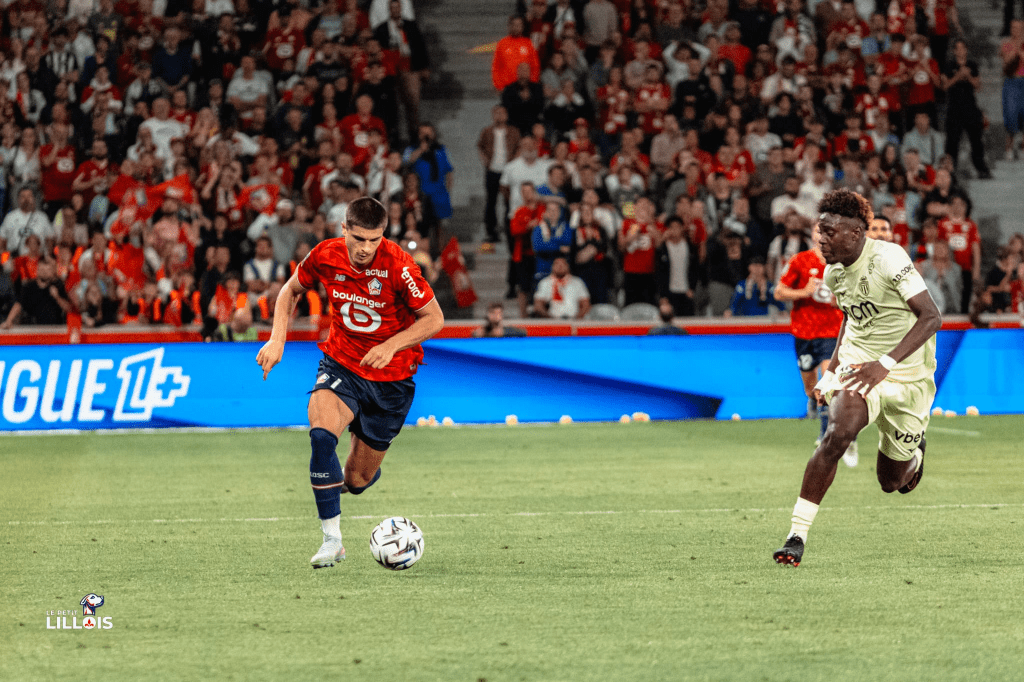
Physically, he boasts a robust frame and a powerful, athletic stride. His movements are characterised by such deceptive fluidity; with each step, he skillfully misdirects opponents, leaving them off-balance and unable to predict his next move.

Furthermore, what truly sets him apart is his distinctive running style. With his back straight and posture upright, he maintains a focused gaze forward, scanning the field with sharp awareness. This striking and unique appearance exudes confidence, making it clear that he is determined to create opportunities for his team.

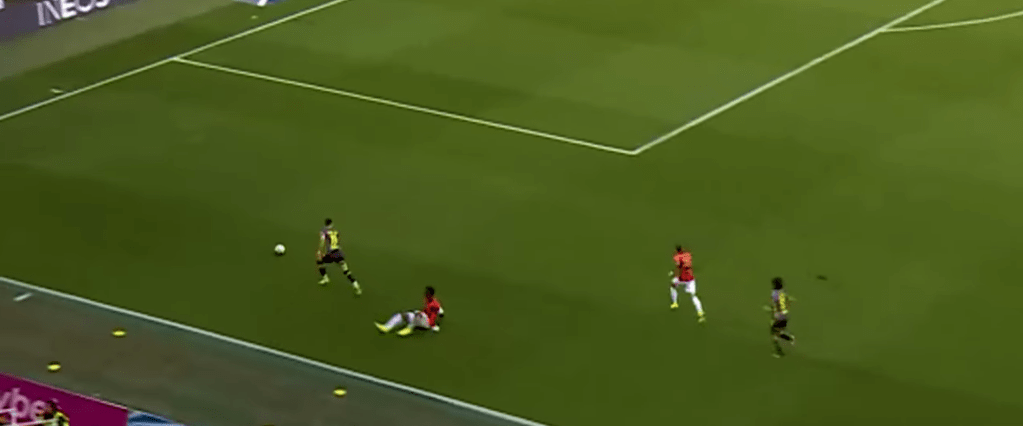
For instance, in the image below, we see Fernandez-Pardo picking up the ball wide, but in a pretty awkward position, with his back to goal and the angle to beat his marker looking extremely difficult…
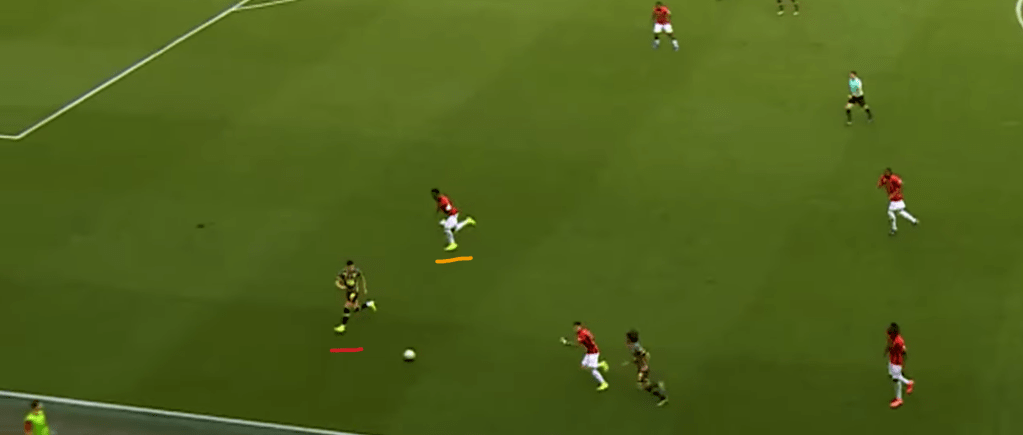
… however, it’s not at all difficult for him.

As we’ve come to learn about the Spaniard, he is all about deception and sudden shifts in his body positioning.

He looks as if he’s about to take a first touch, forcing him into an awkward position to evade…
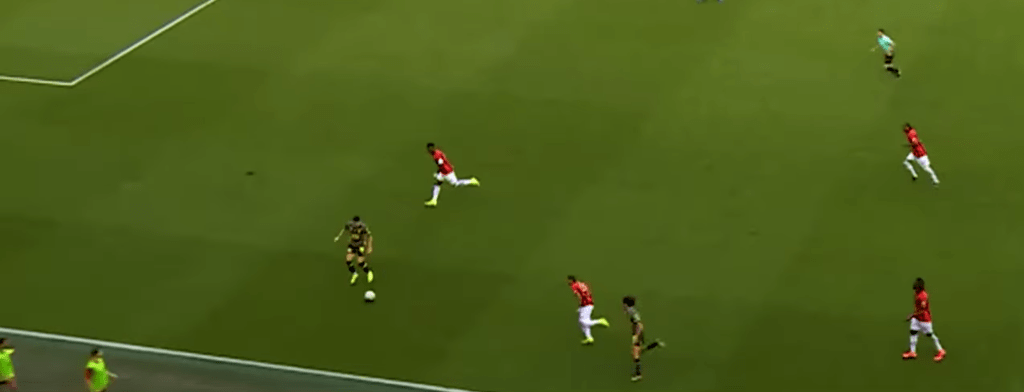
…but instead, he allows the ball to roll across his body…
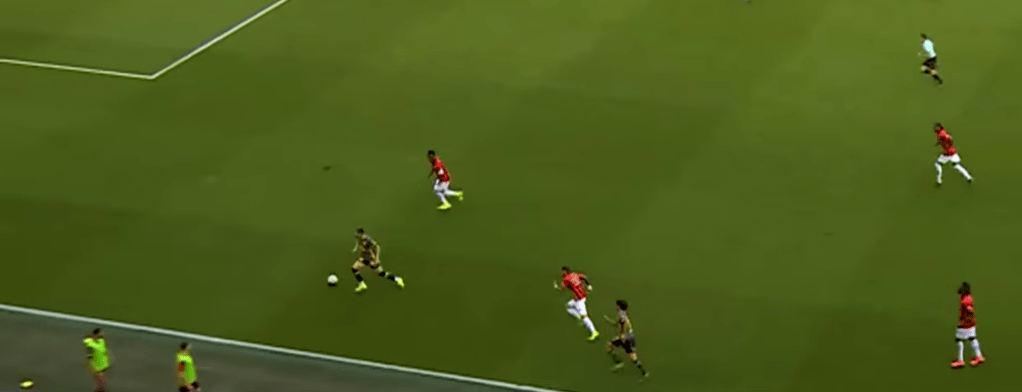
… allowing him to face up against his marker in an advantageous 1v1 scenario and have a full view of what’s ahead.

With his opponent seemingly looking to win the duel, the Belgian-born wizard once showcases his rapid burst of pace to knock the ball past the sliding full-back…
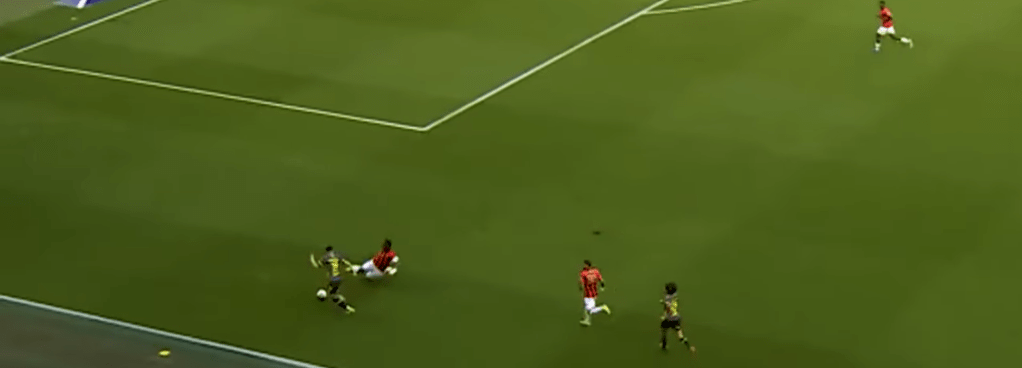
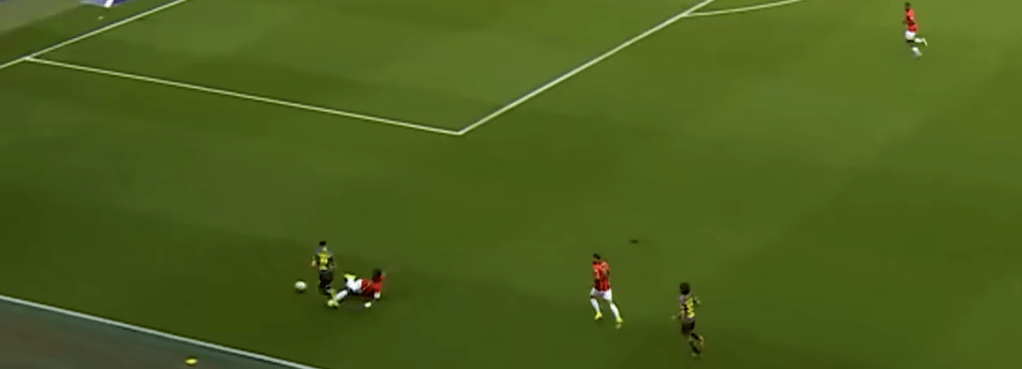
As a result of his electric 1v1 quality, he now has enough time and room to converge into the penalty area and create a goal-scoring opportunity.

Put Fernandez-Pardo in any tight situation, and he’ll quickly and smoothly find the right solutions to evade it.

In another instance, the young winger is provided the ball wide left with an oncoming defender ready to press him the moment he receives it.
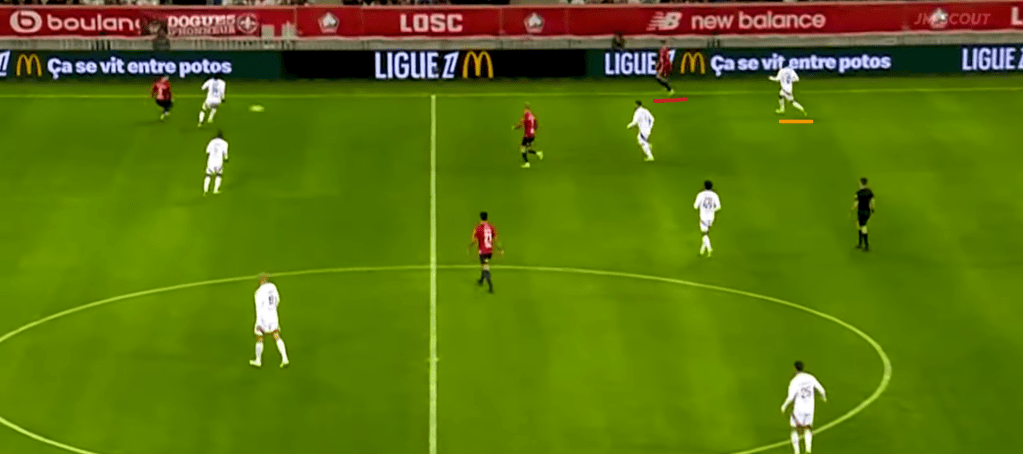
It looks as if he’ll take a touch to settle himself, but that’d be too easy for him.
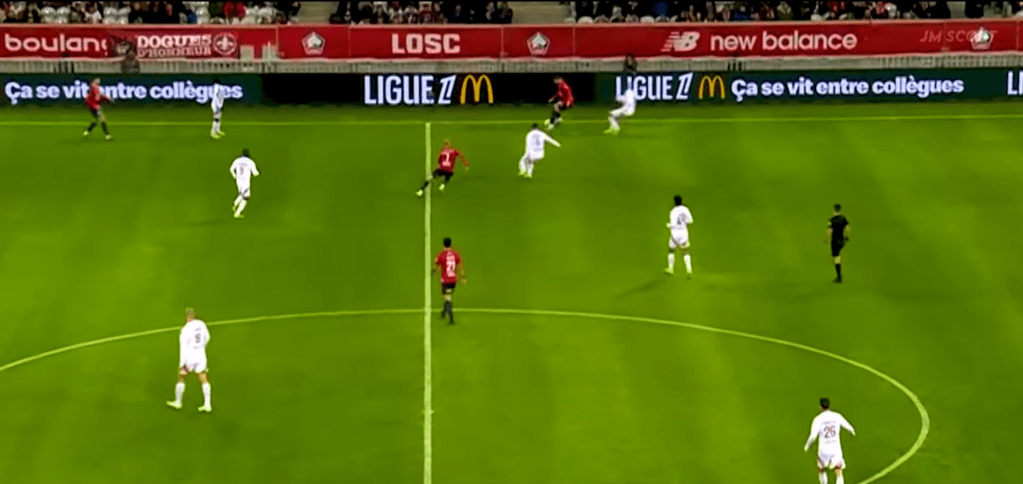
Instead, he flicks it around the defender with his right while going around the obstacle on the left…
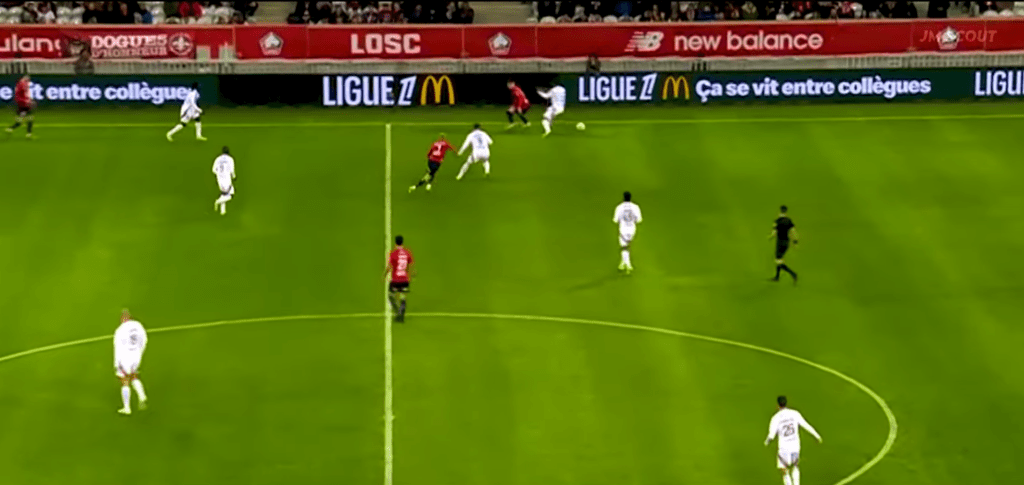
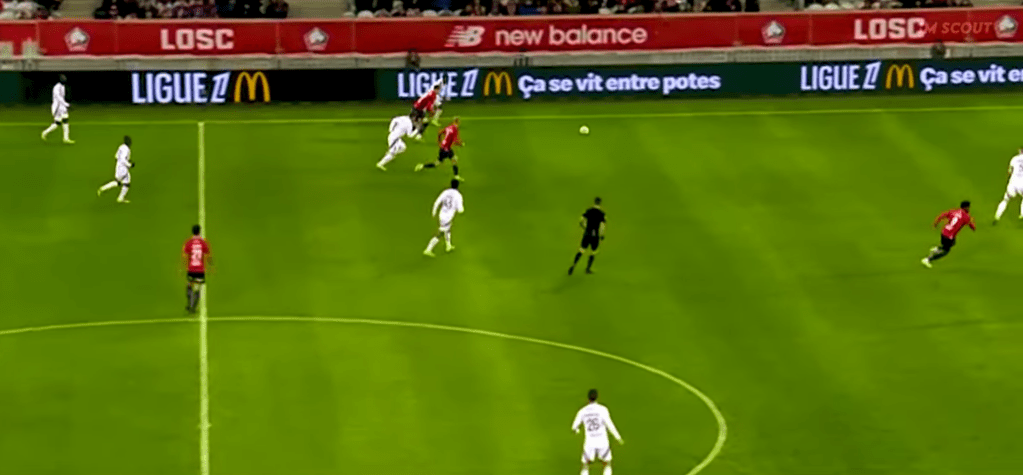
…leaving the defender in his wake.
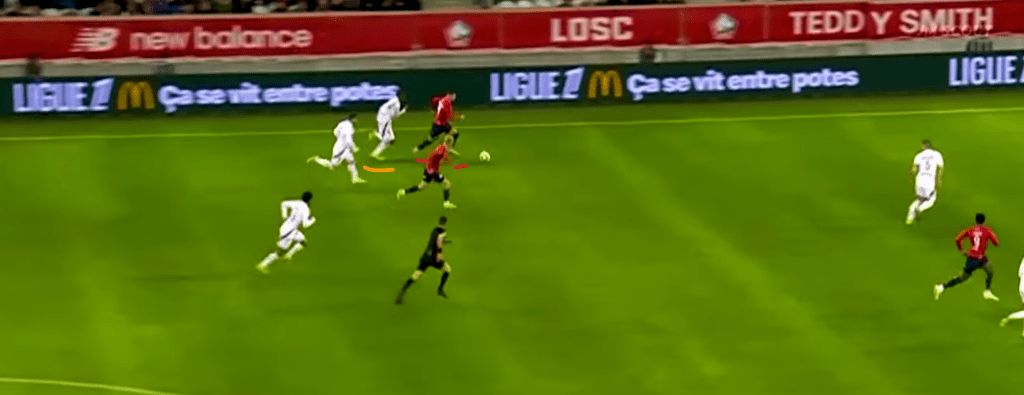
His dribbling is built on short, sharp touches and swift changes of direction, other than sheer explosive top-speed beating of fullbacks. He is exceptional at gaining separation from defenders, also making him effective in tight zones (between fullback and centre-back) and when the team emphasises quick circulation.

The data certainly backs this up: he completes a healthy number of successful take-ons and progressive dribbles per 90, ranking in the 79th percentile of wingers for progressive passes per 90.

In Lille’s 6-1 Ligue 1 mauling of FC Metz on 26 October, Fernandez-Pardo registered two assists, both of which excellently showcase his quality and unpredictability when playing out wide.

As shown in the clip above, the Brussels-born forward receives the ball high and wide, standing up against the opponent’s full-back.

He takes a couple of touches to invite engagement from the defender, then instantly knocks the ball past him, beating him for pace and also, more crucially, he excellently withstands the contact that could easily knock off so many of his positional counterparts.

He bursts into the box, and if you look closely at his unique dribbling style with an upright stature, he’s confident, assured and sees the whole picture ahead while reaching a reasonable speed before picking out striker Hamza Igamane with a terrific cut-back who finishes low into the bottom corner.

Fernandez-Pardo is simply amazing to watch when he’s in full flow.
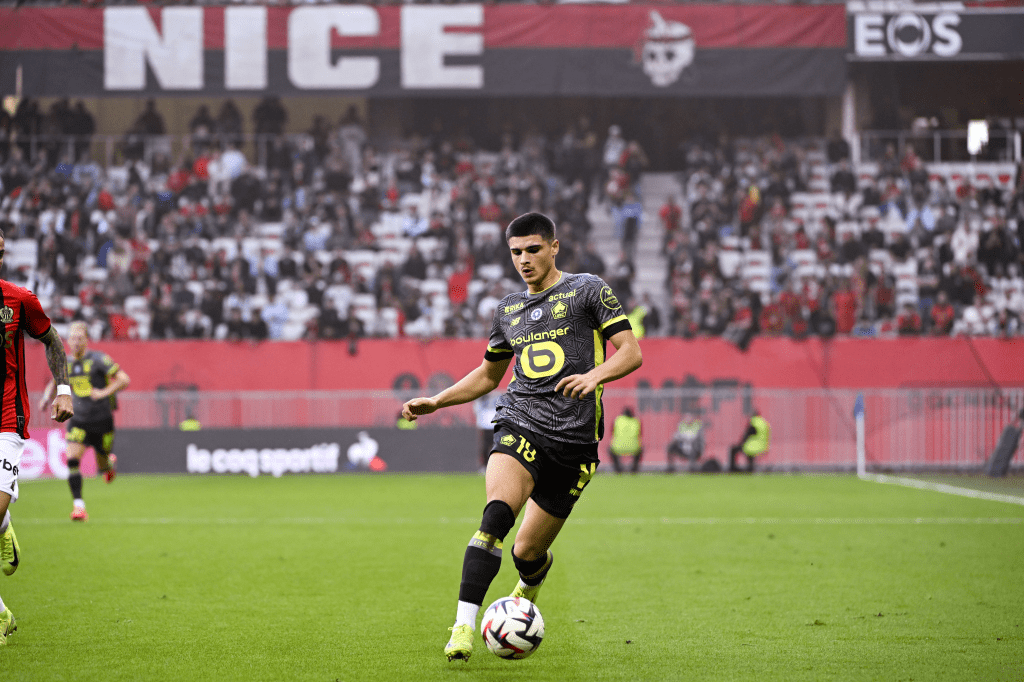
The second of his two assists against Metz is arguably the best of them.

He receives a lofted pass over the top of the opposition defence, once again faced off with the full-back.
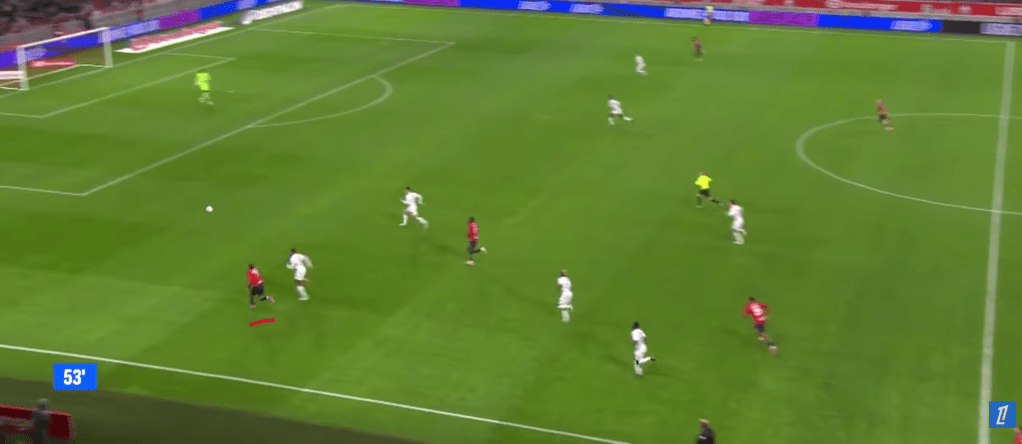
Once again, the 20-year-old finds himself in another 1v1 situation, up against a pretty rugged and towering obstacle.
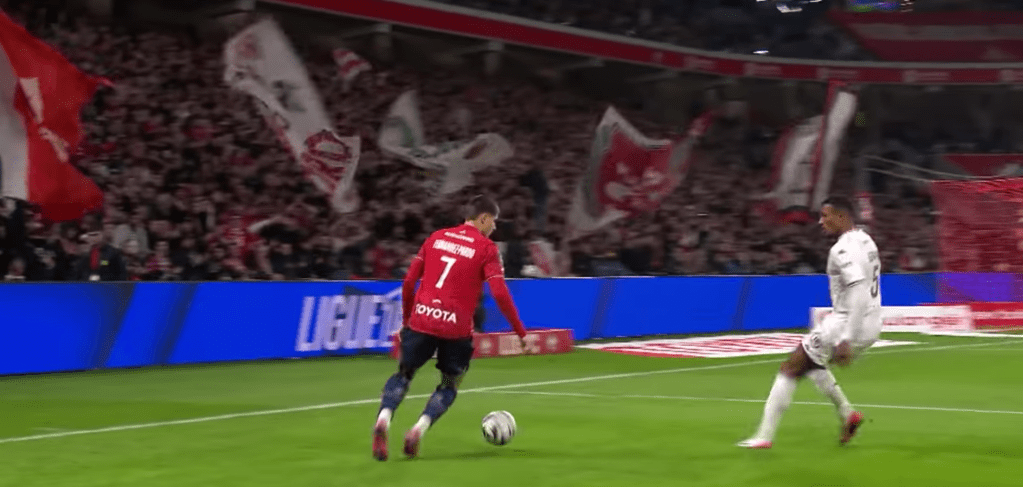
He reels the defender in with some deft touches, as he did in the first assist…
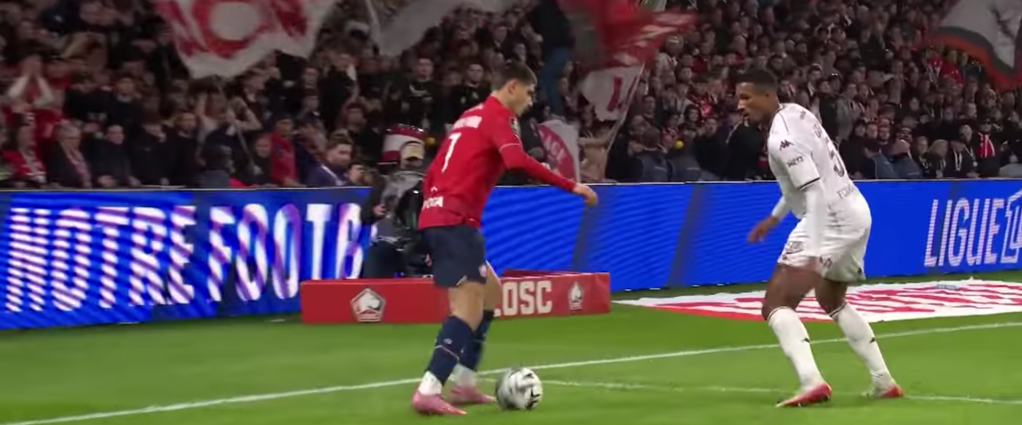
…once he feels the defender is looking to engage in the tackle, he knocks the ball forward, in a tight spot where he could easily knock it out for a goal kick, and speeds past him…
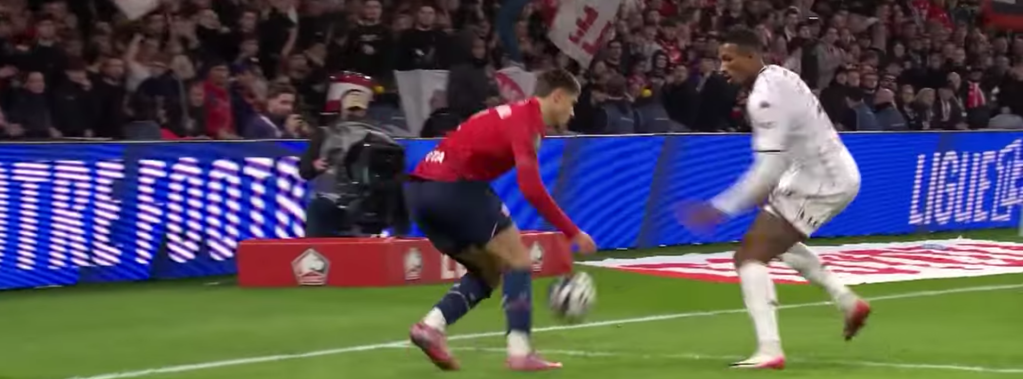
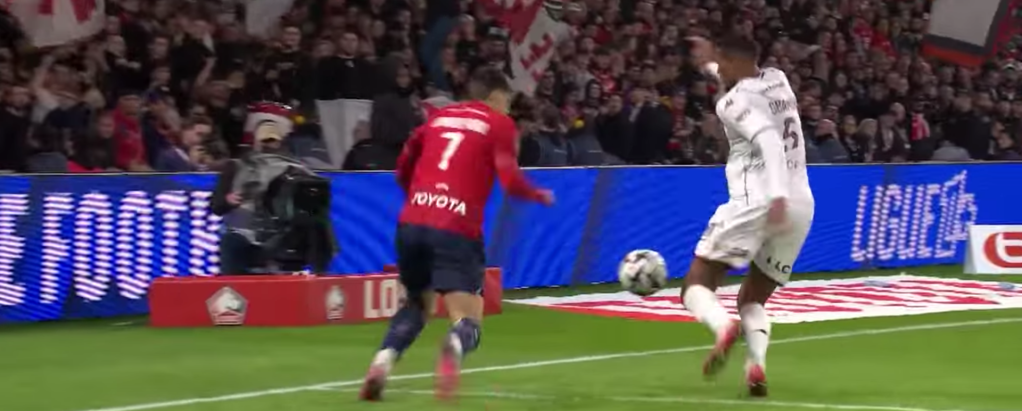
He just about gets their first, and before it goes out of play, crosses the ball for Felix Correia to smash home.
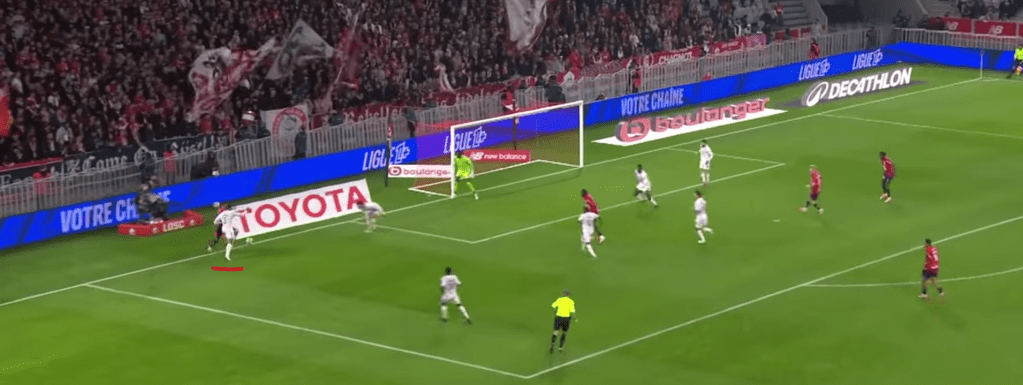
We can certainly see Fernandez-Pardo’s quality and decisiveness in 1v1s. He doesn’t need to rely on explosive bursts of pace to get past his man; he possesses impressive trickery, deftness of touch, balance, ball control and body mechanics to win those duels consistently,

He can even do it on the right flank, too, which is rare to find in even some of the best wingers on the continent.

The Spaniard is exceptional in those stop-start motions. He knows how to slow down his opposing defender, lull them into a false sense of security — thinking they’ve got the situation under control — but then takes that feeling away from them, dropping the shoulder, knocking the ball past them, and accelerating away.

His constant dropping of the shoulder and those nimble and enticing touches have certainly become an art form in his magical wizardry.
In another fine example below, we see Fernandez-Pardo this time high and wide on the right flank.

As stated previously, most right-footed left-wingers are so wedded to that side that they find it challenging to be as effective and decisive on the right. However, that isn’t the case for the uncapped Spanish under-21 wonderkid.

He possesses a tremendous mentality. Always willing to operate wherever he’s asked, and that willingness, coupled with his no-angle bias when dribbling, his quickness of feet and excellent 1v1 quality, means he is just as dangerous there as he is on the left.

Below, he stands up against his opponent in that elusive stop-start operation he so wonderfully executes in 1v1s. He reels the defender in, who thinks he has the winger caged in and going nowhere; in fact, his positioning is quite decent.
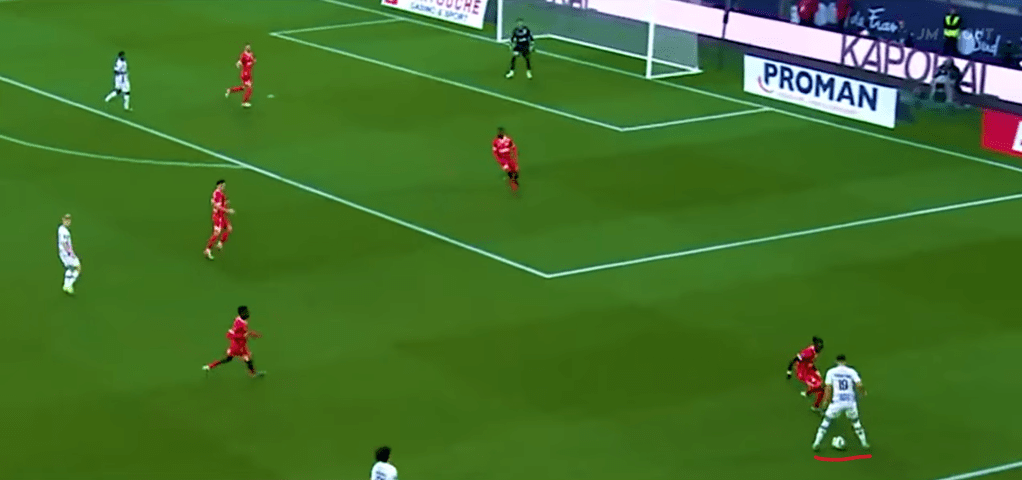
Fernandez-Pardo can’t cut in, and if he goes down his right, the defender can track him.

However, with Fernandez-Pardo’s quality, such assumptions cannot be made.

The defender now engages, attempting to win the tackle…
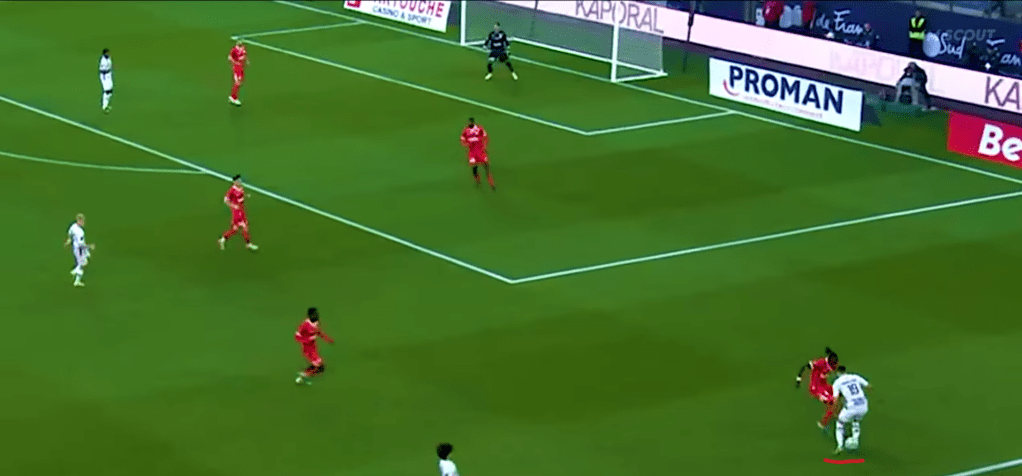
… but as is regularly the case, Fernandez-Pardo leaves the defender for dust in one fell swoop, dropping the shoulder as he engages and knocking the ball past the other way.
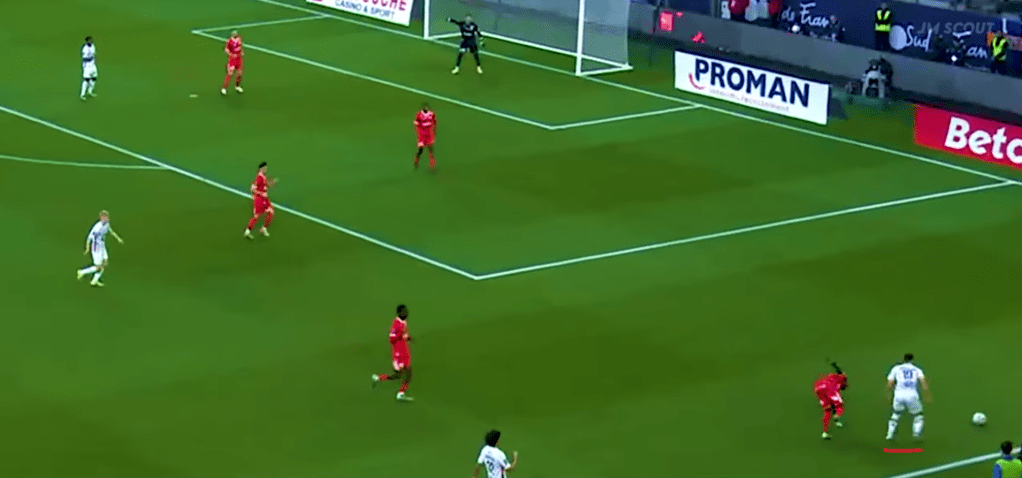
But that isn’t enough for the Spaniard. The defender recovers well…
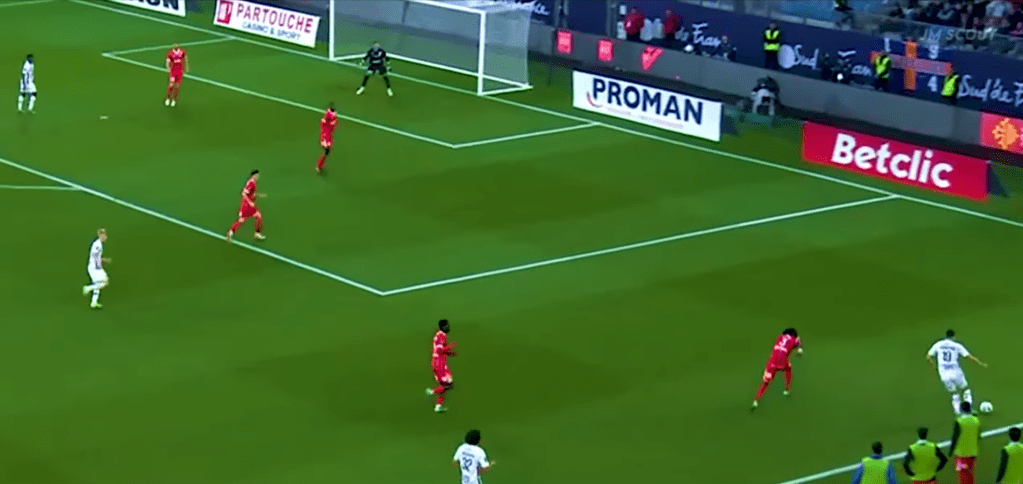
… meets him as he advances, but Fernandez-Pardo takes a deft touch with his left foot this time to get past him.
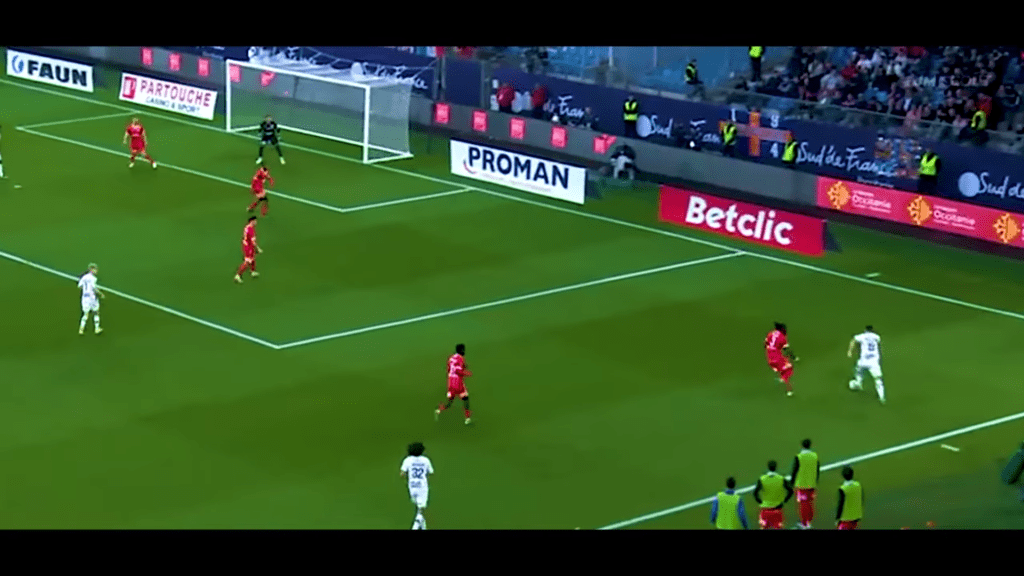
He’s so quick and elusive that the defender can no longer get to the ball, and in real danger of giving a foul away, but even still, Fernandez-Pardo holds the unique ability to withstand the contact and maintain his posture and balance when dribbling…
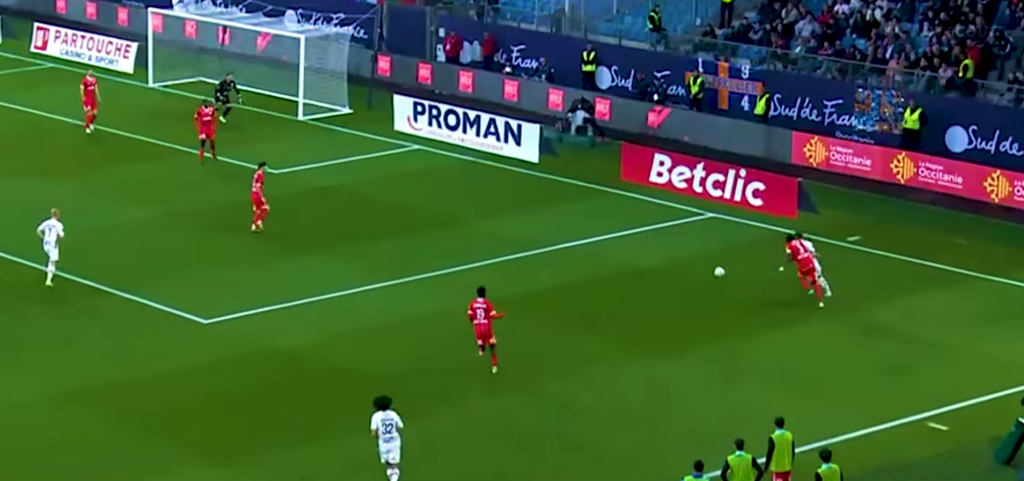
He’s gotten from the touchline to the byline and into the opponent’s penalty area to create a goal-scoring opportunity in a matter of seconds.
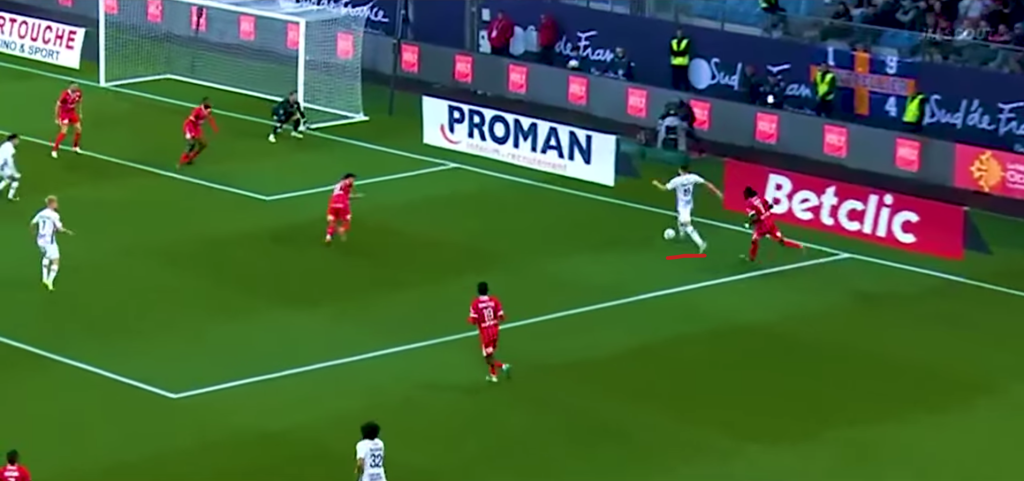
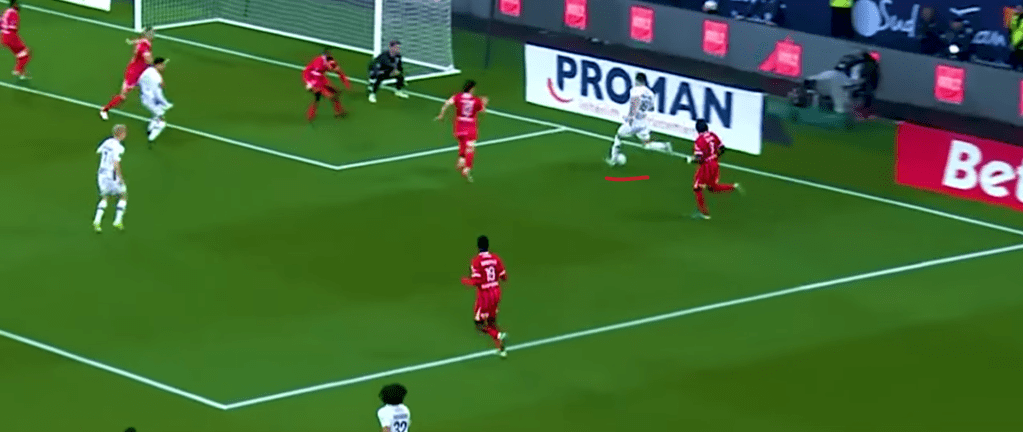
All the above examples certainly showcase Fernandez-Pardo’s expertise as a touchline winger. He’s very good at stretching the play and the opponent’s defence.

From his high-speed, highly technical play, there’s a good chance it ends in a goal-scoring opportunity for him, as in the example below.
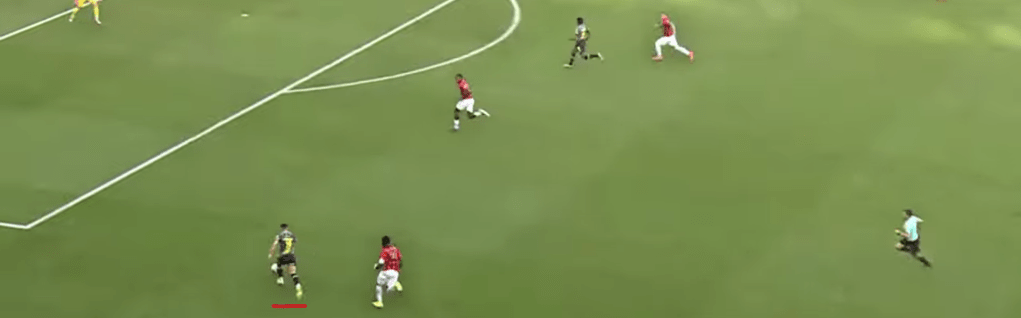
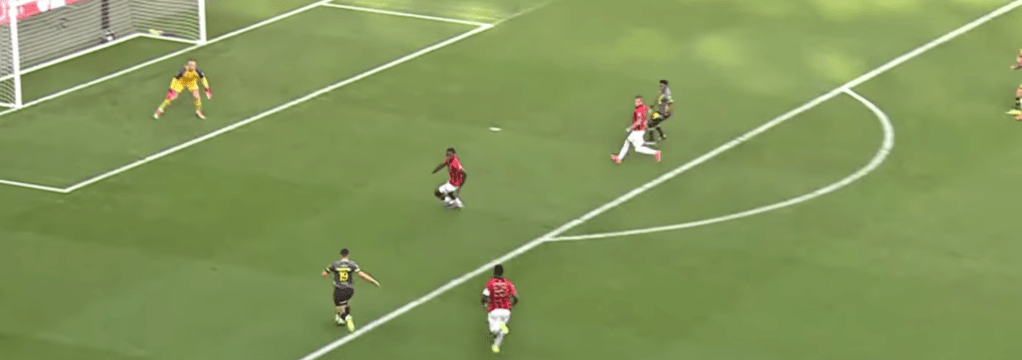
When given the opportunity to beat his man in those 1v1 scenarios, as Lille’s attacking approach demands, he fulfils those responsibilities with great regularity and consistency, whether on the left or the right.

Central creative brilliance

But, you wouldn’t do his abilities any justice if you confine Fernandez-Pardo to one of the wide roles.

While he’s exceptional as a winger, he’s also very adept and as dangerous in the central areas, whether that’s cutting inside from wide-left or performing as a #10.
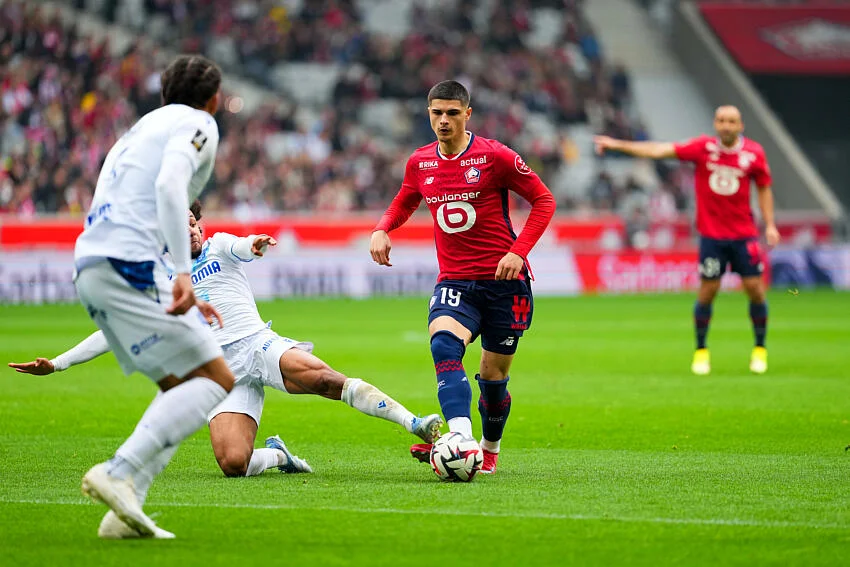
One facet that remains true of the former Gent attacker is that wherever he is in attack, he is effortlessly creative.

So far this season, he’s created four big chances and averages 1.3 key passes per game. In his last four Ligue 1 games for LOSC Lille, he has provided ten key passes (SofaScore).

His underlying stats make for good reading, too. According to FBRef, over the past year, Fernandez-Pardo ranks in the 85th percentile for attacking midfielders and wingers in terms of xAG per 90 (expected assisted goals), 79th percentile for assists per 90, 86th percentile for goal-creating actions per 90, and 88th percentile for carries into the opponent’s penalty area.

In Ligue 1 this season, at the time of writing, he ranks 1st out of all players in the French top flight for goal-creating actions (7), first for progressive carries (41), first for carries into the penalty area (25) and fifth for passes into the penalty area (18) (FBRef).
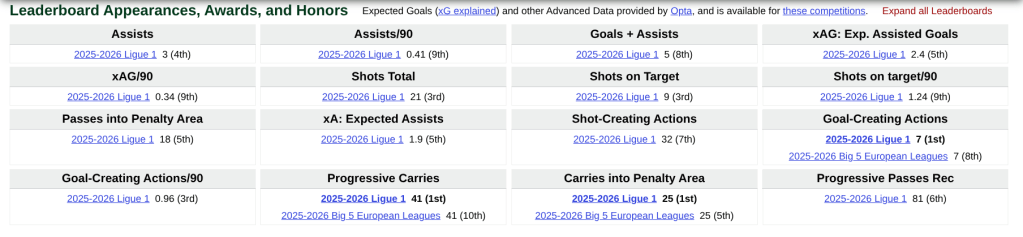
Of all players in Europe’s top-five leagues, he ranks 5th for carries into the penalty area, 8th for goal-creating actions and 10th for progressive carries.

Impressive reading, isn’t it? Remember when we pointed out that stats don’t always give a complete picture of a player’s abilities? In the case of Fernandez-Pardo, it doesn’t, but it certainly provides the ideal complement.

These numbers all stem not only from the youngster’s attacking brilliance, but also from his excellent variation and versatility. At specific points during 2025, he’s been asked to play at #10 or even as a false-nine outlet, as well as in his responsibilities out wide, and he’s taken them on and thrived.

When the former Belgium under-21 international picks up the ball in those central areas, extraordinary occurrences tend to happen.

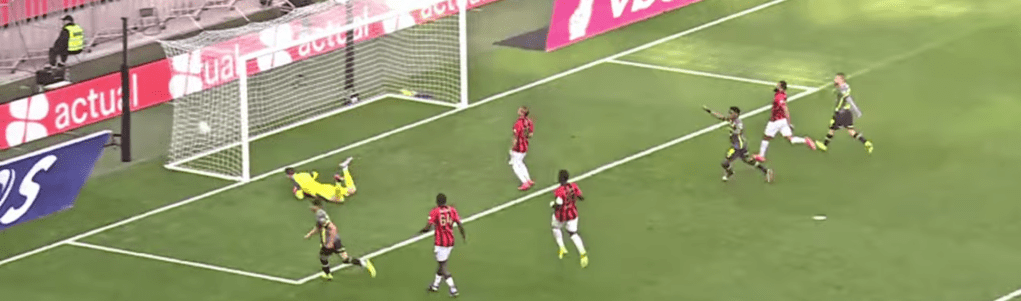
One of his four Ligue 1 goals last season came as a result of him picking the ball up deep in central areas.

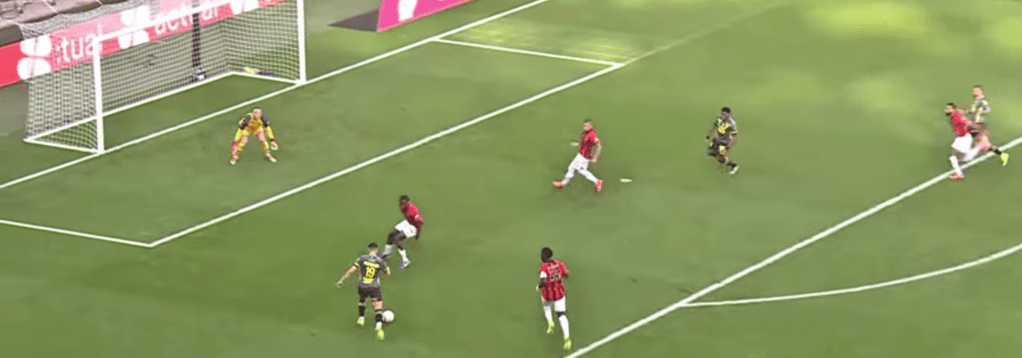
As is the norm for Fernandez-Pardo, he drives at the heart of the opposition defence, and finds himself in a telling position, with two options to choose from…
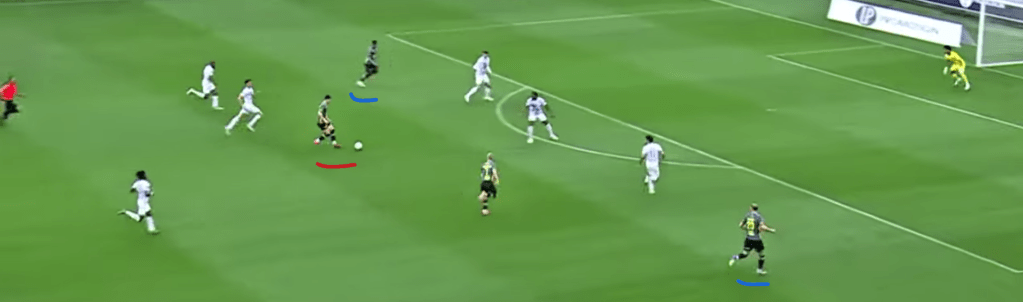
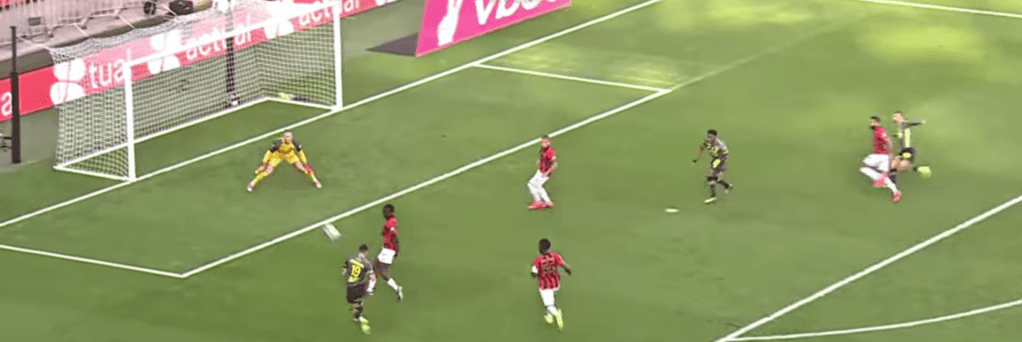
…he instead goes for goal himself, which is understandable given the opposition defensive line could possibly have both of those teammate options covered.

But, it turns out to be something special…
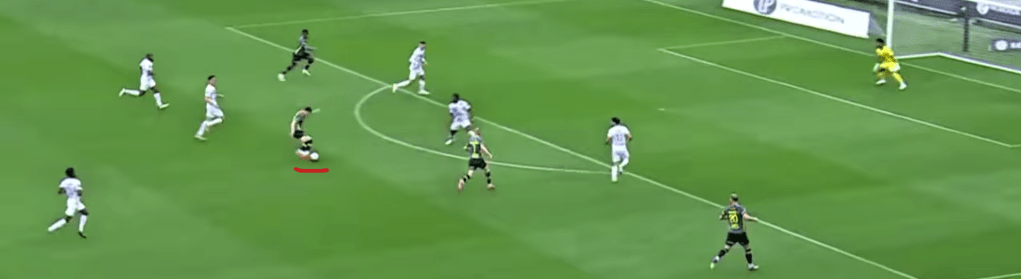
You’d be forgiven to think, as he’s attempting the strike, that it’s the wrong choice or that so many talents his age go on and take that shot but blaze it over the bar or mishit the shot wide.

But, given the Spaniard’s mentality and willingness to attempt the audacious, it somewhat pays off.

The first thing he does, however, picking up the ball and driving into such a position, is just as impressive, and once again highlights the kind of talent Fernandez-Pardo is. He doesn’t mind picking up the ball centrally, where he’s under most pressure when receiving.

In the example below, he picks up the ball deep in his own half as Lille tries to play their way out of OGC Nice’s pressure, desperately needing an outlet to take the ball despite the press and evade it.

Well, step forward, Matias Fernandez-Pardo.

He comes to receive the pass, then immediately deceives the opponent by dropping his shoulder one way and moving the other, allowing the ball to roll across him.
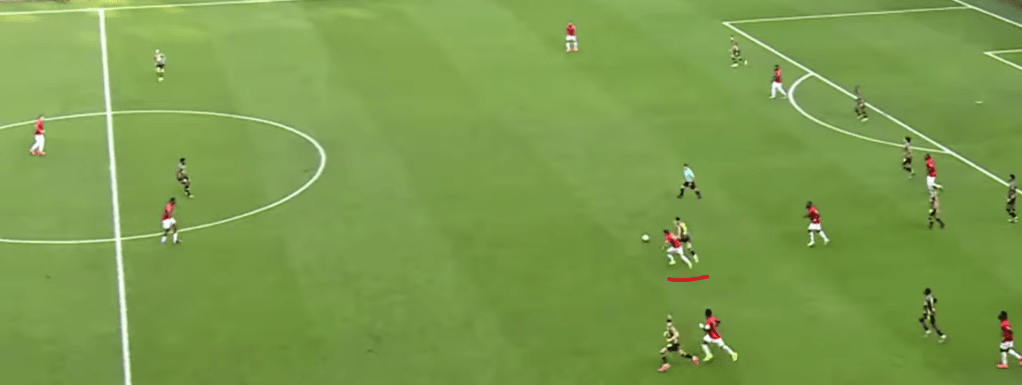
Now, look how the opponent’s high press is carved open by the Spaniard’s willingness and quality to pick up the ball centrally and drive his team into the attacking third, and as a result, he has three attacking teammates to pick out with a clear route to goal…

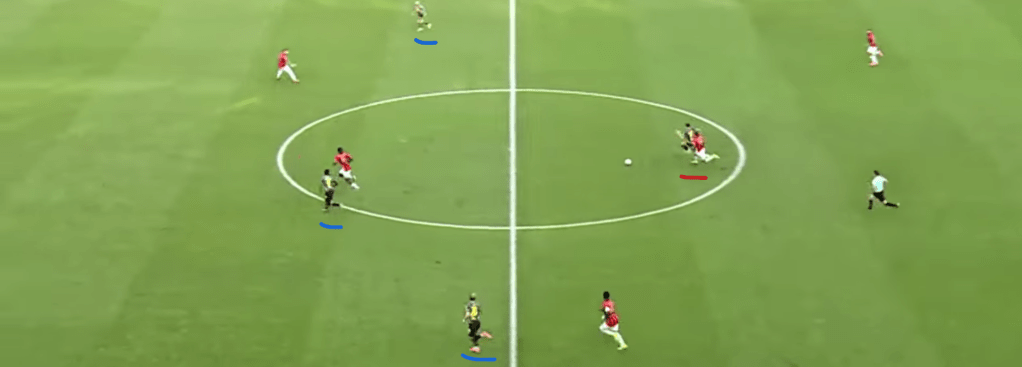
With Fernandez-Pardo in full flow and a complete picture of which teammate to choose from, the only way to stop him is to foul him, which the opponent desperately achieves.

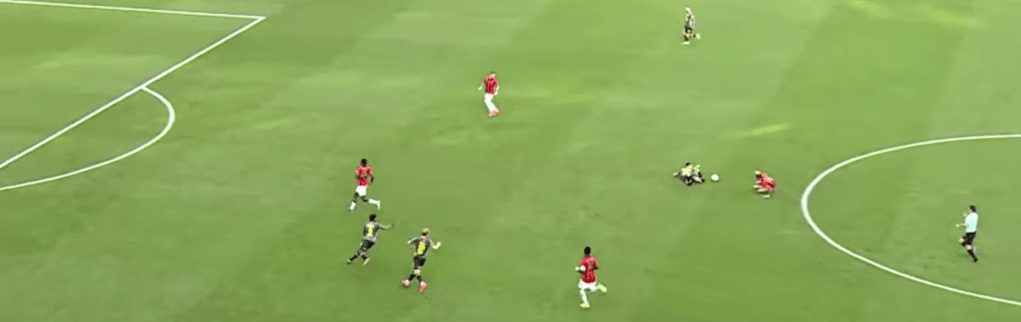
Once again, the young wizard is electric when he’s running at defenders or, in the above cases, defences. He is almost unstoppable, and the only way you can is by fouling him and risking punishment.

In another instance from the 2024/25 campaign last year, the 20-year-old picks up the ball in transition in between the opponent’s midfield and a dissected defensive line, with a full view of what’s ahead and the different avenues to goal…
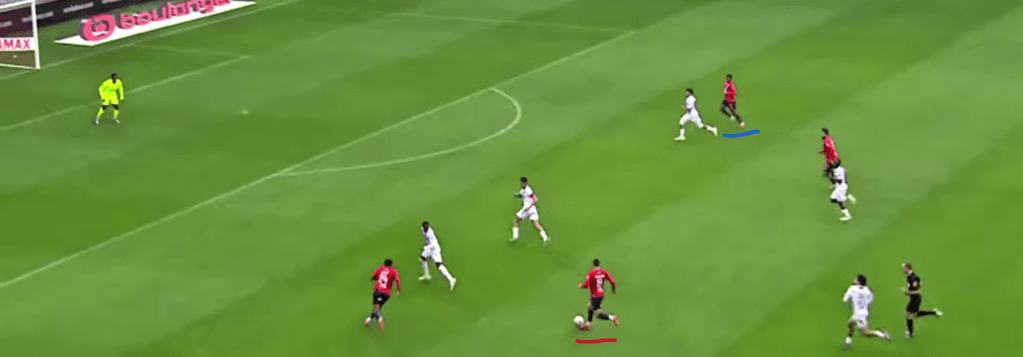
Rather than rush himself into making a decision before the midfielders join their defenders, he bides his time, takes a few more strides towards the box and allows his teammates to get into good positions for him to pass…
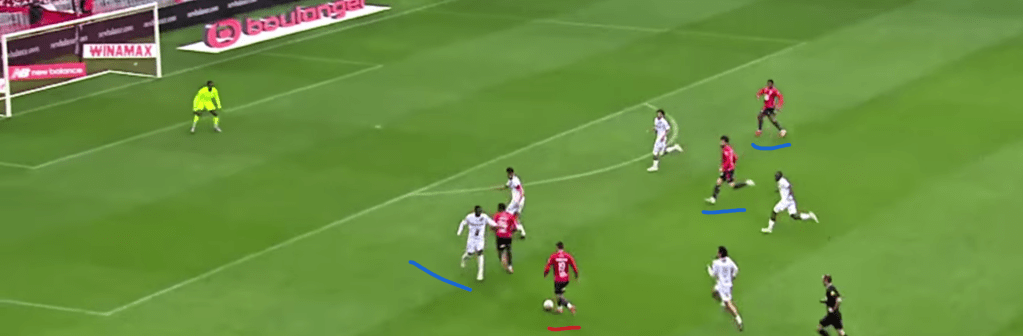
All three of his teammates are now in good goalscoring positions. He can either play a pass in behind the near-full-back, or to his teammate converging in the middle of the defence, or to Jonathan David on the far side, which seems the more difficult pass…
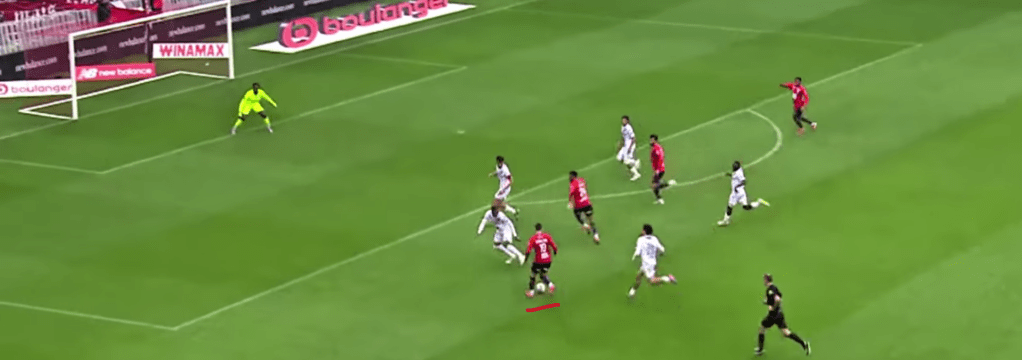
Again, what’s unique about Fernandez-Pardo is that he never once looks down at the ball; he’s always looking ahead, trying to pick out the right moment to release it. His feet are constantly moving, but his brain is meticulously calculating the best route to goal.

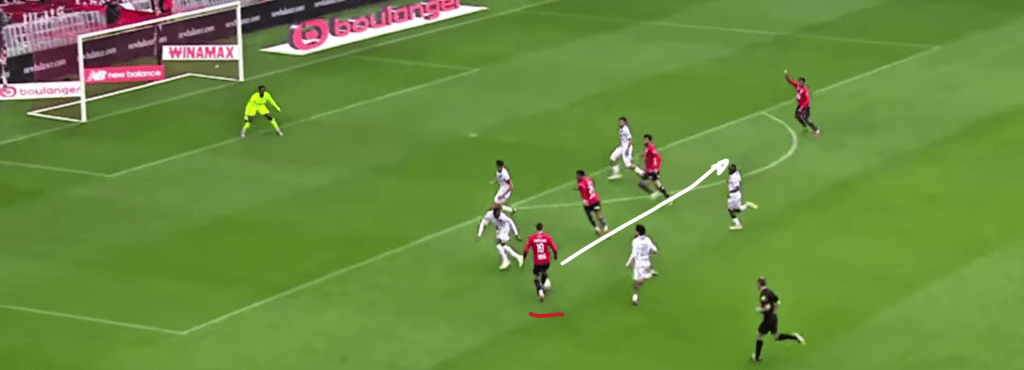
He then pierces an eye of the needle pass via the outside of his boot, in front of the defence, into the path of Jonathan David on the far side, who finishes with tremendous aplomb.
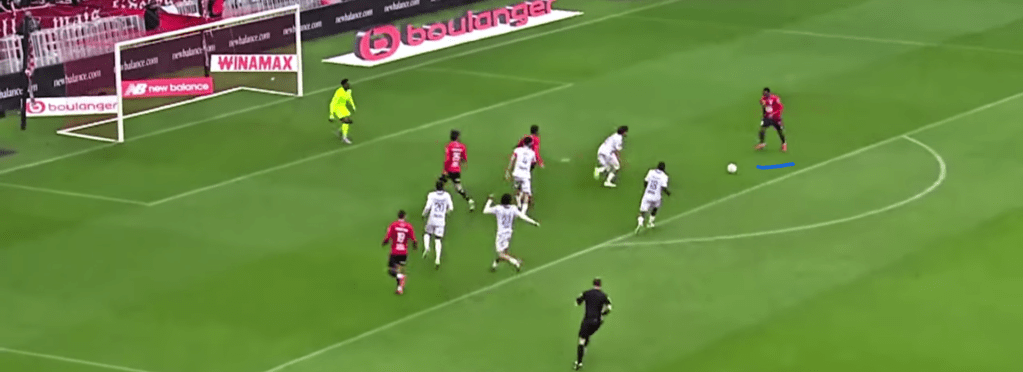
In another example, below, we see him take up a central position, pinning the centre-backs back into their penalty box,
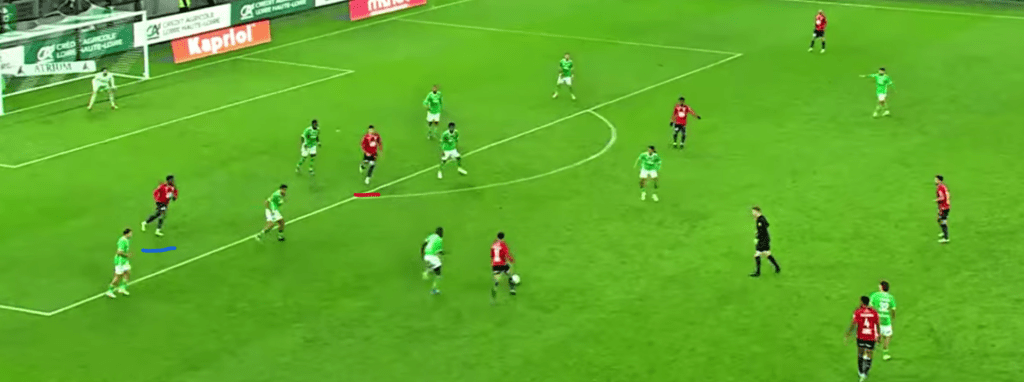
…but take note of what he does once he receives the pass.

He showcases such exemplary awareness despite being surrounded by four defenders who can intercept him at any moment…
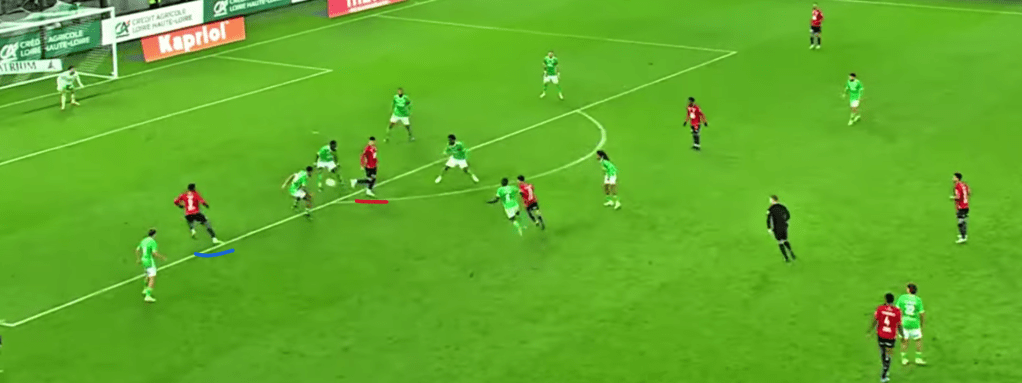
That doesn’t matter to him one bit. He completely takes them all out of the game with one sensational flick with his right boot into the path of Jonathan David (BLUE), who has a clear route and shot at goal.
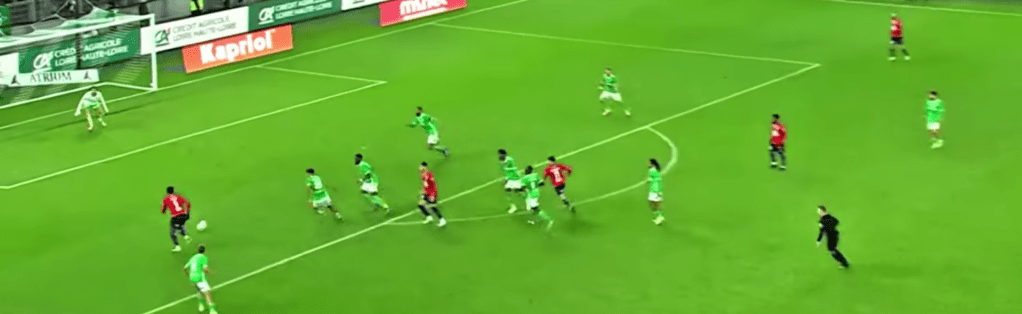
But the Canadian striker surprisingly scuffs his opportunity. However, it’s another fine example of Fernandez-Pardo’s extraordinary imagination, awareness and creativity despite the tight situation.

It’s why LOSC Lille coach Bruno Genesio has no problem playing him as a striker should the situation call for it.

Can he play as a striker, too?

The 20-year-old may not be your typical modern-day #9 when he’s playing there. As we’ve stated in this piece, he does have the quality and mentality to perform in central areas, but he becomes more of a half-nine or a false-nine, as we’re more familiar with.

One who can drop deep to receive with his back to goal, link the play, drag a centre-back marker out of position and allow his attacking teammates to run beyond him so he can feed them.

Fernandez-Pardo celebrates one of his two goals in LOSC Lille’s 7-1 Ligue 1 win over FC Lorient

However, he does have the instincts of a proper #9 through his off-ball runs, peeling off defenders to create space to shoot or create, and, at specific points, occupying the box.

In Lille’s 7-1 Ligue 1 win over FC Lorient on 30 August, the young forward was handed the #9 role, with Olivier Giroud out injured and Hamza Igamane starting on the bench, after only joining from Scottish Premier League giants Rangers a day earlier.

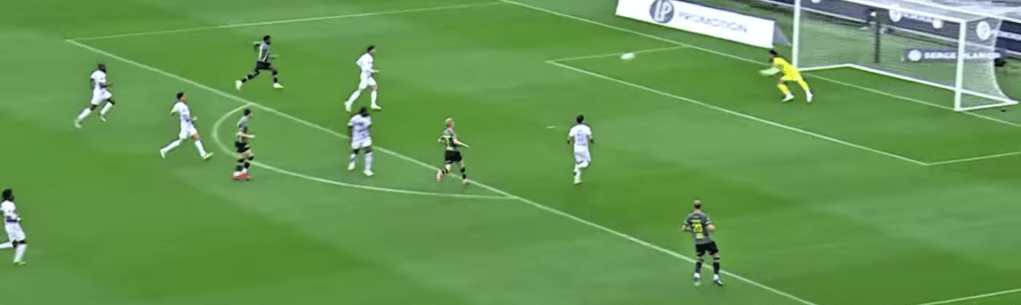
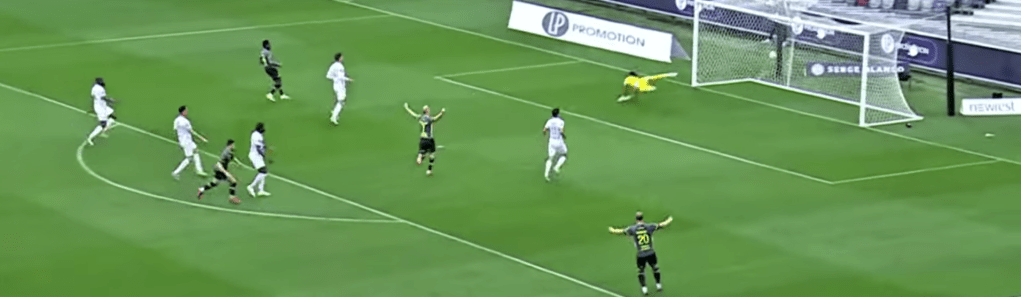
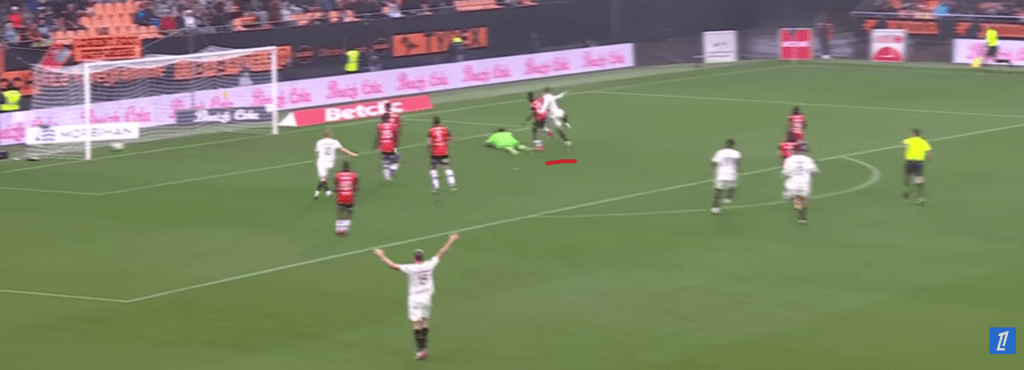
He duly paid back Genesio’s faith in him that day by scoring two goals and an unconventional assist, which won’t be registered as an official one, given his shot came back off the bar for Igamane to tap home.

Still, his actions in the lead-up to achieving those goals demonstrate his excellent maturity, positional intelligence, and undeniable creativity in the attacking third.

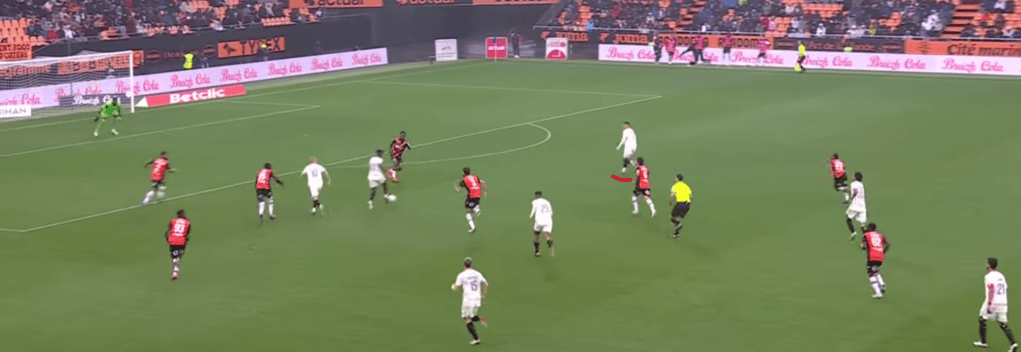
The first of his two goals, the Spaniard has peeled off the back line, looking to get involved with the play. When the ball is won in the air by Igamane, Felix Correia takes advantage of a slack Lorient defence, with Fernandez-Pardo already on the move on the far side…
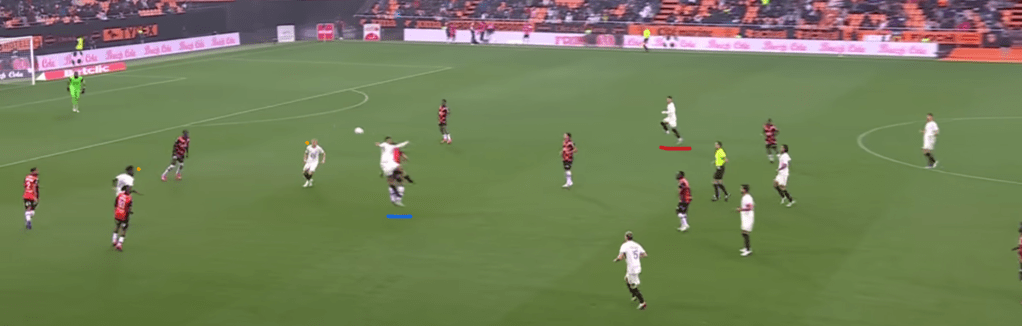
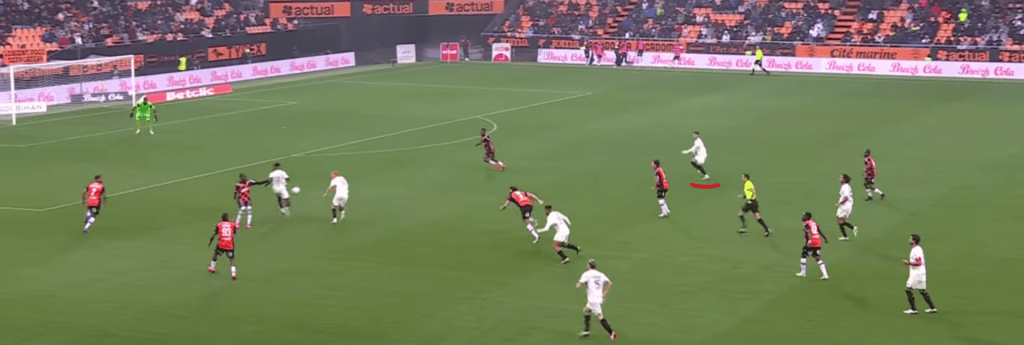
With Igamane, who is an out-and-out #9, on the pitch at this moment in the match, Fernandez-Pardo is played as the second front man in a 4-4-2. His movement beyond the former Rangers man and exploiting the gaps in the opposition defence is excellent.

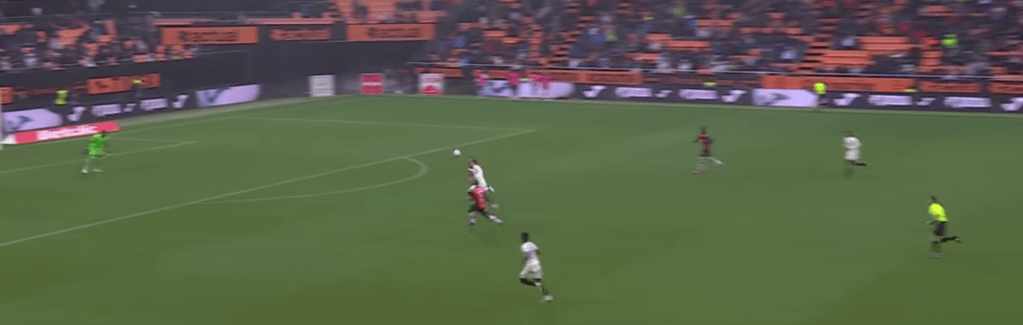
Another fine example of his excellent #9 mentality when called upon is not only in his dropping deep and linking the play, or helping his side get out of pressure when he drops, but he’s also capable of stretching the defence through well-timed last line movement and runs.

Before he even makes the move, he’s aware of what’s around him. The opposition back-line is sitting high, so he can potentially exploit the space behind, but also, his teammates are nearby. Should the ball fail to reach him over the top, they can win the second ball or press the opposition.
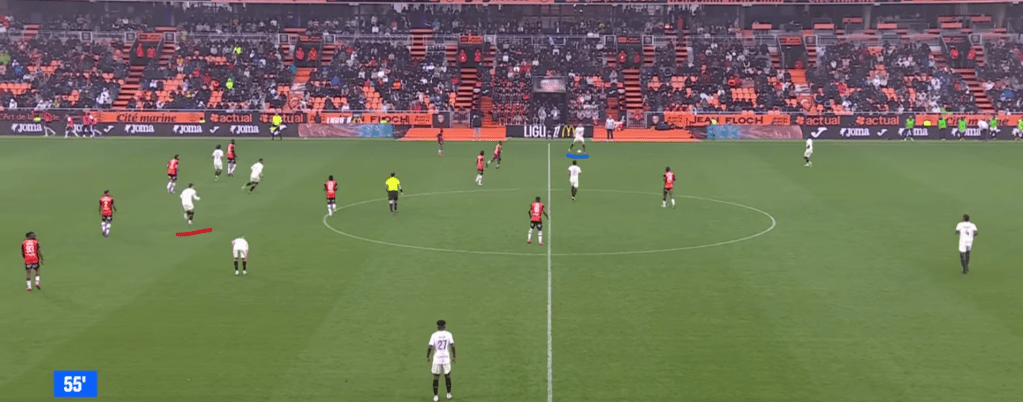
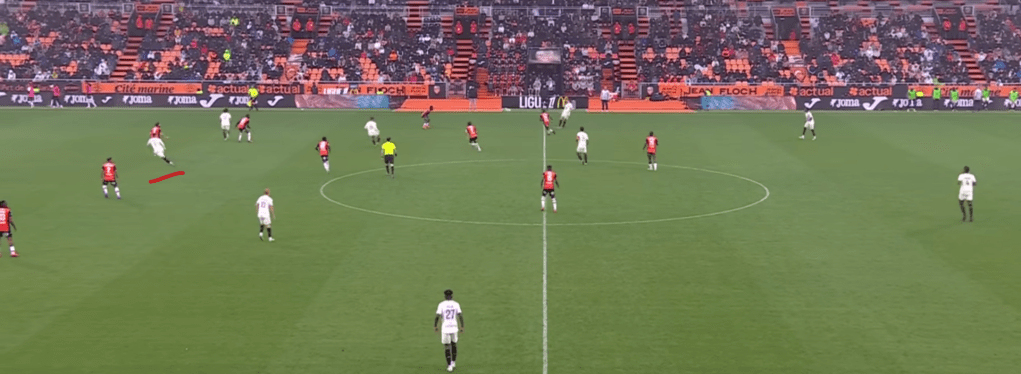
He also brilliantly checks his run to ensure he’s onside…
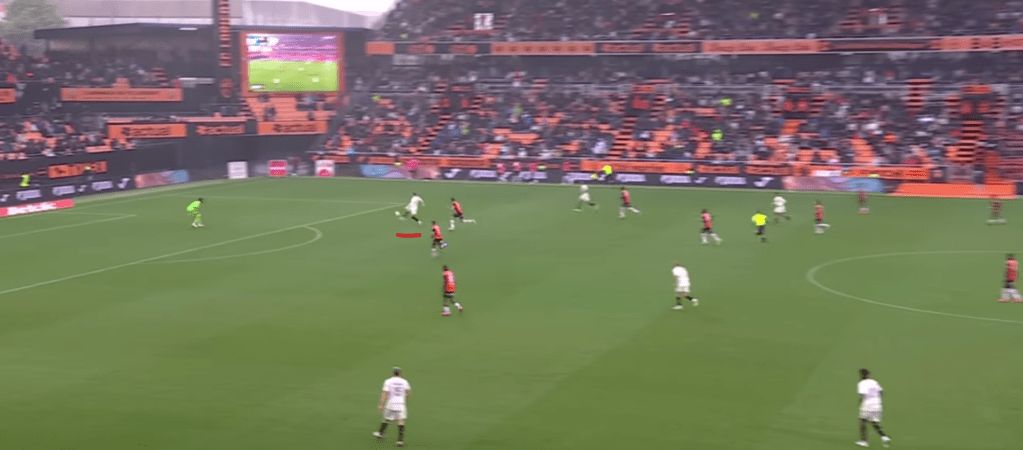
…and the long pass finds him beyond the FC Lorient defence, and through on goal, taking an excellent first touch…
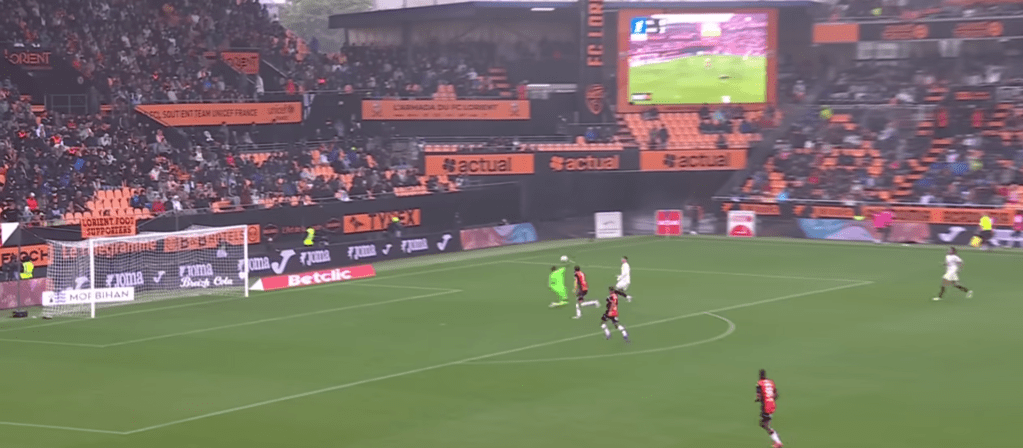
…before attempting an audacious lob
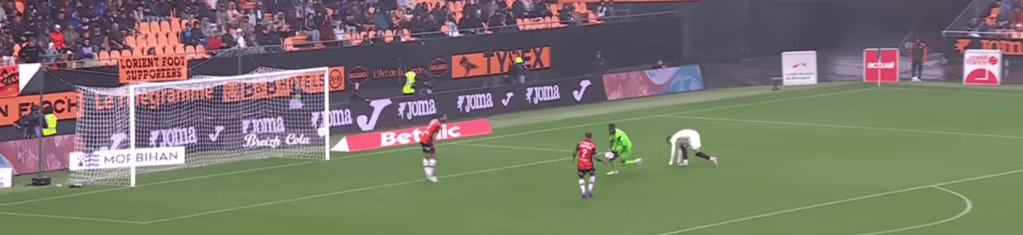
…but the goalkeeper reads his intentions well.

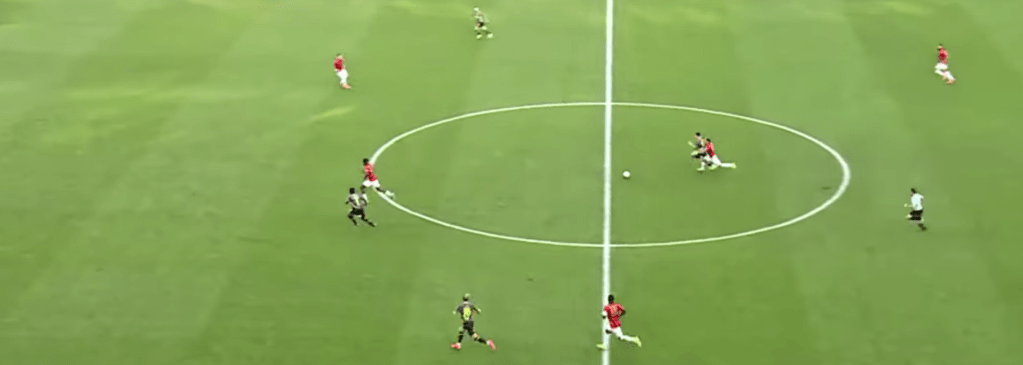
Indeed, it’s a chance he should put away, and he knows it. Still, with such an admirable mentality and determination to put it right, he gets another similar goal-scoring opportunity and puts it away for his second.

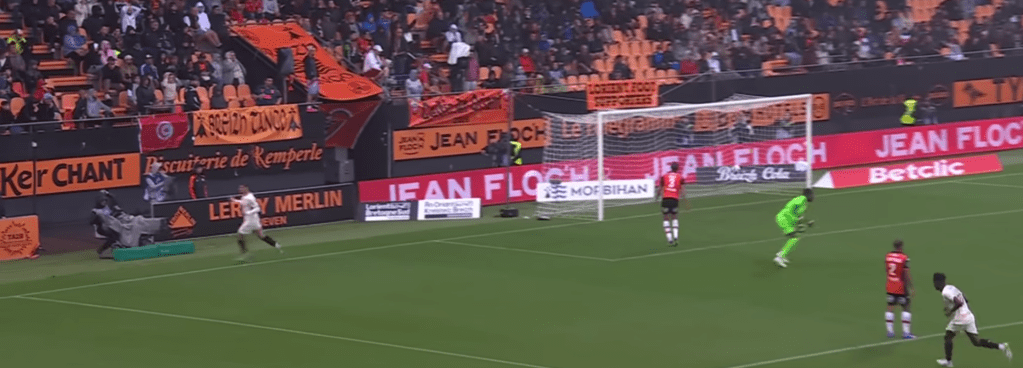
Here, Lille goalkeeper Berke Özer delivers a long ball, hoping to find one of his attacking teammates. The first to engage is an FC Lorient defender, who inadvertently attempts to head back to a teammate behind him but completely misjudges the situation, as his defensive line is so high that it presents an opportunity for Fernandez-Pardo to take advantage…
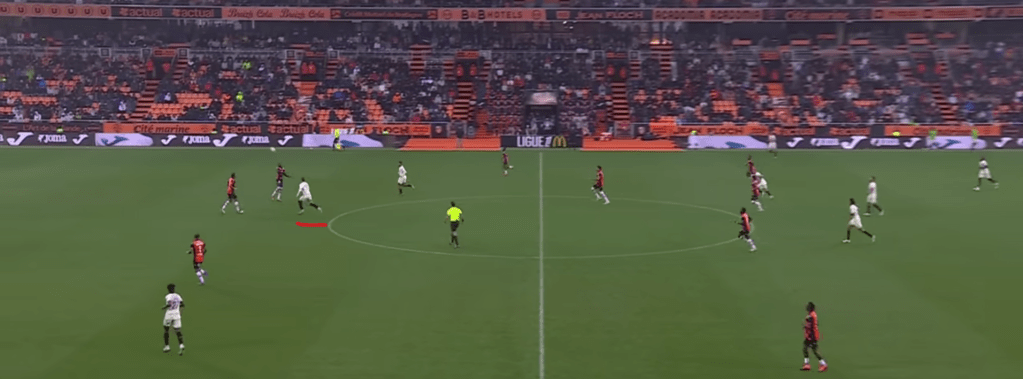
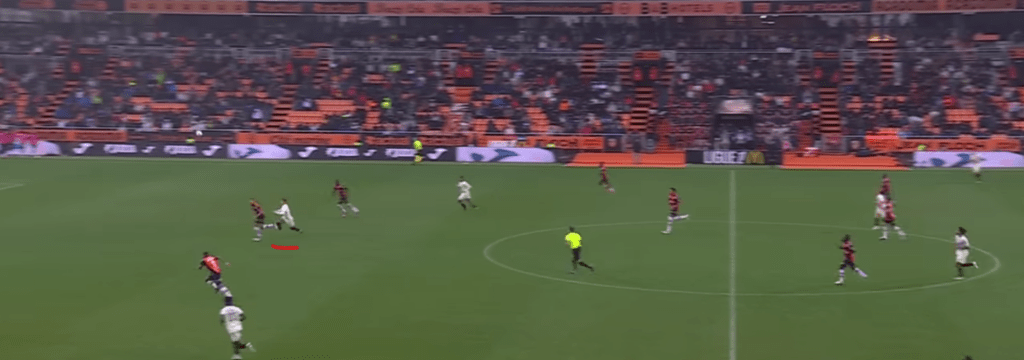
…the FC Lorient defenders simply fail to deal with the loose ball and are punished by the Spaniard’s tenacity, determination and attacking quality.

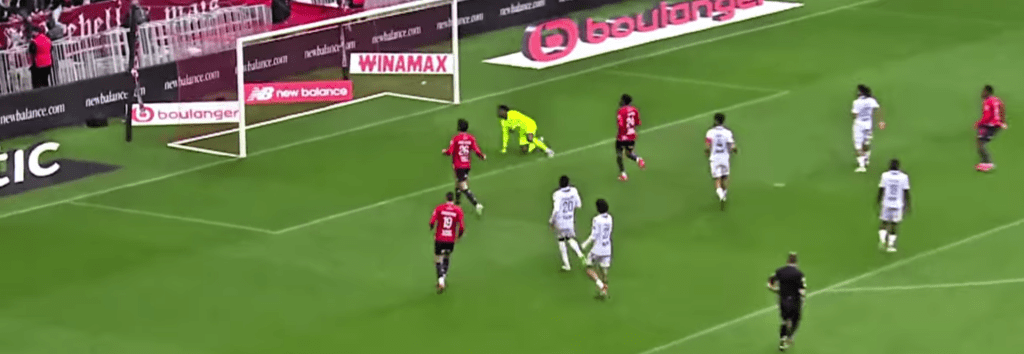
With his searing pace and ability to withstand any sort of desperate contact from the defender, he’s through on goal within an instant, and finishes with consummate aplomb…
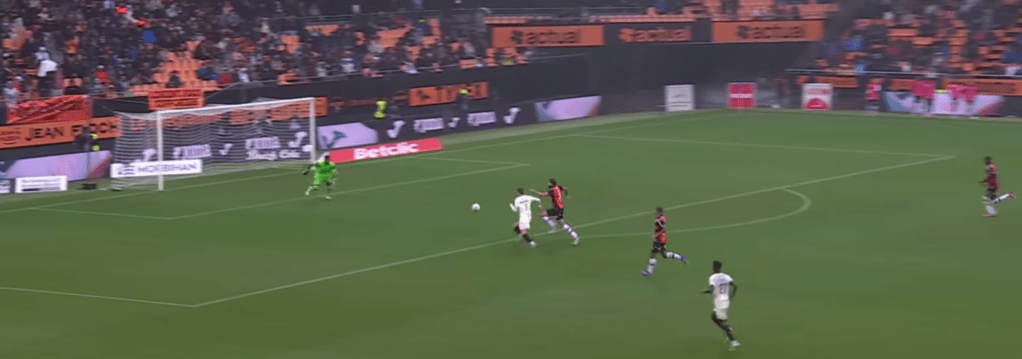
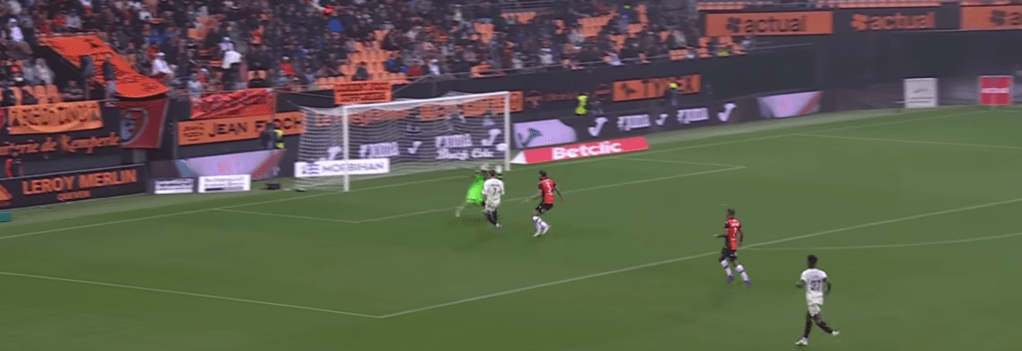
When chasing down loose balls or facing off against hesitant defenders, persistence and determination to turn those situations into opportunities are very crucial, and we’ve seen Fernandez-Pardo can do it, as shown in the example above.

Weaknesses His Strength

Off-the-ball improvements needed?

However, he doesn’t do it often enough, and the stats indeed prove why.

As per Footverse & FBRef, Fernandez-Pardo sits in the 27th percentile among attacking midfielders and wingers when it comes to tackles made in the attacking third. This statistic reveals that he struggles to win duels when opposing defenders control the ball in their own territory, making him less effective in high-pressure situations.

His performance is equally concerning in the middle third, where he ranks in the 18th percentile for tackles. Disturbingly, he falls to the bottom 5th percentile among wingers for both tackles and interceptions, painting a picture of a player who is often disengaged from the defensive effort.
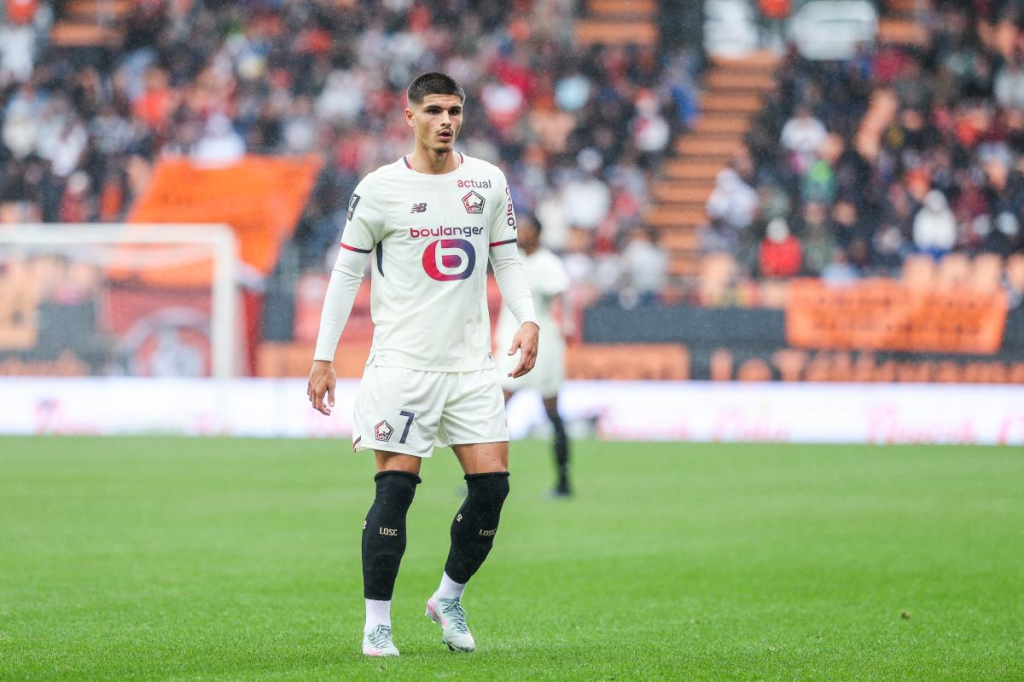
In today’s fast-paced football landscape, many elite teams place a premium on reclaiming possession high up the pitch, either through aggressive pressing against teams that build from deep or relentless counter-pressing after losing the ball during an attack. For Fernandez-Pardo, honing this crucial aspect of his game is imperative if he aspires to make a significant leap to a top league.

Attackers who fail to excel within pressing frameworks can become detrimental to their teams, providing the opposition with considerable time and space to slip away from their grasp and capitalise on the gaps left behind.

In an era where every second counts in such pressing scenarios, this vulnerability cannot be overlooked and must be addressed.

End product consistency (final pass & shot selection)

While we have delved deeply into Fernandez-Pardo’s impressive skill set in the final third, it is crucial to recognise that his conversion rate and decision-making often fluctuate.

There are moments when he makes the daring choice to shoot from less-than-ideal angles, risking the opportunity to score rather than assessing the situation with a more strategic eye.

Additionally, he occasionally holds the ball for an extra heartbeat, allowing precious seconds to slip away when a swift layoff to a nearby teammate could ignite a more promising scoring opportunity. This tendency to delay can overshadow his potential, preventing his team from fully capitalising on dynamic attacking situations.
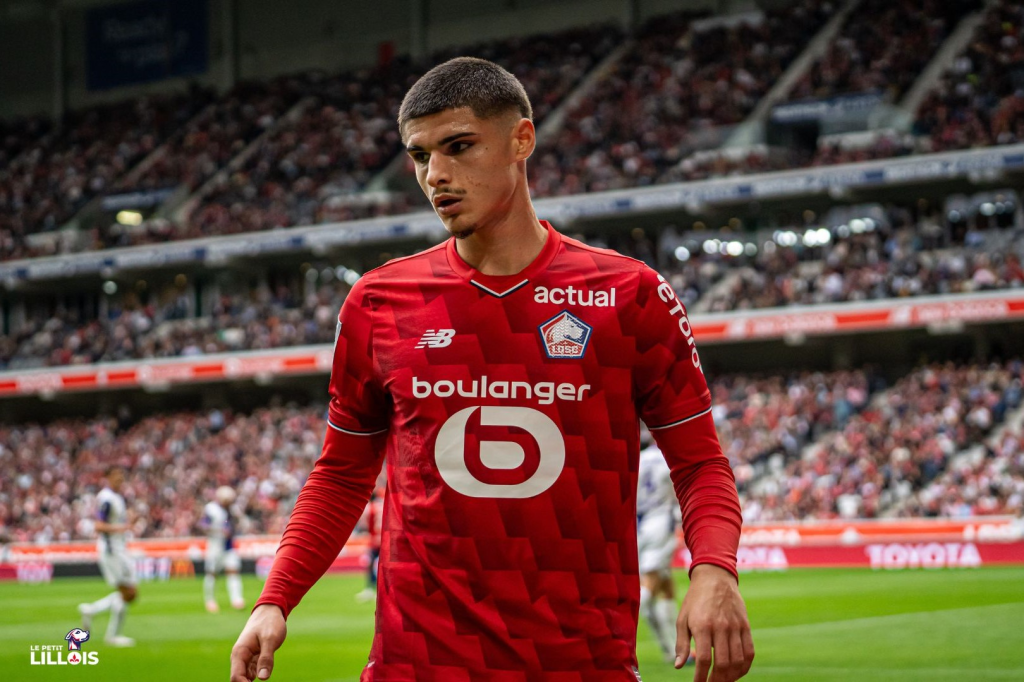
If the 20-year-old is to reach his full potential as an elite winger, he will undoubtedly need to improve his consistency in decision-making in the final third.

However, that’s why he is at a club like LOSC Lille, where he can continue working on those areas without scrutiny and pressure, where he has the room and platform to make mistakes and learn from them. There is arguably no better club in France for providing that environment and platform than at Les Douges. The number of talents who have come through and on to bigger stages from their academy is pretty strong proof of such.

Weaker foot variation

Another factor the Brussels-born winger will need to significantly improve upon is the increasing use and effectiveness of his weaker foot, especially when crossing from the wide areas or shooting when a glaring opportunity presents itself.

He’s certainly unpredictable when gaining separation from his marker and ghosting past them to advance into the penalty area, but what about when he faces a defender who reads him well and forces him onto his left foot?

If we look at all the best 1v1 and destructive attackers on the continent right now, they’ve all mastered the art of utilising their left when the chance presents itself. One player who has emerged from the LOSC Lille talent factory and has now become one of the best in his position on the planet, thanks to his incredible unpredictability and masterful use of both feet, is Rafael Leão.
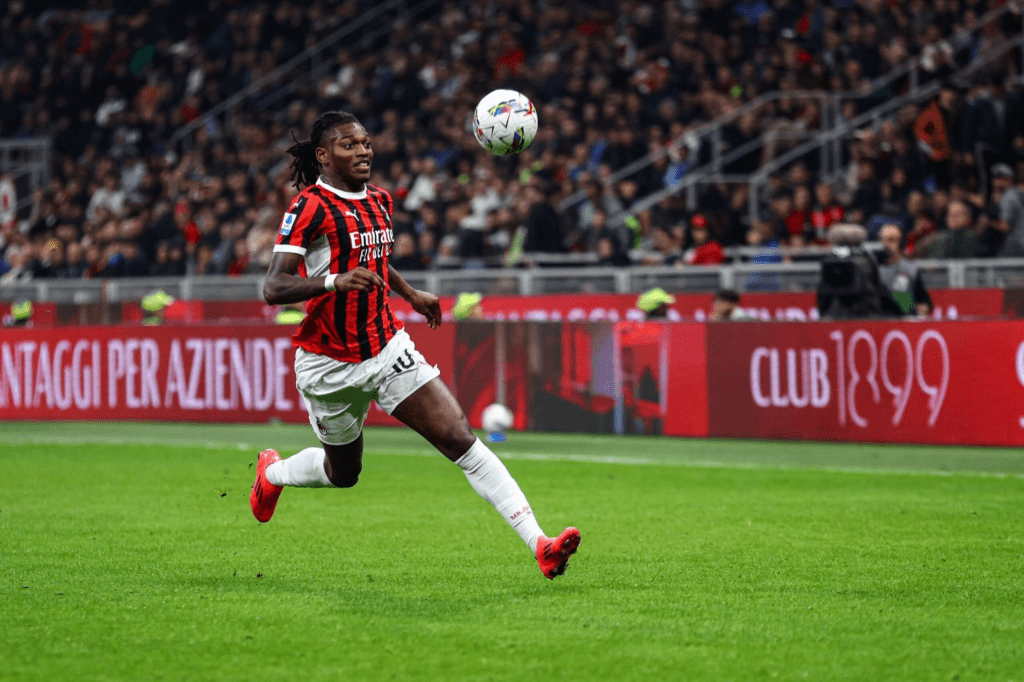
What about fellow countryman Hazard and his destructive ability with both feet? It’s not to compare Fernandez-Pardo with both players, but Leao and Hazard have reached the heights they have because of the incredible consistency in the variations of their attacking style.

Must increase 30-minute flashes

As a promising young talent, Fernandez-Pardo demonstrates remarkable explosiveness and the ability to make significant contributions to games in short, impactful bursts. His moments of brilliance can shift the momentum in favour of his team, showcasing his skill and creativity on the field.

However, there are instances during matches when he seems to fade into the background, becoming less involved in the action. This inconsistency highlights a critical area for development: enhancing his stamina and maintaining focus throughout the entire match.

The objective is to transform those dazzling 20 or 30-minute performances into sustained 90-minute displays of influence, enabling him to consistently and effectively impact both defensive and offensive phases. By building his endurance, Fernandez-Pardo can become a more reliable presence on the pitch, maximising his potential and contributing consistently to his team’s success.

What Does the Future Hold For Fernandez-Pardo?

There’s no doubt that Matias Fernandez-Pardo is on his way to becoming a future superstar.

This is quite simply a maverick-type talent, capable of changing games instantly through his exceptional technical and dribbling qualities, his unique tactical intelligence and versatility, and not to mention his elite ability in one-on-one scenarios out wide.

Currently, he is in an ideal club environment that supports his rapid and impressive development.

LOSC Lille has established a stellar reputation for cultivating emerging football talents, providing players like Fernandez-Pardo with the necessary environment to thrive.

The club not only offers a supportive platform but also allows these young athletes the crucial time needed for growth and development. This approach has proven successful with players such as Baleba, Chevalier, and Yoro, who have all transitioned to noteworthy careers.

The promising trend continues with Fernandez-Pardo, Bouaddi, and Haraldsson, three extraordinary prospects who are already drawing interest from top-tier clubs across Europe. Their exceptional skills and performances have not gone unnoticed, indicating that it won’t be long before they receive enticing offers from some of the continent’s elite teams.

Fernandez-Pardo, now 20 years old, is in the midst of his second full season with Lille. Being at this stage in his career, he is under no pressure to rush into a high-profile transfer. Instead, he can focus on honing his skills and making a meaningful impact on the pitch while the right opportunity presents itself in the future.

Genesio has led Lille on an upward trajectory once again in the French top-flight

The club are on the up again under Genesio, currently fourth in the French top flight at the time of writing, and are very much amongst the leading pack of clubs expected to be in the latter stages of the Europa League as the season progresses, which you could argue is the ideal level for the exciting young winger to develop and mature his game.

The decision to switch his international allegiance to Spain may provide him with increased visibility and valuable playing time with the under-21 national team.

This opportunity likely offers a superior platform for him to showcase his remarkable skills on an international stage, especially when compared to his earlier experiences representing Belgium.
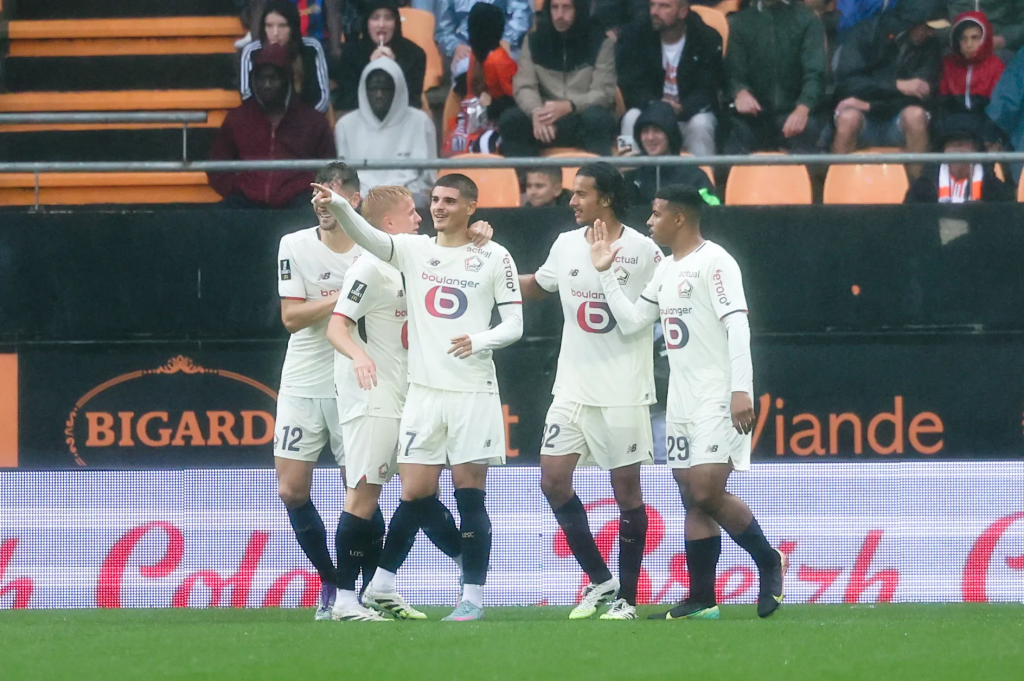
If this talented player from Gent continues to progress at his current rate, it would indeed be surprising if he didn’t catch the eye of some of Europe’s top clubs by the time the summer of 2026 arrives. Lille, known for its exceptional track record in the transfer market and ability to nurture players, is likely to consider letting him move on should they receive an attractive offer.

In the meantime, it’s crucial for Fernandez-Pardo to stay humble and focused while training at Lille, which is recognised as one of the premier talent development hubs in Europe.

With access to world-class facilities and coaching, he possesses everything he needs to unlock his immense potential. There’s no reason why he can’t join some of his predecessors, such as Baleba, Yoro, and Diakite, and more directly, Leao, amongst Europe’s elite in the near future. It’s where his unique and undeniable talents are meant to be.
Meet Cristhian Mosquera: The Next Elite Graduate From Valencia CF’s Prestigious Academy

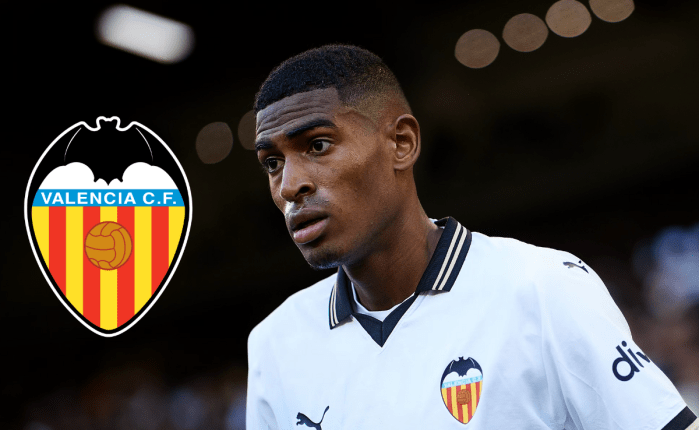
Meet Cristhian Mosquera: The Next Elite Graduate From Valencia CF’s Prestigious Academy

Ask any football fan who the most famous clubs in the Spanish La Liga are, and they’d be sure to pick out the usual culprits: Barcelona, Real Madrid, Atletico Madrid and Valencia CF, who will arguably crop up approximately eight or nine times out of ten.

In fact, you won’t be surprised to find that most would name the latter more than the former.

The club from the southeastern Mediterranean coast of Spain has had many great squads and managers in its decorated history.

Remember some of their famous players, David Villa, David Silva, Santiago Canizares, Vincente, David Albelda, Juan Mata, Ever Banega & Pablo Aimar or in their past managerial department, Rafael Benitez, Claudio Ranieri, Ronald Koeman & Unai Emery?

Pretty glowing & decorated indeed.

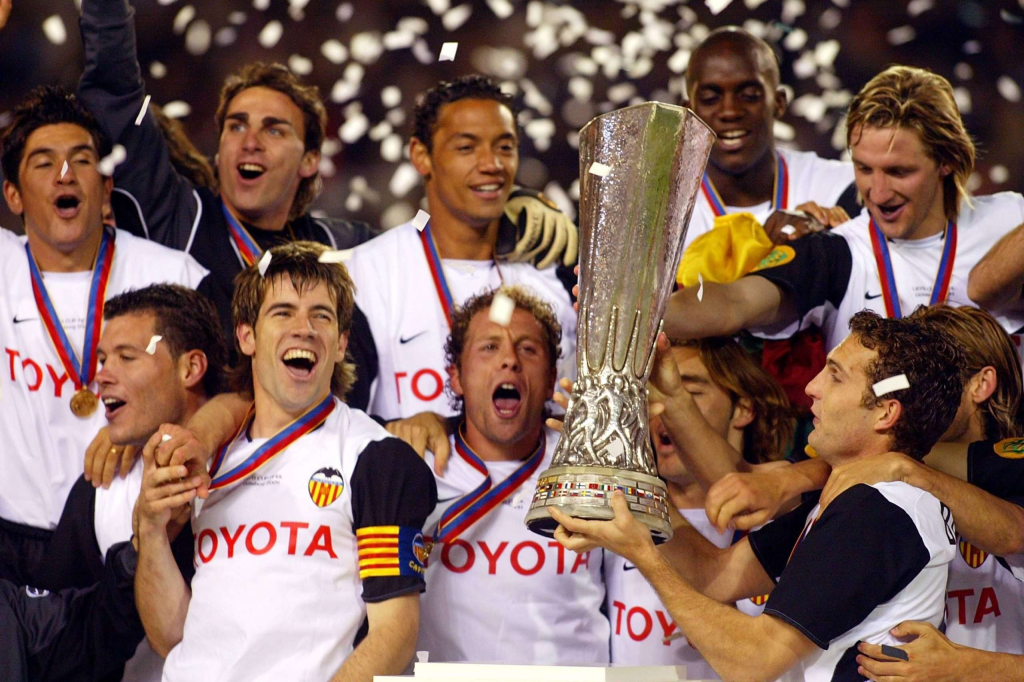
Their peak was at the start of the 2000s when they reached two UEFA Champions League finals and won the UEFA Cup and La Liga in 2004 under Benitez.

Valencia CF celebrate winning the 2003/04 edition of the UEFA Cup under Rafael Benitez’s management.

However, the club fell into somewhat of a great depression because of a series of bad financial decisions and the 2008 financial crisis.

They never managed to recover and, therefore, were sold to investor Peter Lim.

In the early stages of the takeover, things seemed upward, with the club qualifying for the Champions League multiple times.

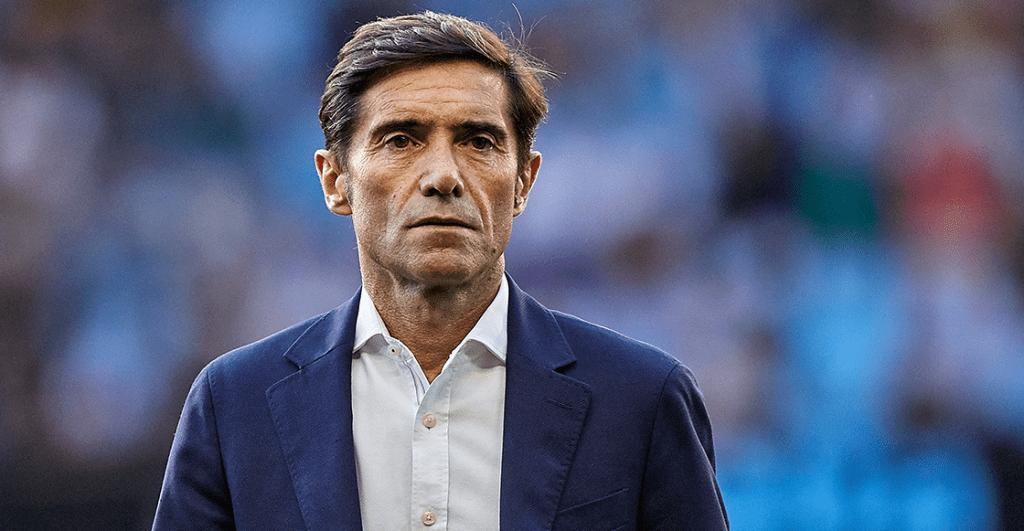
Under manager Marcelino, the team finished fourth in La Liga in consecutive seasons, 2017/18 and 2018/19, and even reached the semi-final of the UEFA Europa League in 2019, also winning the Copa del Rey that year.

Marcelino guided Valencia to Spanish Copa Del Rey success in 2019 before being sacked the following season.

After that, Marcelino was fired by Peter Lim himself, and the club found itself in a downward spiral, being forced to sell star talent like Carlos Soler, Ferran Torres or club legend Dani Parejo and only being able to replace them for cheap or through their academy, which is one of the best in Europe.

Ever since Marcelino’s sacking, Valencia’s league positions have fluctuated, finishing 9th, 13th, 9th, 16th and 9th over the last five years whilst having to rummage through a handful of managerial appointments to find out its best fit, but to no avail.

The current 2024/25 campaign has proven to be arguably their most tumultuous.

After only winning two out of their last 24 league games, legendary Valencia midfielder Rubén Baraja was relieved of his duties as manager with the club steeped in the relegation zone.

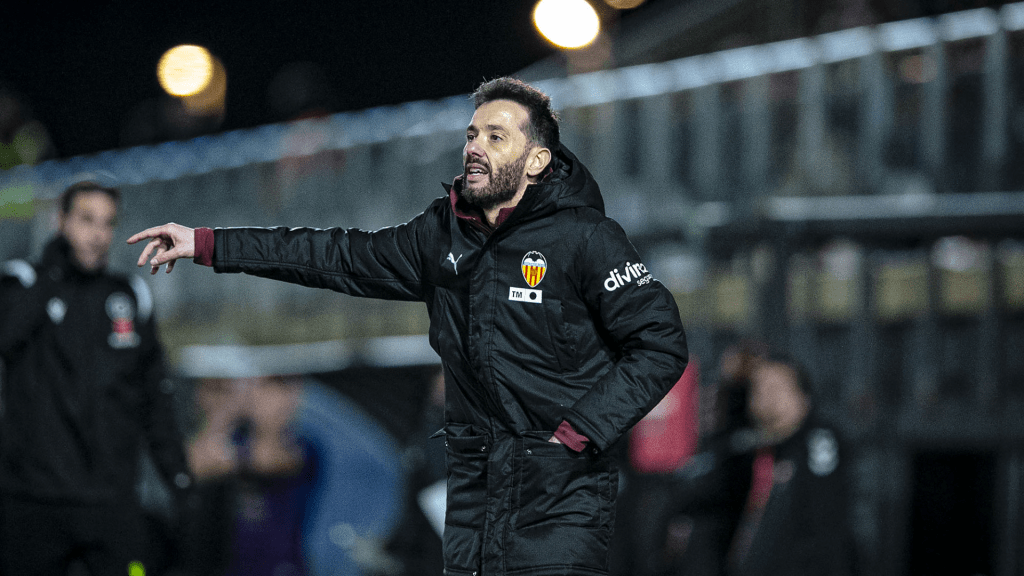
At Christmas, desperate times called for desperate financial measures as they activated a release clause of between £3-4 million to acquire talented West Brom head coach Carlos Corberan. Four months on from that decision, Los Che have enjoyed an upward trajectory on the field.

Former West Bromwich Albion coach Carlos Corberan has made a considerable impact at the Mestalla Stadium since his appointment in December.

At the time of writing, they’ve won the second-most points total (25) [Transfermarkt] of any club in La Liga since Corberan’s appointment, and now currently sit 14th in the table, seven points off the drop zone.

Since the Spanish coach took over at his dream job, Valencia have lost just four out of 16 games, against Real Madrid, Atlético Madrid and twice against Barcelona. They’re unbeaten against everyone else they’ve faced, and that’s down to Corberan’s impact both tactically and in his personable management.

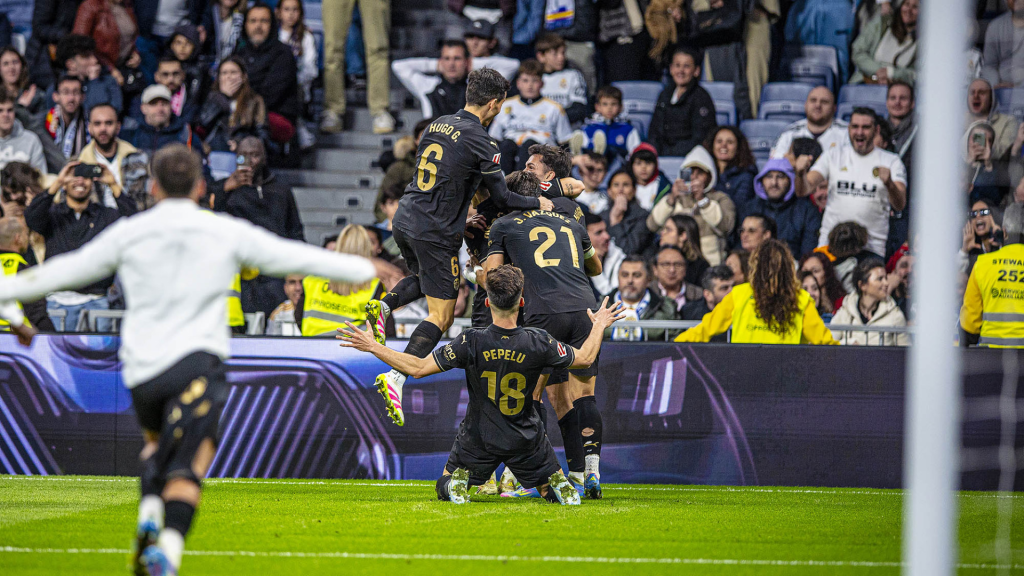
Valencia also recently beat Real Madrid on their own turf – the first time they’ve done so since 2008 and their first away win of the campaign – another massive signifier of Corberan’s stellar impact at the Mestalla in just four months.

Even if the club’s off-field matters continue to plague the club’s standing amongst the elite in Spain and their reputation in Europe, their current form under Corberan is certainly providing a light at the end of an incredibly dark tunnel.

One element Valencia continue to find some sense of pride in is its flawless academy, with a number of their young talents currently thriving under Corberan’s tutelage.

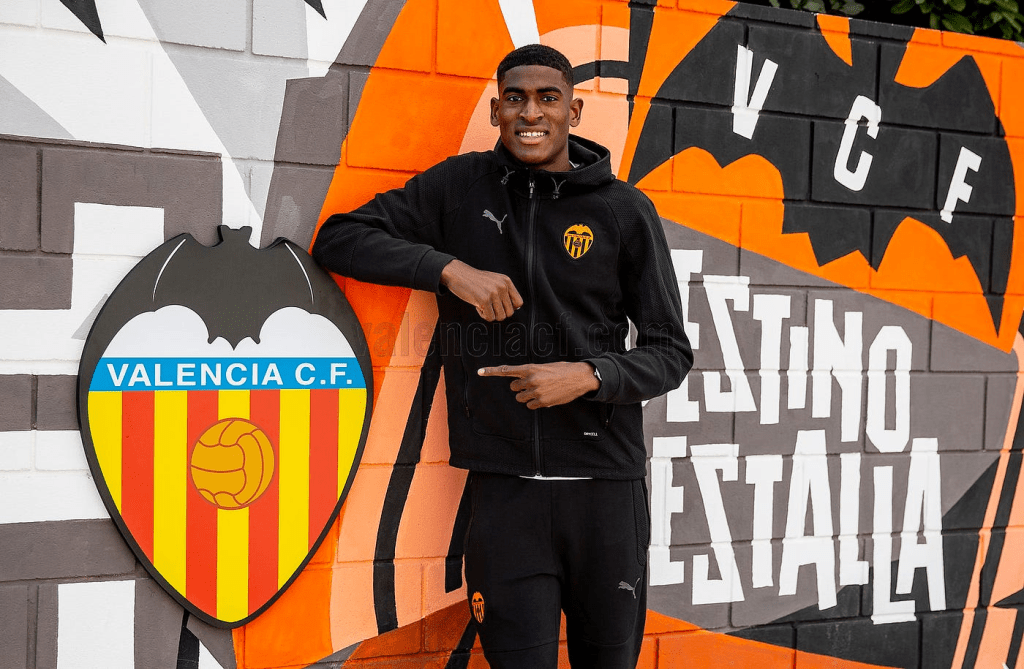
Javi Guerra, Yarek Gasiorowski, Fran Perez, Jesús Vázquez and Diego Lopez are a few of their most exciting academy graduates, but one player arguably garnering the most attention both domestically and within Europe’s elite is young, uniquely gifted centre-back Cristhian Mosquera.

The current campaign is Mosquera’s second as an established first-team player at Valencia, and he is already showcasing why he is considered one of the most complete young centre-backs in Europe.

As a result, he’s attracting a whole host of interest with the likes of Barcelona, Real Madrid, Juventus, AC Milan, Bayern Munich, Liverpool and AS Roma all rumoured to be casting an eye on him over the past year.

It won’t be long before the Spanish under-21 international is Valencia’s next big sale in the transfer market. So, how has the 20-year-old gotten to this stage in his career & what will he offer potential suitors?

Who is Cristhian Mosquera?

The story of Cristhian Mosquera starts in Alicante, Spain, a coastal city in the south of the Valencian Community.

He was born to Colombian parents and, at a young age, picked up the sport of basketball instead of football.

Mosquera grew up during the NBA’s global rise when Pau Gasol was winning championships with the late Kobe Bryant.

Given the Spaniard’s height and physique, it’s no surprise to find that he could well have been donning an LA Lakers jersey rather than a Valencia CF had he gotten his own way.

But it was on a Futsal pitch where Mosquera started, developed and honed the unique footballing qualities that we see in his game today.

He joined a local youth team for the sole reason that his cousin played for the team, and they needed a player due to being a man short.

Whatever happened during that period certainly persuaded Mosquera to try out a full eleven-a-side pitch, and it all led to him making his move to the Valencia CF youth team.

He then moved up the ranks quickly, making his full first-team debut in a January 2022 Copa del Rey victory over CD Atlético Baleares.

At 17 years, 6 months, and 23 days, Mosquera became the eighth youngest debutant for Los Che in their club’s history, as well as the youngest ever centre back.

Since then, the now 20-year-old has become the bedrock and heartbeat of the club’s defensive line ever since his La Liga debut against Sevilla in 2022, continually growing and developing to become one of Spain’s most prestigious young footballers.

He’s yet to feature for Luis de la Fuente’s European champions, continuing his development and maturity for the youth teams, but it certainly won’t be long before he’s performing at the highest level not only at club level but for Spain.

However, Mosquera also holds a Colombian passport, making him eligible to feature for Los Cafeteros should he find his opportunities for the Spanish senior side limited.

So far this campaign, he’s clocked just under 3000 minutes of football for Valencia. Last season, he registered 3,252 minutes, highlighting his incredible durability and availability for the club- a unique characteristic that elite clubs will be looking for when trying to sign a young, reliable and workaholic centre-back.

Mosquera, without a shadow of a doubt, will fit the bill for several of Europe’s best.

Dissecting the Cristhian Mosquera Hype / Style of Play

There’s the old saying, ‘Never judge a book by its cover, ‘ but in Mosquera’s case and for the sake of this analysis piece, we simply have to go against the old adage because the Spaniard’s cover arguably makes up for his exceptional footballing gifts.

At face value, when looking at the 20-year-old, the first characteristics you’d notice are his striking physical attributes.

Standing at 6’2″, Mosquera commands attention with his impressive physique and striking presence. With broad shoulders, a lanky frame and a solid build, he resembles a centre-back that could have been designed in a lab to meet the ideal specifications of modern football.

The Los Che academy graduate embodies the quintessential traits of a contemporary centre-back, perfectly blending physical prowess with a refined understanding of the game.

Mosquera’s height and strength enable him to dominate in aerial duels, while his keen tactical awareness and agility add to his imposing on-field persona.

Antonio Rudiger Regen?

The young Spaniard is drawing compelling comparisons to the formidable Real Madrid centre-back Antonio Rudiger.

Each match you watch intensifies the similarities, revealing a blend of poise, strength, and tactical awareness that echoes Rudiger’s commanding presence on the pitch. The parallels in their playing styles are becoming increasingly striking and undeniable, adding depth to the admiration for this emerging talent.

Should Real Madrid be looking at potential Rudiger replacements in the near future, Mosquera should certainly be at the top of their list.

Like the German, Mosquera is a commanding presence, a true backline leader, and an unstoppable force and given his knowledge and understanding of the Spanish top flight, he’d fit right in at the Santiago Bernabeu.

There’s a reason Mosquera is highly regarded amongst Europe’s elite, and before we can delve into his attributes/abilities, let’s see what the stats say.

Stats a fact

Immediately, two attributes stand out for Mosquera: defensive action volume and duel success rate.

The defensive actions component is encouraging but can be influenced heavily by possession, and with Valencia sitting 14th in the La Liga for possession of the ball [FBRef] this season, it explains a good bit of his success. 

Los Che under Carlos Corberan have improved considerably defensively. Their freak 7-1 defeat to Barcelona in late January should arguably be considered an outlier since the change in management.

The only other time they’ve conceded more than twice in a game since then came in their 3-0 defeat to Atletico Madrid a month later. Yes, it’s only hypothetical, but if not for those two results, Valencia would hold one of the best defensive records in the league since the turn of the year.

Corberan has moulded and shaped Valencia into a more dogged, organised and determined defensive unit, just like he did for Sky Bet Championship side West Brom during his tenure in Birmingham. Los Che may not have the ball all the time, but they are well-versed in controlling their opponents regardless.

Throughout his tenure, the Spaniard has alternated between 3-4-2-1 and a 4-2-3-1 formation, with his wingers dropping back out of the 4-2-3-1 to form a back-three with two wing-backs early on.

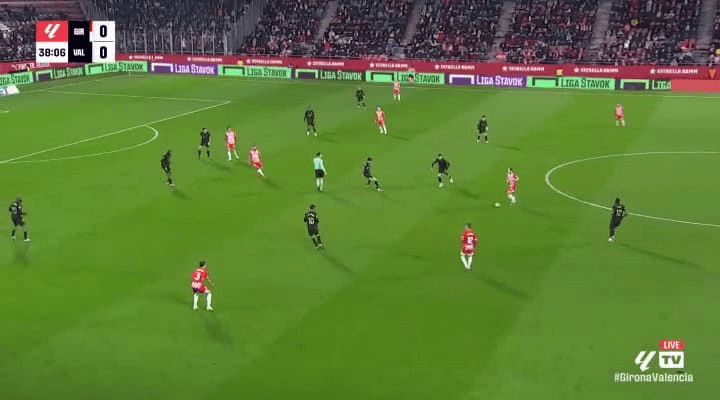
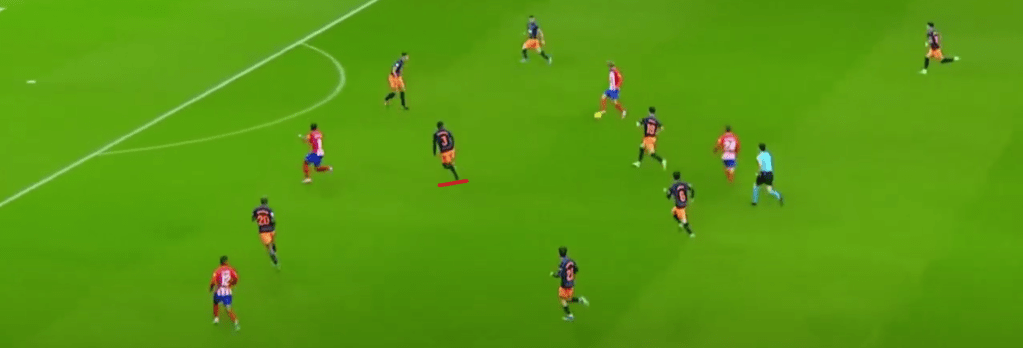
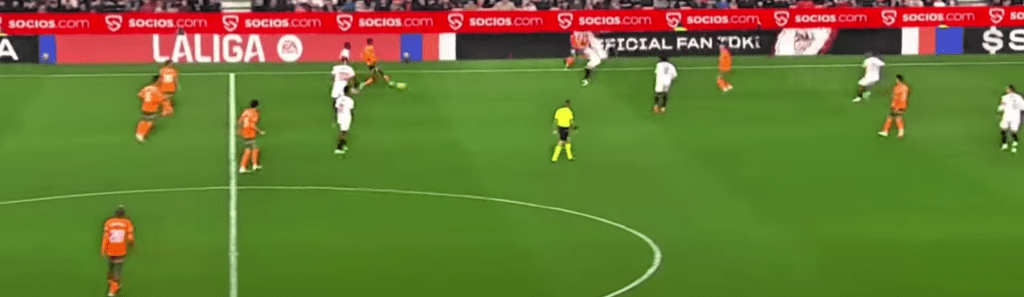
In the above image, we can see their defensive shape up against Girona with five defenders forming the last line with the three centre-backs, including Mosquera, and the wing-backs marking Girona’s attackers.

André Almeida and Diego López, the attacking midfielders or wingers per se, are dropping to the height of the two central midfielders to create another line in front of the defensive line.

This line is focused on defending the centre of the field and is aligned to cover the gaps in Valencia’s backline.

Mosquera’s role [the second to last man – from right to left – in the Valencia backline] is to engage and track his marker in front whenever the player receives in between the lines but also he’s tasked in sweeping up any loose balls in his zone while also providing strong coverage to the central centre-back César Tárrega.

This campaign, he has been instrumental for Valencia, contributing to seven clean sheets so far. His defensive prowess is evident, as he averages 1.1 interceptions and 1.4 tackles per match. Remarkably, he recovers an astonishing 5.4 balls and has been dribbled past a mere 0.3 times. With 3.1 clearances per game, his impact across the defence is undeniable, mastering the art of last-ditch, timely defending.

You’ll find in this article that Mosquera is, in fact, a pleasing-on-the-eye modern-day defender due to his progressive and unique attributes in possession, but he’s also

Wide Defending/Coverage

Mosquera stands out due to his remarkable versatility and positional intelligence. He exudes confidence as he seamlessly navigates any position across the back three.

His extraordinary focus and keen sense of anticipation allow him to read the game with uncanny accuracy, often predicting threats before they materialise. Coupled with his striking physique—tall, lean, and agile—he showcases surprising quickness over short distances, making him a formidable presence on the pitch.

The Alicante-born colossus has so far won almost 70% of his ground duels, again highlighting his dominance when engaging in duels. Amongst centre-backs in Europe’s top five leagues, he ranks in the top eight per cent for balls recovered per 90.

As pointed out previously, he is so comfortable sitting in one of the wide centre-back roles either on the left or on the right.

Mosquera showcases an impressive versatility on the field, displaying no bias toward his dominant right foot. This means that despite being right-footed, he skillfully patrols the left side, seamlessly tracking and engaging with attackers. Whether they attempt to race past him on the outside or cut inside toward his stronger foot, he stands unfazed, ready to counter their moves.

His one-on-one defending ranks among the elite in his position. With a powerful, athletic build, Mosquera exudes an imposing presence that poses a formidable challenge for any attacker, no matter their speed or finesse.

At just 20 years old, he faces each defensive situation with a blend of confidence and authority that belies his youth. His adeptness is particularly evident in his wide defending, where he showcases both poise and precision, making him a critical asset to his team’s defensive line.

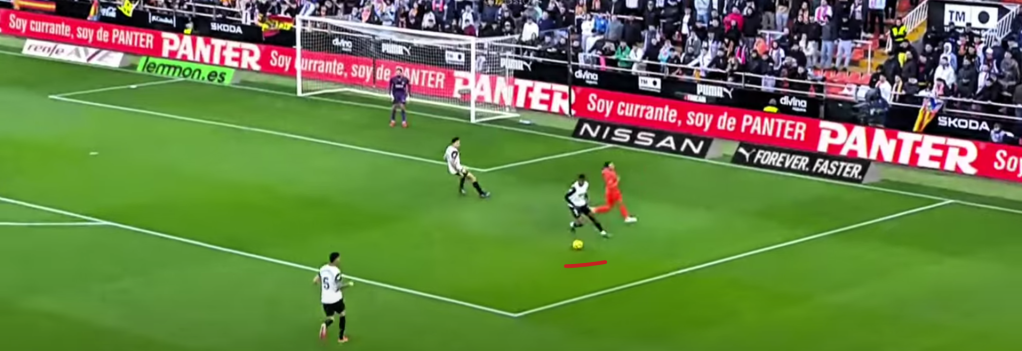
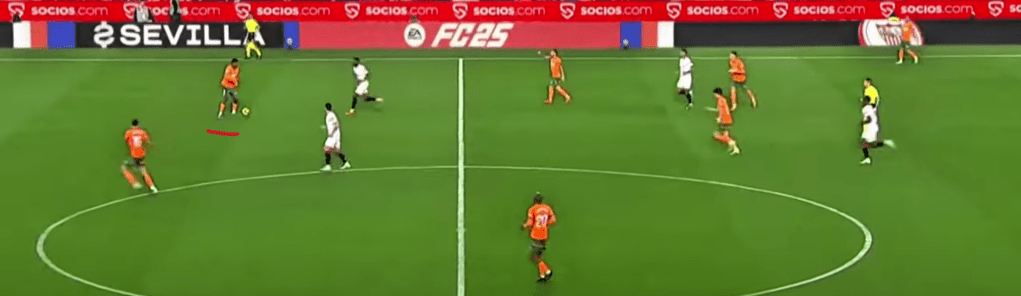
In the defensive situation below, Mosquera is faced with an opponent who thinks he can get the drop on him by bringing him over to a tight situation…

The Spaniard’s body positioning to read the danger and what comes next is excellent at first…

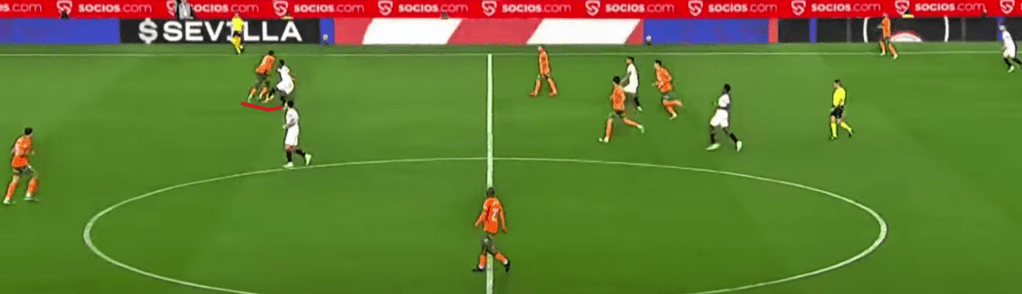
However, it looks like he’s engaged the situation too early. Rather than standing goal side and not allowing him room to drive the ball towards the goal, he attempts to retrieve the ball on the wrong side.

The Spaniard recovers expertly.

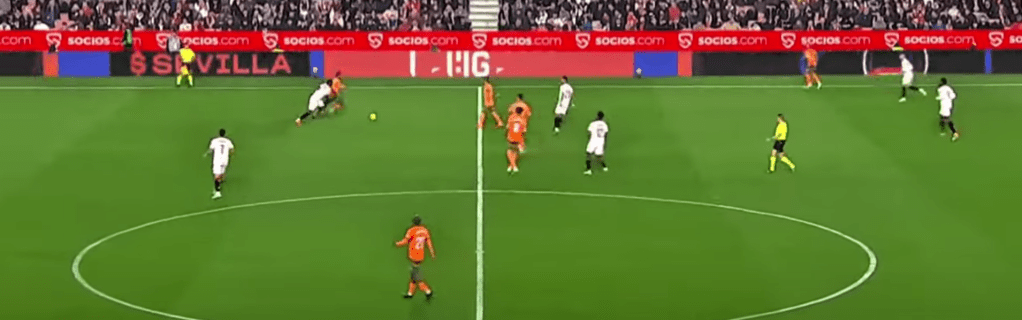
The attacker may have got a yard on Mosquera because of him engaging early, but the 20-year-old uses his strength, anticipation and speed of thought to get himself goal side, marshal his opponent off the ball..

… snuff out the danger and take control of the situation.

He is excellent at matching his opponents for pace, standing up to them with his lanky and striking frame before possessing the quickness of thought and anticipation to read what his opponent will do next.

But as shown above, even when a situation appears hopeless, the Spaniard demonstrates quick thinking, speed, and agility to recover and eliminate danger.

Unbreachable force in the box

Without a doubt, the most important expectation or responsibility of a centre-back is being able to safeguard the penalty area and control central positions on the pitch. Mosquera exemplifies this duty with remarkable finesse and authority.

His defensive nous is characterised by an uncanny ability to intercept passes and foreshadow the moves of opposing attackers, often positioning himself as a formidable barrier against advancing forwards.

With a keen eye for the game, he reads situations meticulously, anticipating threats and stepping in decisively to thwart them.

Mosquera’s commanding presence instils a sense of confidence in his teammates, as he consistently organises the defence while ensuring that no opposing striker can find a comfortable passage into dangerous areas.

As pointed out in this piece, Valencia are a much more dogged, organised and stout defensive unit under Carlos Corberan, with Mosquera becoming one of the focal points of their recent success under the former West Bromwich Albion coach.

The Spaniard’s frame, size, incredible physicality, aggression, and striking athleticism make him an immovable object at the heart of the Valencia defence.

Opposition attackers simply don’t like coming up against him in the box because he’s so hard to bypass. He’s a defender who loves to defend via winning his individual duels, battling up against the strongest or quickest #9s, sweeping up loose balls in front of or behind the back-line, or just simply becoming literally the last line of defence.

His impeccable timing in last-ditch tackles and clearances underscores his commitment to protecting his territory.

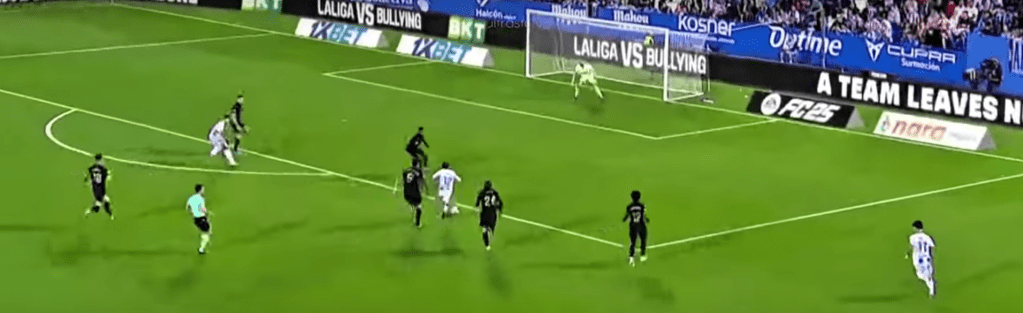
In the instance below, Mosquera and his defensive teammates face an attacking threat. One pass to the attacker on the Spaniard’s right shoulder and he’d be in through on goal…

It’s important to note, though, that Mosquera’s positioning in this scenario is excellent. He has a view of the play and threat before him and is aware of the threat behind him…

…because of that, he’s perfectly able to intercept the pass and get Valencia on the attack.

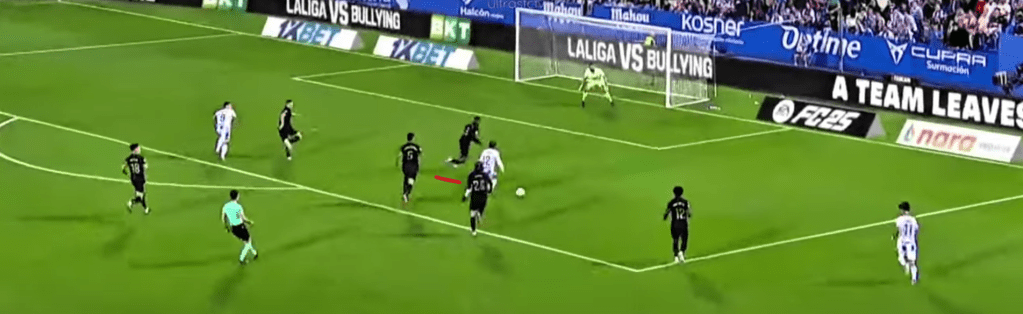
In the defensive scenario below, the opposing attacker looks like he’s got the run on Mosquera and looks through on goal…

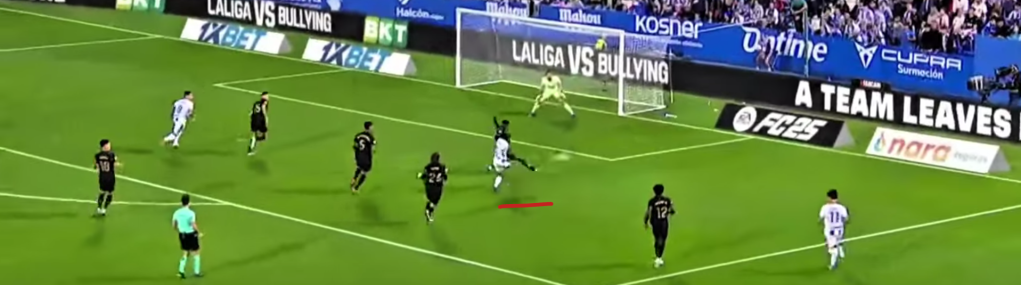
…but such situations don’t seem that relatively easy and plain-sailing when the 20-year-old is around. The Spaniard is quick, agile, and confident enough to stop the attacker getting a shot on goal…

Any kind of threat being formed in the Spaniard’s vicinity, he is always there to mop it up and deal with it.

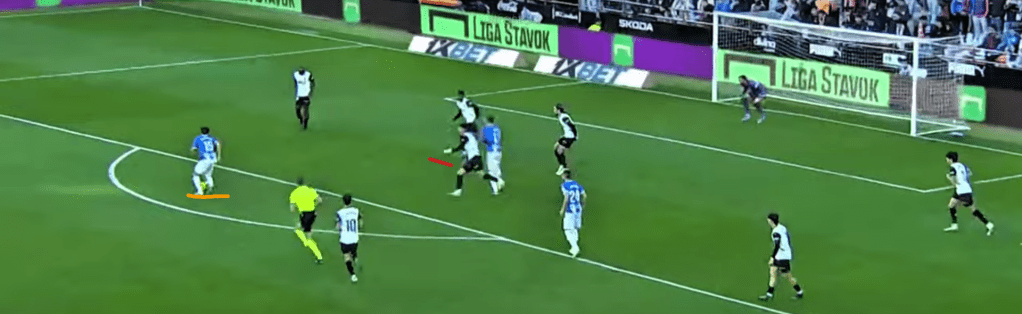
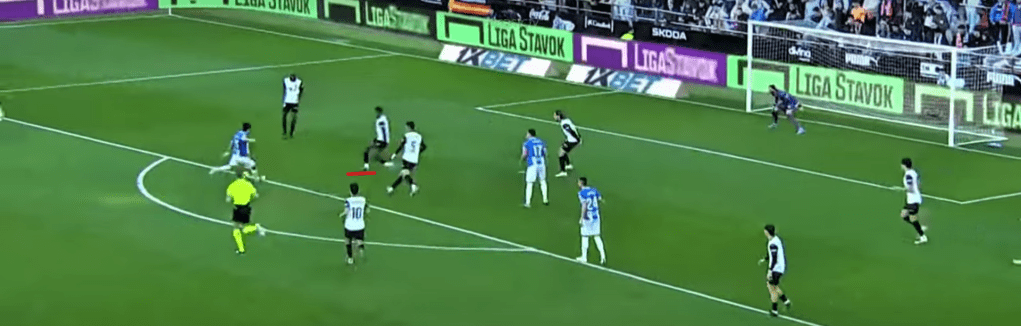
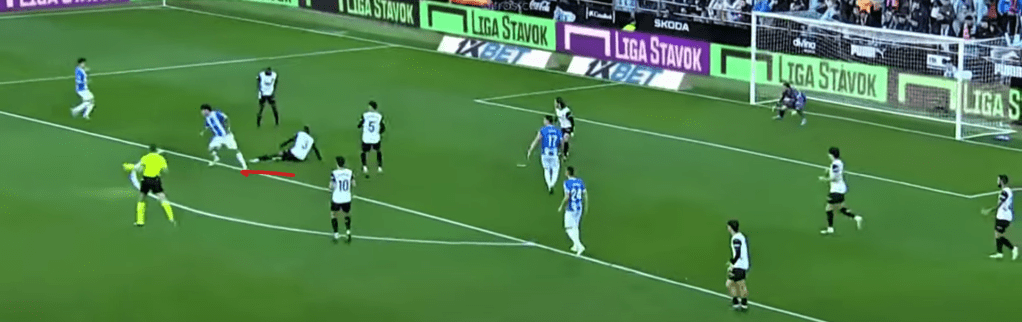
An example of his excellent last-ditch defending through blocks is shown below.

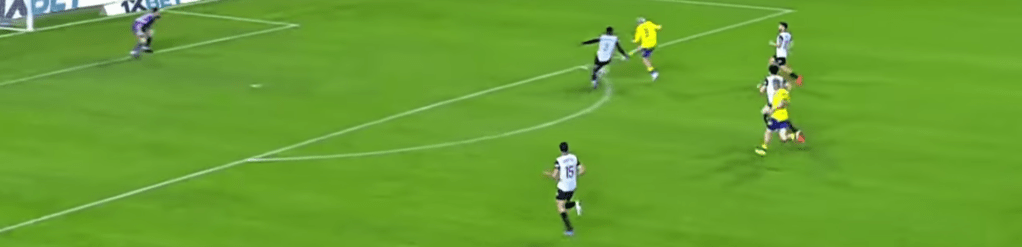
The opposing attacker (ORANGE) has all the time and space in the D outside the penalty area to line up a shot on goal…

…but look at how quick Mosquera gets out to his man to stop him having an easy route to goal. His imposing frame and size, instant anticipation and reading of the situation completely diffuses the situation.

Take a look at the next example of Mosquera’s box defending, which is just as impressive.

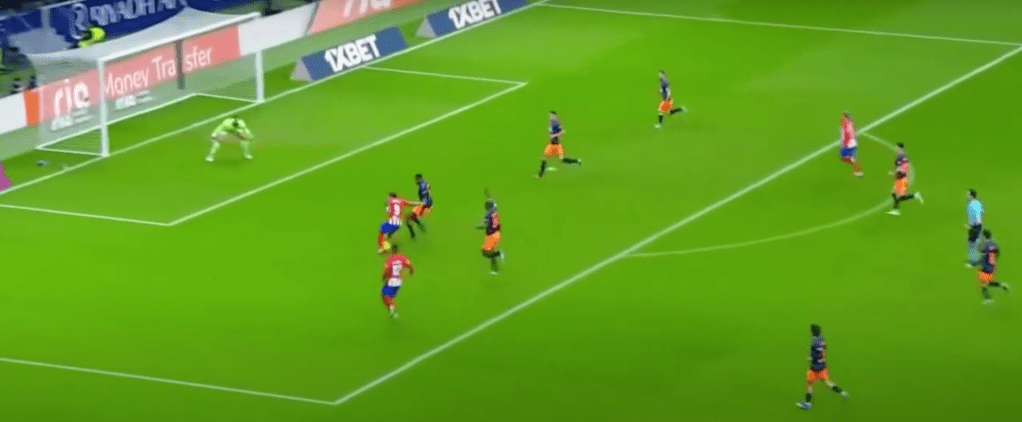
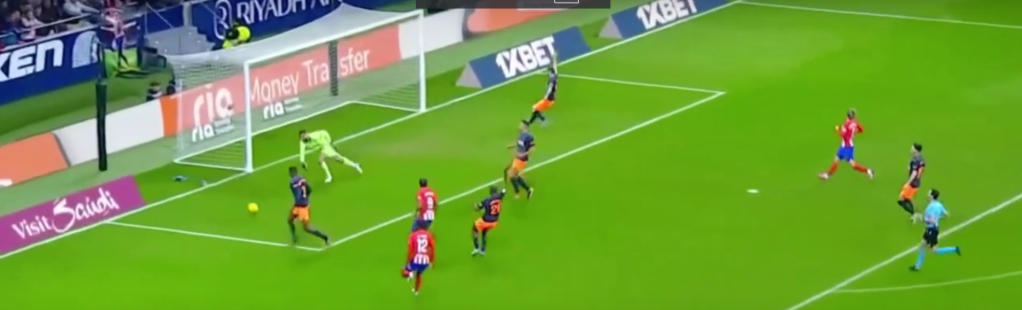
The Spaniard is literally Valencia’s last hope as three of his teammates have been taken out of the scenario with a piercing run into the penalty box by an onrushing attacker…

However, as he approaches the box, his line of sight on goal decreases, once again because of Mosquera’s imposing frame, athleticism, speed and defensive reading…

The attacker tries to position himself to get a shot off, but Mosquera’s is always primed and ready to engage…

… and he does, blocking the shot and completely dispelling the danger.

Critics could argue that it’s a situation which many defenders should be dealing with, but trying to anticipate what an attacker does in that moment, whilst also possessing the presence of mind and quickness to follow the speed of the situation, is incredibly difficult.

But Mosquera makes it look relatively easy.

When faced with a striker playing with his back to goal, Mosquera stays tight and uses his size, strength and defensive nous to stop that forward getting any room for manoeuvre. When faced with a dangerous low cross into his penalty area he is, nine times out of ten, always the first one to deal with the cross.

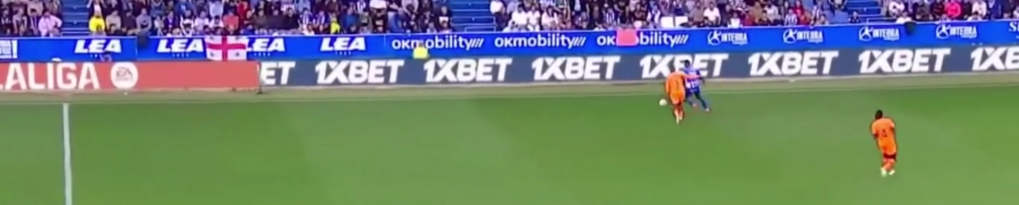
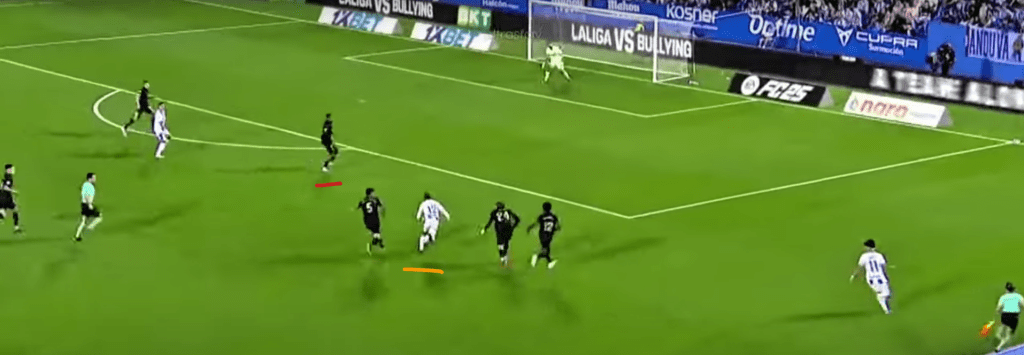
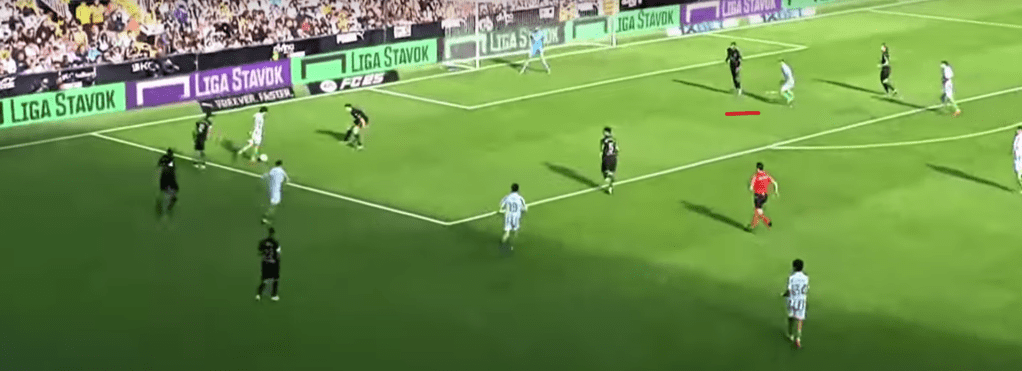
For example, looking at his positioning below (RED).

Mosquera is positioned well and has excellent body alignment. He has a clear view of the ball as well as a complete view of his marker, which allows him to anticipate their efforts to get ahead of him for a potential cross.

Such defensive and positional understanding means he is primed and ready to deal with the cross…

What about dealing with situations when running towards his own goal? Well, you probably know the outcome.

In the instance below, once again, Mosquera’s positioning here is really good. He’s aware of what’s around him.

The player with the ball has a lot of space in behind Valencia’s defence to play a through pass for his teammate on Mosquera’s left shoulder…

Mosquera’s speed, positioning, anticipation and reading are once again put to the test, but it’s a test he passes with flying colours.

He’s always in control of the situation, and that’s down to his flawless speed when covering large spaces and also the speed at which he eats ground.

If the Spaniard had dabbled in a sport beyond basketball before his football career, one would inevitably envision him sprinting in the electrifying world of athletics or track and field.

With his explosive speed, athleticism and striking frame, he could undoubtedly rival Usain Bolt, making the race a breathtaking spectacle.

In any defensive situation, Mosquera is more than capable of fulfilling his responsibilities.

At just 20 years old, having such confidence, poise and decisiveness in his defending is truly remarkable and illustrates the journey and trajectory towards greatness that Mosquera is currently on.

The Art of Recovery

Mosquera’s prowess in recovery defending is undoubtedly one of his standout features, showcasing an impressive blend of athleticism and tactical awareness.

There are moments when the Spaniard’s eagerness to thwart onrushing attackers can lead him to leap out of his defensive line, passionately striving to eliminate the threat. While this intensity demonstrates his commitment, it can sometimes leave both him and his teammates vulnerable to counterattacks, creating gaps that opponents can exploit.

However, what truly elevates a centre-back to elite status is the ability to quickly reassess and respond to dangers that arise after making a miscalculation—whether that’s his own or due to a teammate’s error.

Take, for instance, elite centre-halves like Rudiger or Liverpool’s Virgil Van Dijk, who embody this skill with remarkable finesse. They possess an uncanny ability to read the game, allowing them to recover seamlessly and mitigate threats, turning potential crises into manageable situations.

Mosquera, with his keen instincts, aspires to master this crucial aspect of his game, positioning himself among the top young defenders in Europe.

As mentioned previously, the Valencia academy product possesses incredible athleticism and speed; the way he eats ground when matching an attacker for pace is a phenomenal sight, utilising these attributes consistently to his advantage when eliminating threats or getting his team out of trouble.

In the below instance, the Spaniard is caught out by a long ball, hoping his teammate Dimitri Foulquier bails him out of trouble..

Foulquier fails to get rid of the ball, which squirms under him, giving the opposing attacker a chance to take advantage…

However, look at Mosquera’s recovery.

What seemed like a lost opportunity for the Spaniard to deal with the danger, he more than makes up for, rapidly eating up ground through excellent speed and agility and locking himself in a duel with the attacker…

A duel Mosquera wins with relative ease and confidence…

In another instance, against Atletico Madrid, Mosquera gets caught out of position with Antoine Griezmann, given ample time in between Valencia’s midfield and defence to exploit the gap in the last line and pick out Memphis Depay…

The Dutchman looks like he has all the time in the world to take his chance on goal, but once again, Mosquera bears down on his opponent quickly and precisely…

Instead of going for a left-foot shot, Depay tries to chop back onto his right – a skill he’s done time and time again throughout his decorated career – but Mosquera reads it brilliantly, deflecting the ball off his opponent for a goal kick.

The Spaniard is excellent at reading situations and dealing with them, but he’s also become a master at quickly rectifying individual mistakes due to his tremendous anticipation, athleticism and defensive awareness.

As of matchweek 31 in La Liga 2024/25, Mosquera recorded the most ball recoveries (180) of any player in the Spanish top-flight (ValenciaCF.com)

While many critics may insist that Mosquera must eliminate the occasional lapse in judgment—like the mistakes noted earlier, reminding us that it’s often better to prevent problems than to solve them—it’s important to recognize that these experiences will only serve to enhance the growth and development of the Los Che academy graduate.

Every error is a stepping stone on his path to becoming an even more formidable defender. Every defender makes mistakes, though, it’s almost part and parcel of the job description, just ask some of the best around, like Van Dijk or Antonio Rudiger. It’s how a defender responds in that moment to rectify them, or after the deed has been done, that defines their legacy.

Mosquera is certainly well on his way to writing his own given his stunning trajectory since his emergence on the scene, but still has a long way to go given he’s only 20 years of age.

Aerial efficiency or deficiency?

Aerial duels stand out as a significant concern in his overall performance profile, a point of worry that persists even when factoring in his age. Typically, athletes experience improvement in their aerial skills as they mature, which aligns with the natural biological progression of the human body.

During the teenage years, athletes undergo substantial physical development, and this maturation process continues well into their late 20s.

When we look at Mosquera’s aerial statistics, the situation becomes even more troubling. He consistently ranks among the lowest in the category of aerial duels won per 90 minutes across Europe’s top five leagues, placing him in the bottom six percentile among his positional counterparts.

This statistic is particularly perplexing, especially considering his impressive physique and athletic build. He possesses a long, rangy frame that suggests he should excel in aerial contests. Additionally, he demonstrates remarkable leaping ability for someone of his stature, often appearing poised in the air. Despite these physical advantages, he tends to be more effective at making crucial connections while defending against early crosses, ensuring he often gets the first touch.

As previously noted, his ability to read the game is already highly developed, showcasing an understanding of positioning and timing that belies his youth. His jumping prowess inspires confidence that he should be a strong contender in aerial situations.

Despite the current statistics falling short of expectations, it is important to remember that at just 20 years old, Mosquera has ample time to refine his skills. With continued development, he will likely rank among the elite in aerial defending, transforming potential into consistent performance.

Ball-progression/passing

In the modern game, the role of the centre-back has evolved dramatically. These defenders are now not just stalwarts of the backline; they are pivotal playmakers who initiate attacks from deep within their own half. The expectation is to exhibit exceptional passing abilities, allowing them to seamlessly transition from defence to offence.

In addition to technical prowess, modern centre-backs must possess keen tactical awareness, demonstrating the ability to read the game and make split-second decisions, even under immense pressure when their team is building from the back. They must exhibit keen confidence on the ball, composure and good pass selection to seamlessly get their team into the attacking phase of play.

Valencia are not known for being one of the possession-focused teams in La Liga, and they rank among the lowest in terms of time spent on the ball as a collective unit. Therefore, evaluating Mosquera’s passing ability may not provide a complete picture.

However, according to the statistics, the Spaniard is a safe, low-risk passer. He ranks in the 44th percentile among centre-backs in Europe’s top five leagues for progressive passes per 90 minutes, indicating he falls into the lower bracket for this particular attribute. There is a case to argue that the system deployed at Valencia may be the cause for him not being as progressive as he should be.
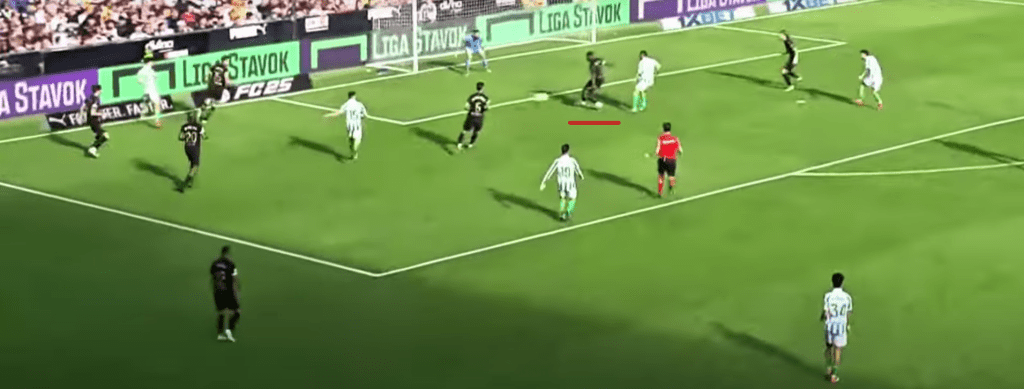
Once he makes the move to an elite side in the near future, those progressive attributes may be exerted with much more confidence and comfort.

Nonetheless, Mosquera excels in pass completion percentage, ranking in the top 15% with a remarkable completion rate of 90.9% over the past year.

Just because Mosquera may not exert as many proactive qualities in his passing at Valencia, given his deceptive technical acumen, doesn’t mean he isn’t a progressive outlet.

The Spaniard is proactive through other means and arguably the rarest attribute for a centre-back, his dribbling/ball-carrying.

If the situation presents itself, the 20-year-old possesses the presence of mind, athleticism and excellent ball control to travel with the ball at his feet to force his team up the pitch or evade a tight situation.

Like the instance below…

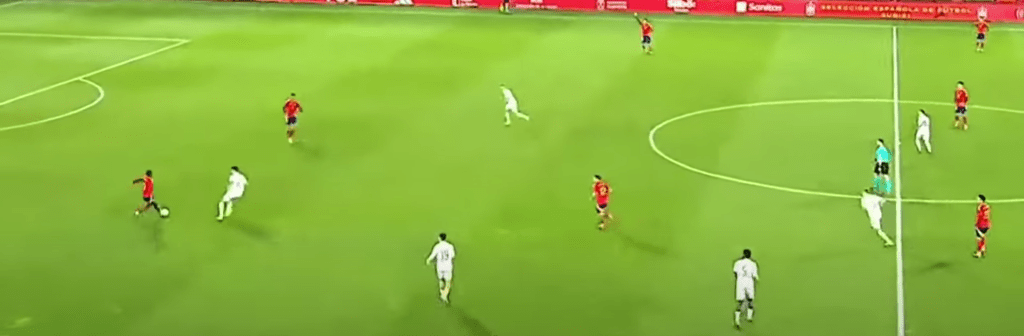
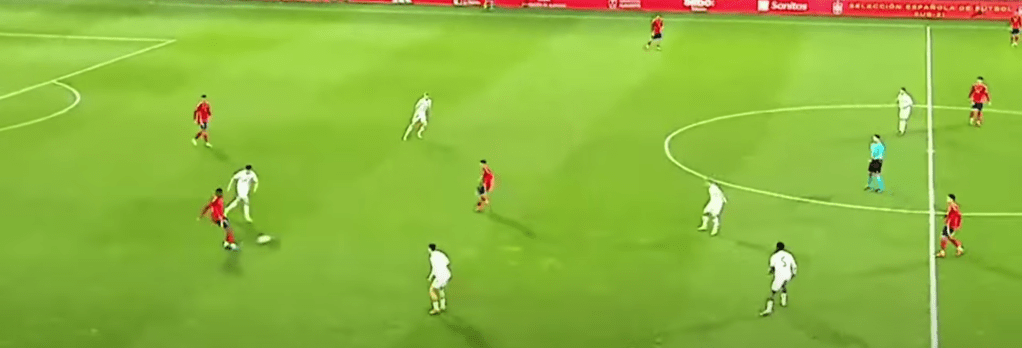
Mosquera, playing for the Spanish under-21s, has the ball deep in his own half with an onrushing attacker attempting to press him and force a mistake.

The Spaniard can’t pass to his teammate alongside him as he is also being pressed. He may have to switch it across to find a teammate in space…
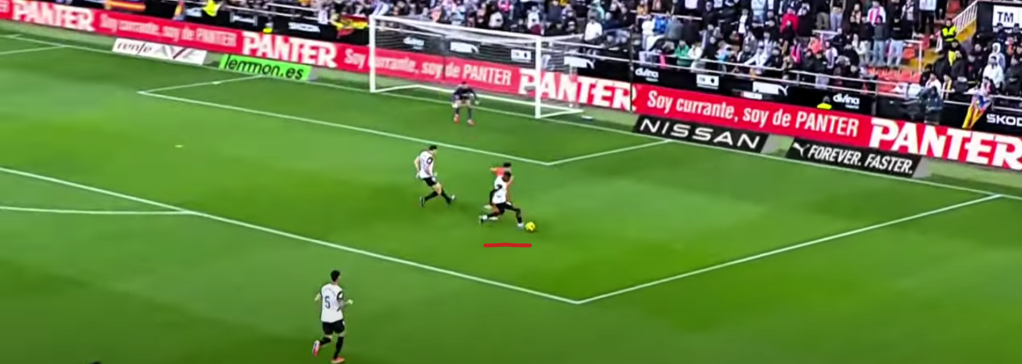
Instead, Mosquera does exceptionally well to con and evade his marker with excellent body deception and movement…

…opening up a passing lane to find his teammate in midfield, aiding ball progression by working around the opponent’s press…

In another similar instance, Mosquera holds the ball in a pressurised situation..

…but has no problem bypassing his opponent, showing him one way before shifting the ball quickly the opposite way and driving forward…

The Spaniard then has to pick his pass right, but isn’t given the best of options to aid progression, with his teammates all bunched up in the same vicinity, but it’s no problem…

He drives forward a few yards more…

…before picking out his attacking teammate in a bit of space to build an attacking scenario.

Mosquera’s dribble take-on success rate stands at 63%, which is a very decent mark for a centre-back ranking in the 69th percentile, showing he is more selective when he dribbles the ball out with his feet, choosing to take players on and carry the ball when it is most opportune.

Again, the above instances are only too small a sample size to fully judge Mosquera on, but it’s a small indication that he holds all the attributes to be a top-level progressive centre-back, capable of getting the ball forward quickly through quick thinking and incisive decisions once being pressed.

Future Mosquera Forecast

In a matter of two seasons, Cristhian Mosquera has already established himself as one of the best defenders in La Liga.

Boasting a formidable physique, exhilarating athleticism, and lightning-fast speed, Mosquera is an immovable force at the heart of defence. His remarkable physical strength and astute defensive awareness set him apart as the quintessential modern-day centre back.

It’s no wonder that he is frequently compared to the likes of Antonio Rudiger from Real Madrid, as both share an impressive ability to dominate their opponents and command the defensive line with authority.

And the way his current trajectory is heading right now, it won’t be a surprise to see the Spaniard surpass the former Chelsea man.

At 20 years old, he’s already got some of Europe’s biggest names tracking his progress at the Mestalla Stadium, including AC Milan, Juventus, Atletico Madrid and FC Bayern Munich (Sky Sports journo Florian Plettenberg).

Judging by the way he’s excelling so far, especially under Carlos Corberan’s management, he’d certainly fit right in at any of those clubs.

When considering the potential of a young talent like Mosquera to integrate into elite football clubs, it’s essential to analyse the tactical frameworks employed by these teams.

Each club’s style of play, formation, and player roles can significantly influence whether Mosquera can flourish in that environment.

A club like Bayern Munich is certainly more progressive and positional focused than the others, but the Spanish youngster has shown he can fulfil the role of a progressive centre-back. At a club like Atletico Madrid, where Diego Simeone expects his CBs to dominate their box, be physical up against the markers, and defend at all costs more than a progressive outlet, Mosquera certainly fits the bill.

Whatever role you want Mosquera to fill, he’d have no problems acclimatising himself.

In a back three as a wide-centre-back or a central one or as one of the two centre-backs in a back four, the Spaniard is incredibly versatile and adaptable, making him one of the most attractive options in the market for any potential suitor.

He will certainly need to continue to make giant strides in his passing and aerial duels, but there is reason to believe all three areas will improve as his play evolves. 

It won’t be long before we see this incredibly gifted young talent playing at the highest levels, both at club and on the international stage. When coming through Valencia’s academy, that’s certainly the expectation for its young academy products, as seen throughout the club’s decorated history.

Mosquera is up next and ready to take that giant step towards the elites.

Arnaut Danjuma proving a key figure for Villarreal

Arnaut Danjuma proving a key figure for Villarreal

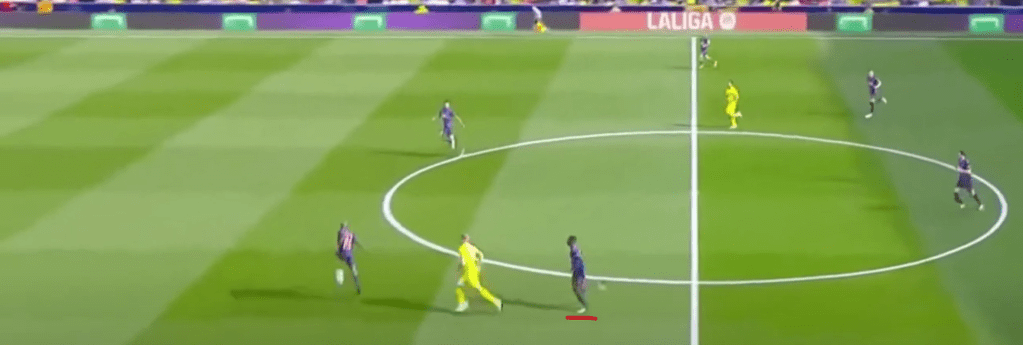
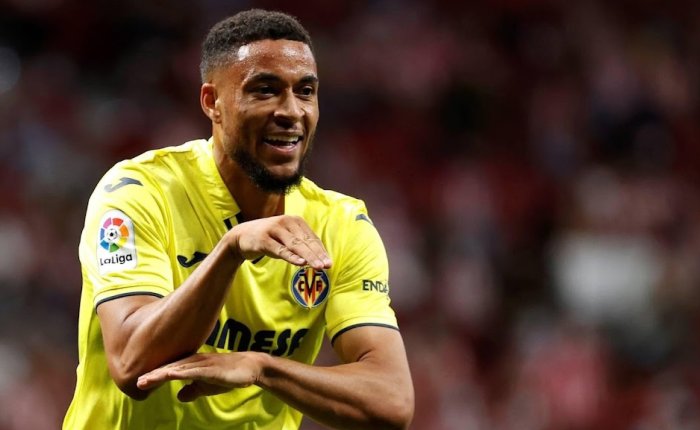
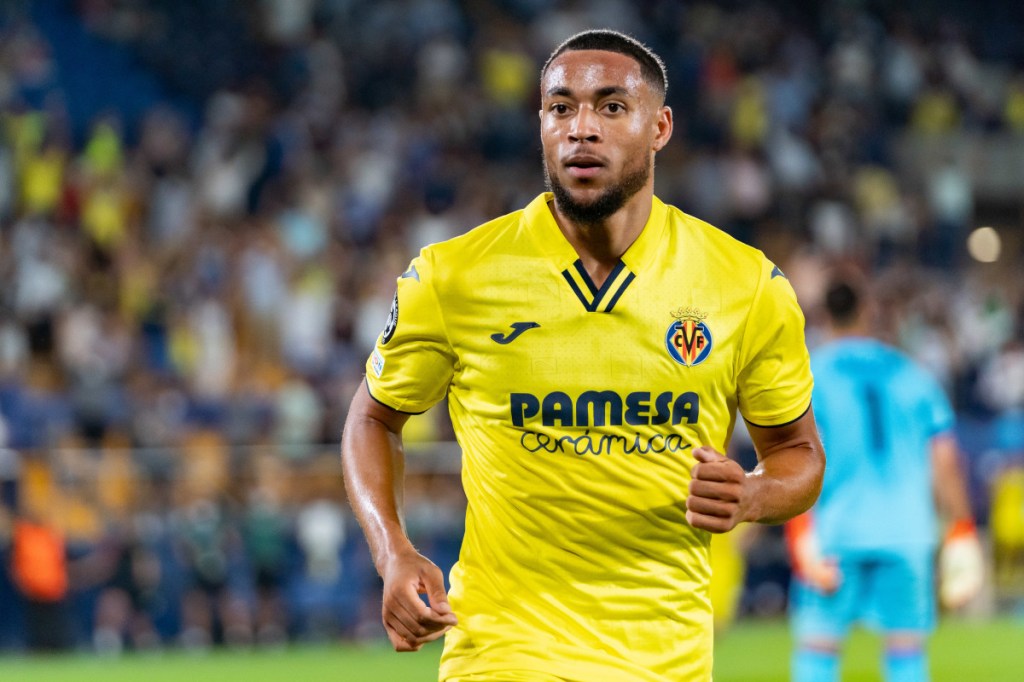
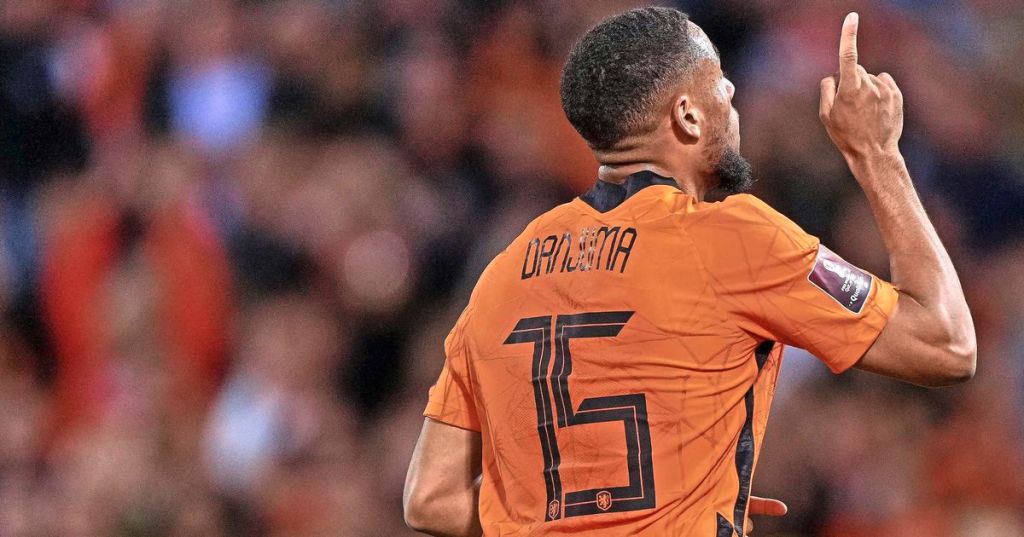
When Arnaut Danjuma joined Villarreal from AFC Bournemouth last summer for €25m, little did we know he’d make such a telling impact in Unai Emery’s progressive side so soon.

A few months into his Spanish top-flight career and the recently-made Netherlands international is a man of fire, and one of La Liga’s blossoming individuals so far this season.

After hitting 17 goals and 7 assists in the Sky Bet Championship last season, the former Club Brugge forward was always destined for bigger and better things but many thought he’d make that step up in the Barclays Premier League rather than beyond borders.

With several clubs interested in his services last summer, it was Villarreal who took a punt on his flawless abilities, and its safe to say the 24-year-old hasn’t looked back.

He did state recently, he felt he was too good for the Championship and he needed to get out, and after his first few months under Unai Emery’s tutelage, Arnaut Groeneveld Danjuma’s has supremely backed up his lofty statement with some show-stopping, electric and superb performances for the Yellow Submarines.

14 appearances, 7 goals (5 in La Liga), and 3 assists Danjuma has certainly showed he is good enough and ready to cut it amongst the most elite footballers in Europe. The slippery Dutchman has gone from the Championship to the Champions League without batting an eyelid at the transition.

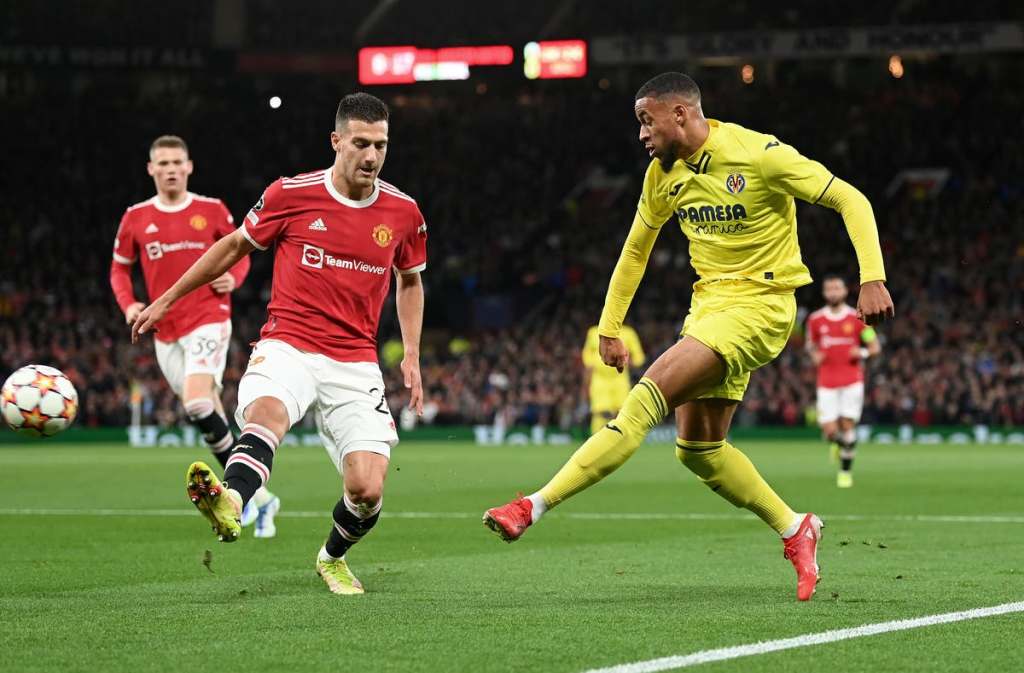
Danjuma’s trajectory over the past year has been nothing short of sensational, and already he is showing his talents on the most prestigious of footballing stages in the UEFA Champions League. If you need any pieces of evidence as to how good he is, not only that, but how invaluable he’s become to Unai Emery’s side in short space of time, check out his performance against Manchester United at Old Trafford.

It was simply jaw-dropping.

The forward was the most electric player on the Old Trafford pitch, despite sharing it with five-time Ballon d’Or winner Cristiano Ronaldo, Jason Sancho, Bruno Fernandes, Paul Pogba and other stars.

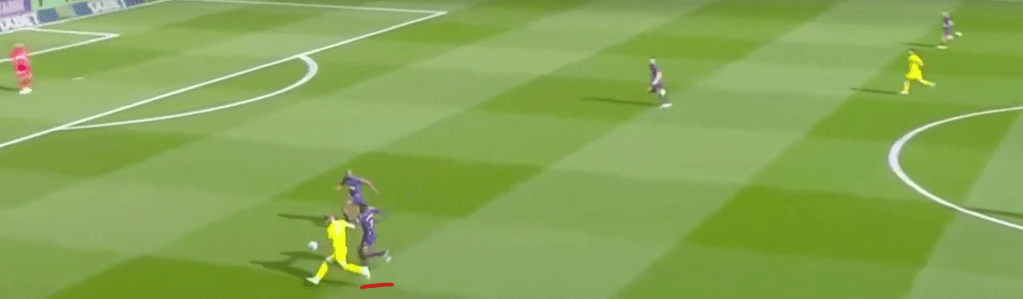
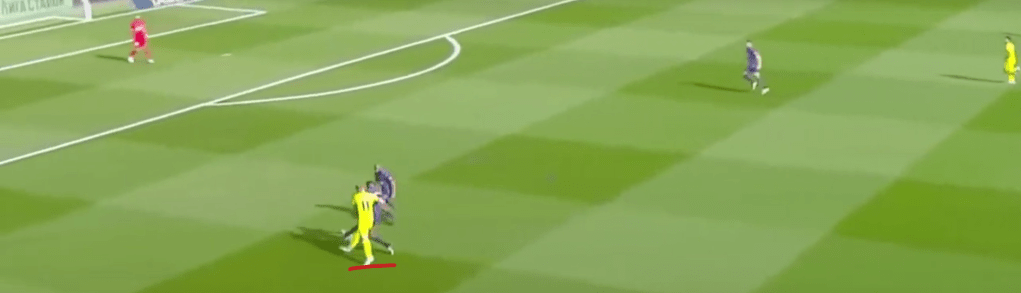
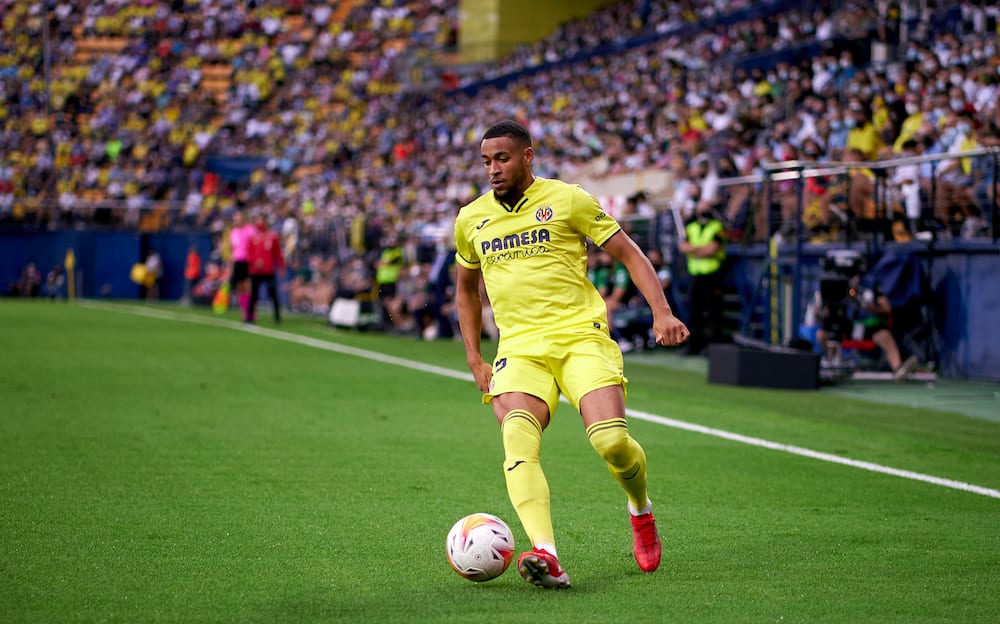
The former Bournemouth man had United full-back and Portuguese international Diogo Dalot on toast, cutting through him with such expert but thrilling ease. Solskjaer’s defence simply could not handle his pace, acceleration, unerring trickery and swift close-control and deceptive movement. He finished the game with an assist to his name, but also four shots, 2 key passes, 3 dribbles and with a WhoScored rating of 7.42.

There’s no doubt about it, Danjuma is amongst the most devastating forwards in Europe right now.

Danjuma’s instant impact in Spain has surprised many, but probably not coach Unai Emery, who asked club president Fernando Roig to sign the winger this summer.

The former Arsenal manager must have made a strong case because Villarreal splashed out €25 million (£21m) on the Bournemouth man – a large transfer fee by recent Spanish standards.

While giants Real Madrid and Barcelona picked up David Alaba and Memphis Depay on free transfers, Villarreal made Danjuma the second-most expensive signing in their history, behind Paco Alcacer.

Danjuma may have been one of La Liga’s most expensive transfers this summer, but is currently proving he’s worth every penny spent. The Europa League winners were looking for a player who could help them jump forward to the next level tactically and in attack and Danjuma is keeping his part of the bargain.

Unai Emery’s men are clearly more efficient, potent and exciting on the attack and much of that is down to Danjuma’s unpredictable nature on the left-flank.

The Dutchman is one of La Liga’s most aggressive and destructive dribblers in La Liga, averaging 2.4 dribbles per game so far this campaign, per 90 he completes on average almost 2 dribbles per game, 7.76 progressive carries, 1.34 carries into the final third and an outstanding 3.43 carries into the 18-yard box showcasing just how vital he is to Villarreal’s attacking phases of play.

Danjuma also averages 9.30 touches in the opposition’s penalty box, again highlighting that he is arguably La Liga’s most effective wingers alongside the rejuvenated Real Madrid Brazillian superstar Vinicius Jr. His non-penalty XG of 0.66 is in the 99th percentile amongst Europe’s top-five leagues making him one of the most efficient scorers so far on the continent.

The 24-year-old has certainly shown up for Emery so far this season, he netted in the thrilling 2-2 draw with Atletico Madrid at the Wanda Metropolitano – a stadium he knows well from his Club Brugge days – lashing past Jan Oblak in a 2-2 draw for his first goal for the club.

Clinically netting in a 2-2 draw with Atalanta in Villarreal’s Champions League opener, he was also a livewire against Elche in a 4-1 win, bursting through the defence and scoring after an hour, and also put in a brilliant showing at the Santiago Bernabeu against Real Madrid.

That was followed by two more in the 2-0 win over Real Betis, the first coming after he cut inside from the left and cleverly slipped the ball back inside the near post. He rounded the goalkeeper for his second, showing poise and good judgement. He again came to his side’s rescue against forcing a late leveller in the closing minutes against Cadiz in a 3-3 draw.

His tremendous form so far this season earned him a late Netherlands call up under Louis van Gaal in October, and the winger duly delivered.

“Can anyone stop Danjuma?” asked Spanish newspaper Marca after he dazzled from the bench in a 6-0 win for the Netherlands against Gibraltar.

The coach called him spectacular and pointed out that his team-mates still have to adapt to his explosive balls across the face of goal. 

“He had very nice and impressive dribbles, but his team-mates were not yet geared to his hard crosses,” said Van Gaal.

With time, things will only get better in that aspect, but its clear that Danjuma has given both Louis Van Gaal and Unai Emery reasons to stand up and take notice at his incredible gifts.

His Villarreal team-mates have already given him the nickname ‘Danjumagic’, although the player humbly credits his coach for his superb start in Spain.

“I need to give a massive thanks to Unai Emery,” he told Villarreal’s website. “The coach is very busy (working) with me and he really helps me perform.”

The 24-year-old has proven the star of the show at the Estadio de la Cerámica, but has most of all proven that he can be amongst the best forwards in Europe after the tremendous campaign he enjoyed last year in the English second-division. Arnaut Danjuma was always primed for much more, and he has his sights set on much bigger things which may cause some worry amongst the Villarreal fanbase.

“I came to Villarreal to prove myself again but I’m definitely visualising the next step,” he told Mail Online in September.

It’s no surprise that the forward is already drawing interest from Jurgen Klopp at Liverpool with the former Borussia Dortmund coach reportedly sending scouts to watch Danjuma in action, who knows, the flying Dutchman may well be Sadio Mane’s heir on that left-flank at Anfield, and he’s certainly good enough to take over the role.

Danjuma is serious joy to watch in action with his blindingly quick feet, deceptive body movement and jaw-dropping trickery so it won’t only be Liverpool scouring for his services in the near future. Villarreal have already taken kindly to the 24-year-old wing wizard, and they should enjoy his magic while it lasts because the sky really is the limit for such a truly decorated footballer.